
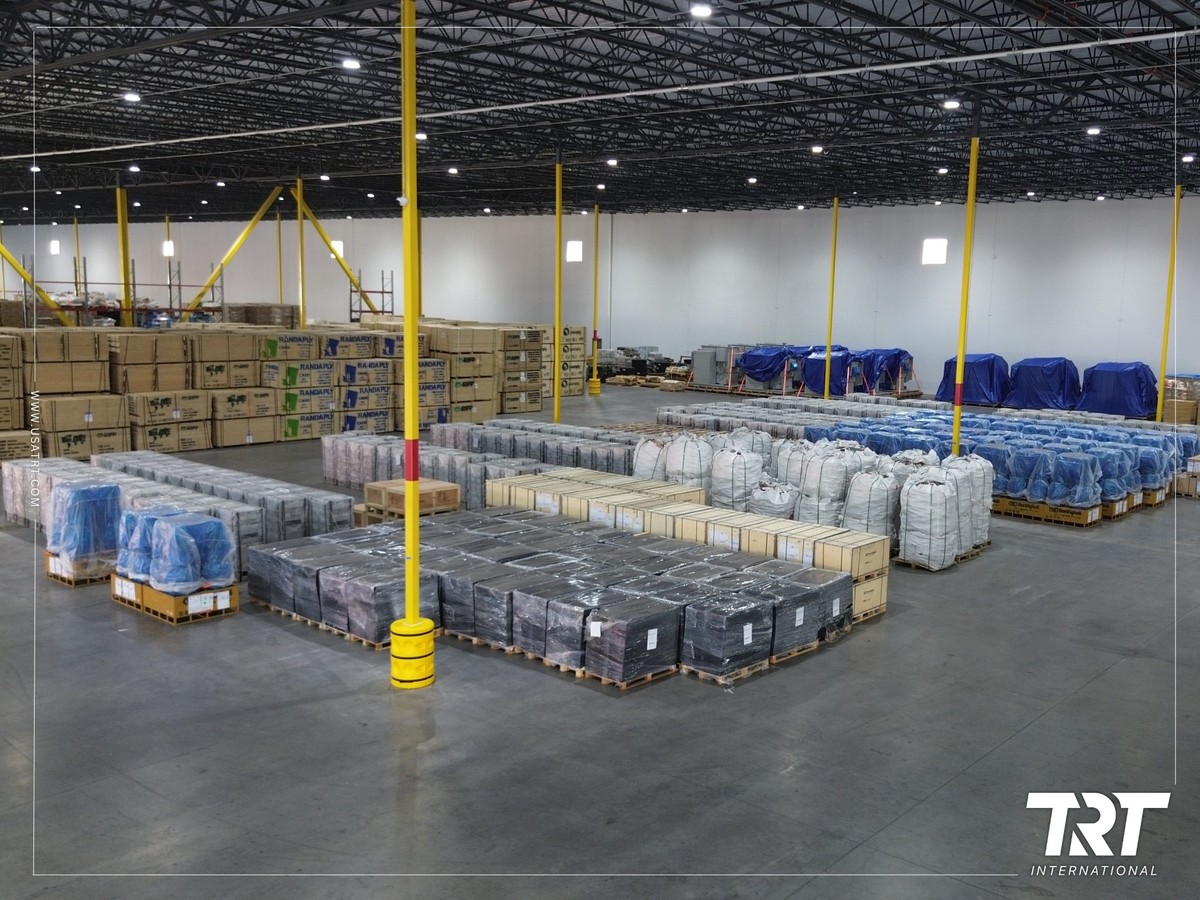
A port warehouse is a warehouse located inside a port complex, used to receive, store, work on, and dispatch cargo moving through that port — and choosing the right port warehouse matters far more for heavy and oversized cargo than it does for ordinary pallet freight. A standard carton can be re-routed to almost any building with a dock door. A 40-ton machine, a crated project piece, or a container of heavy equipment cannot: it needs floor space that can take it, docks and equipment that can unload it, room to stage and prepare it, and a truck fleet that can move it onward legally. Choose the wrong building and the cost shows up somewhere else — in extra drayage, in demurrage while a container waits, or in a second handling nobody planned. At TRT International, warehousing is work we do every day inside Port Newark-Elizabeth and inside the Port of Savannah. This checklist is the one we would hand any shipper: the seven checks that separate a warehouse that can actually handle heavy cargo from one that simply has square footage to sell.
Why the Warehouse Choice Matters More for Heavy Cargo
For general freight, warehousing is mostly a question of price per square foot and how long the goods will sit. For heavy and oversized cargo, the warehouse is part of the transport plan itself. The cargo often arrives in a container or on a flat rack that has to be unloaded promptly, it may need to be re-worked, crated, wrapped, or lashed before its onward move, and its onward move may depend on permits, a vessel sailing, or a project schedule the shipper does not control. Every one of those steps happens at, or is coordinated from, the warehouse. A building that can store the cargo but cannot work on it, or that can work on it but cannot move it, leaves the shipper coordinating the gaps — and the gaps are where days and charges accumulate. Our own warehouse services are set up as one part of a single operation that also runs the trucks, the yards, and the preparation work, precisely so those gaps do not open. The checks below explain what to look for, in the order we would look for it.
Check 1: Is the Warehouse Actually Inside the Port?
The first check is location, and it is a yes-or-no question: is the warehouse inside the port complex your cargo moves through, or is it somewhere else in the region? An in-port warehouse removes an entire road leg from every move. The container is drayed a short distance inside the port, unloaded, and the empty returned inside its free time; the freight never makes a long highway trip just to reach storage, and when it is time to move onward, it starts from the port, not from across a metro area. It also means the warehouse team and the terminal work to the same clock — availability, gate hours, and appointments are daily routine, not a special trip. TRT’s headquarters is at 250 Port St, Newark, NJ 07114, inside Port Newark-Elizabeth — see our Port Newark, NJ operations — and our Savannah warehouse sits inside the Port of Savannah, with our public address at 117 A Parkway Dr, Rincon, GA 31326 — see our Savannah, GA operations. When you evaluate any warehouse, ask for the address and check it against the port map yourself; the answer decides how many moves your cargo will make.
Check 2: Is There Real Space — for Your Cargo, Staged Your Way?
Square footage on a brochure is not the same as usable space for heavy cargo. Ask how much floor is genuinely available, whether oversized pieces can be staged as a set rather than scattered, and whether the building can hold your cargo for the full period your schedule might need — including the delay you are not planning for. Project and industrial cargo arrives in waves: several containers in a week, then a pause, then the outbound move all at once. The warehouse has to absorb the wave without turning away the next one. In Newark, our warehousing totals 150,000 square feet inside Port Newark-Elizabeth — a 120,000-square-foot warehouse plus a 30,000-square-foot site. In Savannah, our warehouse is brand new, at 316,800 square feet on a 30-acre site inside the Port of Savannah, with room on the site for the trailers and equipment that serve it. TRT has many warehouses; Newark and Savannah are the main ones. The point of the check is not the biggest number — it is whether the space, the staging layout, and the time window all fit the cargo you actually have.
Check 3: Can It Unload What You Are Shipping?
A warehouse earns its keep in the first hour, when your cargo has to come out of a container or off a trailer. Ask about the docks: how freight is received, whether containers can be unloaded at dock level and heavy pieces handled on the floor, and what equipment does the handling. A building with plenty of space but no practical way to unload a heavy, awkward piece is a storage unit, not a working warehouse. At TRT, the 30,000-square-foot Newark site’s feature is its loading docks, built for exactly this receiving work, and our warehouses run electric forklifts and lower-emission equipment to handle freight once it is inside. Ask the same question of any operator: walk through, in words, exactly how your heaviest and most awkward piece gets from the container to its storage position. If the answer is vague, the first delivery will be an experiment — conducted with your cargo.
Check 4: Can the Cargo Be Worked On in Place?
Heavy cargo rarely just sits. It needs to be consolidated with other pieces, transferred between equipment, crated or wrapped for its next leg, or re-worked because it arrived shifted, damaged, or badly packed. If the warehouse cannot do that work in place, every task becomes another truck move to another facility — with another appointment, another handling, and another chance to damage the freight. Check which of these the warehouse handles under its own roof or on its own site: transloads and re-works when cargo has to change equipment or be put right, cross-dock loadings when freight should pass straight through without storage, and outdoor storage when a piece is too large for the building or better kept in the yard. Our guide to port warehousing describes how we organise in-port storage for heavy and oversized cargo day to day. A warehouse that can work on the cargo where it stands turns a storage bill into a preparation step — the freight leaves more ready than it arrived.
Check 5: Does One Operator Run the Trucks as Well?
The most common failure in port warehousing is a handoff: the warehouse is ready but the truck belongs to someone else, or the truck arrives and the warehouse was never told. When you choose a warehouse, ask who drays the container in, who returns the empty, and who runs the onward move — and prefer the answer that names one operator. TRT runs its own fleet of 85-plus Freightliner day-cab trucks with company drivers, and 300-plus company chassis, including tri-axles for heavy containers, so the pickup, the warehouse receipt, and the dispatch are one plan made by one dispatch team. Our drayage services cover local bonded drayage inside the port, and the same fleet runs over-the-road throughout the United States, Canada, and Mexico when the onward leg is a long one. One operator also means one phone call when the plan changes — and with port cargo, the plan always changes at least once.
Check 6: Can You See Your Cargo While It Is There?
Storage should never mean silence. Ask how the warehouse reports your cargo: when it arrived, where it is positioned, what work has been done on it, and when it is ready to move. For multi-piece shipments this is not a courtesy — it is how you know whether the set is complete, whether a vessel or a permit is now the critical path, and whether a container is approaching the end of its free time. TRT tracks cargo by milestones through every handoff — arrival, unloading, storage position, preparation work, loading, and dispatch — the approach we set out in our guide to state of the art tracking. Before you commit cargo to any warehouse, ask for a sample of how a stored shipment is reported. If the answer is that you can call and ask, expect to spend your storage period doing exactly that.
Check 7: Does the Storage Type Match the Cargo and the Wait?
The last check is fit. Indoor warehousing suits cargo that needs cover, floor handling, and preparation work. Outdoor storage suits oversized pieces, machinery, and cargo on trailers that does not need a roof but does need a secure, organised yard inside the port. Cross-docking suits freight that should not be stored at all. And the honest answer is sometimes a combination: pieces held indoors while an oversized unit waits in the yard, all released together for one onward move. A good warehouse will tell you when a cheaper storage type fits your cargo just as well — and when it would not. Match the storage to the cargo and to the realistic length of the wait, not to the optimistic one: schedules slip, vessels roll, permits take time, and the storage plan has to survive the slip without an emergency move.
Questions to Ask Any Port Warehouse Before You Book
- Is the warehouse inside the port my cargo moves through? Give me the address.
- How much floor space is available for my dates — and can my pieces be staged together as one set?
- How exactly will my heaviest piece be unloaded, and with what equipment?
- Can cargo be transloaded, re-worked, crated, or wrapped in place, or does it have to leave the site for preparation?
- Who drays the container in and returns the empty — you, or a third party I have to coordinate?
- How will I be able to see the status of my cargo while it is stored?
- For my cargo, would indoor storage, outdoor storage, or cross-docking serve me best — and why?
Talk to TRT About Warehousing
If you have heavy or oversized cargo arriving at Port Newark-Elizabeth or the Port of Savannah and you want it stored where it can also be worked on and moved onward by the same team, send us the piece list, weights, and your expected timing and we will tell you plainly how it would be handled. Call us at +1 973 344 7100 ext 221, or email sales@usatrt.com. Our headquarters is at 250 Port St, Newark, NJ 07114, and our Savannah address is 117 A Parkway Dr, Rincon, GA 31326. TRT International – Delivering Excellence since 1994.
Frequently Asked Questions
What is a port warehouse?
A port warehouse is a warehouse located inside a port complex, used to receive, store, work on, and dispatch cargo moving through that port. TRT International operates warehousing inside Port Newark-Elizabeth and inside the Port of Savannah, so containers are unloaded, stored, and dispatched without an extra road leg to reach storage.
How do I choose a warehouse for heavy or oversized cargo?
Check seven things: the warehouse is inside the port, it has real floor space to stage your pieces as a set, it can unload your heaviest piece with its own docks and equipment, cargo can be worked on in place, one operator runs the trucks as well as the building, you can track the cargo while it is stored, and the storage type — indoor, outdoor, or cross-dock — matches the cargo and the wait.
How much warehouse space does TRT have in Newark and Savannah?
In Newark, TRT’s warehousing totals 150,000 square feet inside Port Newark-Elizabeth — a 120,000-square-foot warehouse plus a 30,000-square-foot site whose feature is its loading docks. In Savannah, the warehouse is brand new at 316,800 square feet on a 30-acre site inside the Port of Savannah. TRT has many warehouses; Newark and Savannah are the main ones.
Why does it matter that the warehouse is inside the port?
Because an in-port warehouse removes a road leg from every move. The container is drayed a short distance inside the port, unloaded, and the empty returned inside its free time, instead of the freight travelling across a region to reach storage and travelling back to the port for its onward move. The warehouse team also works to the same terminal clock — availability, gate hours, and appointments — every day.
Can cargo be worked on while it is in storage at TRT?
Yes. Cargo stored with TRT can be transloaded or re-worked if it has to change equipment or arrived shifted or badly packed, cross-docked if it should pass straight through, prepared for its onward move, or held in outdoor storage if a piece is too large for the building. The work happens where the cargo already is, instead of the freight being trucked to another facility for each task.
Who handles drayage to and from TRT’s warehouses?
TRT does, with its own fleet of 85-plus Freightliner day-cab trucks with company drivers and 300-plus company chassis, including tri-axles for heavy containers. The same fleet runs local bonded drayage inside the port and over-the-road work throughout the United States, Canada, and Mexico, so pickup, warehouse receipt, and onward dispatch are one plan.
Should heavy cargo be stored indoors or outdoors?
It depends on the piece. Indoor warehousing suits cargo that needs cover, floor handling, and preparation work. Outdoor storage suits oversized pieces and machinery that does not need a roof but does need a secure, organised yard inside the port. Some shipments use both — pieces held indoors while an oversized unit waits in the yard, released together for one onward move.
What information does TRT need to plan warehousing for my cargo?
The piece list with dimensions and weights, how the cargo arrives — container, flat rack, or trailer — the expected arrival and onward dates, any preparation work the cargo needs while stored, and one contact who can approve changes the same day. Call +1 973 344 7100 ext 221 and we will confirm the space, the unloading plan, and the storage type before the cargo arrives.