
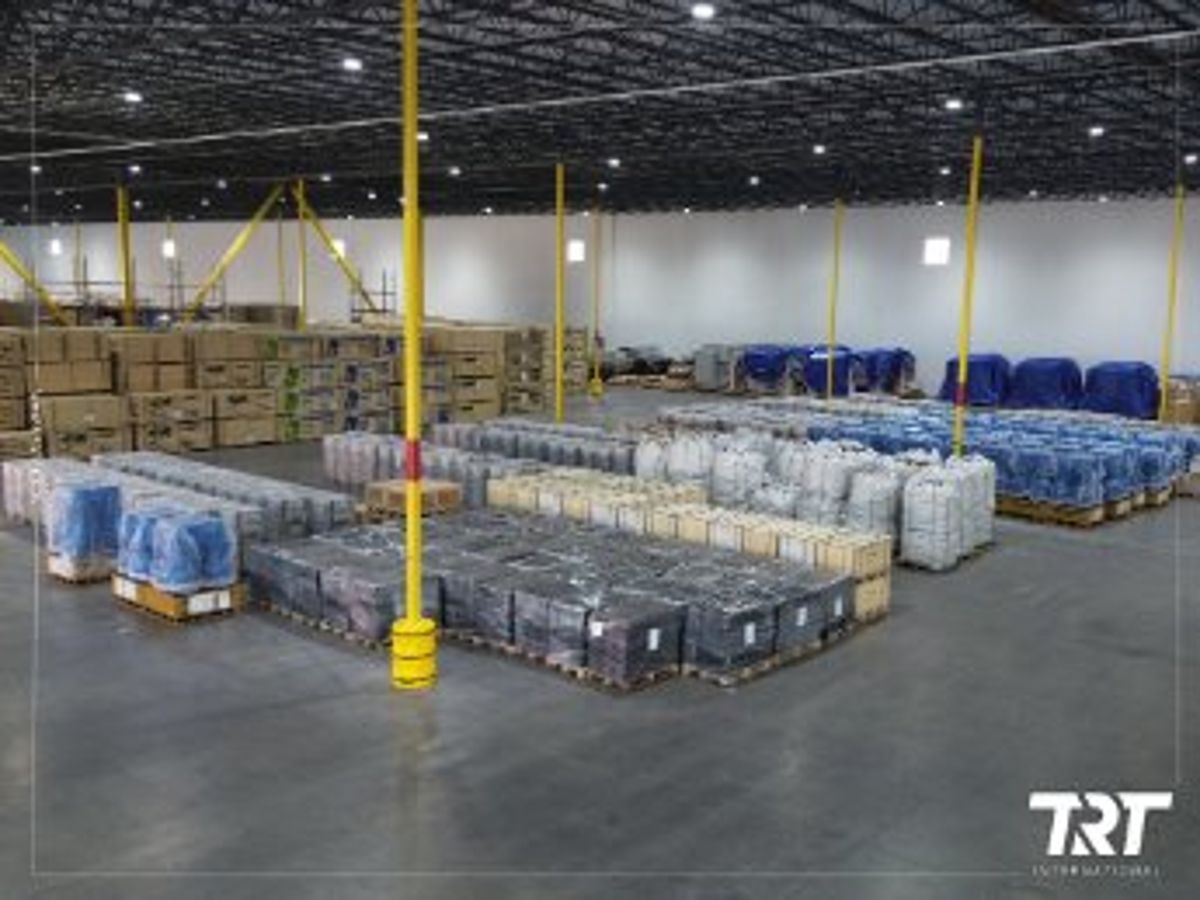
Project consolidation is the receiving, staging, preparation, and coordination of the many separate pieces of one project as a single shipment. A project rarely arrives as one load. Its machinery, components, crates, and structures are built by different suppliers, finished on different days, and shipped from different places — yet at the destination they are needed together, in sequence, as one working set. Project consolidation is the discipline that closes that gap: every piece is received at one port facility, checked in against one plan, held safely until the set is complete, prepared for the voyage, and then moved out as one coordinated shipment instead of a scatter of unrelated deliveries. At TRT International, project consolidation is one of our named solutions for oversized and project cargo, run from our facilities inside Port Newark-Elizabeth and inside the Port of Savannah. This guide explains what consolidation actually involves, when a project needs it, how we run it step by step, and what to send us so your pieces arrive as a set — not as a problem.
What Project Consolidation Is — and What It Is Not
Project consolidation is often confused with three related services, and the distinctions matter because they decide how a shipment is planned. It is related to, but bigger than, ordinary freight consolidation. Our freight consolidation work at our bonded Container Freight Station in Newark combines smaller LCL shipments into full containers for export and deconsolidates imports so each consignee receives the correct goods. Project consolidation uses that same receiving-and-building discipline, but the cargo is a project: oversized, overweight, and out-of-gauge pieces alongside crated and containerized freight, all belonging to one job and one destination, often moving on flat racks and open-top containers as well as in standard boxes. It is also more than warehousing. Storage holds cargo; consolidation holds cargo for a purpose — against a piece list, a sequence, and an outbound date, with each piece’s status known at every moment. And it is more than transport. The trucks and the vessel are the last step of a consolidated project, not the first. By the time a consolidated shipment moves, the hard work — receiving, counting, staging, preparing, and building — has already been done under one roof.
When a Project Needs Consolidation
Four signs say a shipment should be consolidated rather than sent piece by piece. First, the pieces come from more than one supplier or more than one origin, so no single shipper controls the whole set. Second, the pieces are finished and shipped at different times, but they are needed together — a plant, a construction site, or an installation crew cannot do much with half a machine. Third, the set mixes cargo types: out-of-gauge pieces that need flat racks or open-top loading, heavy pieces that need planned lifting, and ordinary crated freight that rides in a container. Fourth, the destination leg is expensive or tightly scheduled — a vessel sailing, a site delivery window, an installation sequence — so arriving in fragments costs real money in waiting crews, repeat deliveries, and re-handling. If two or more of those describe your shipment, you do not have several small shipping problems. You have one consolidation job, and it should be planned that way from the start.
Step 1: One Piece List, One Plan
Every consolidated project at TRT starts on paper, with the complete piece list: what the project consists of, piece by piece — dimensions, weight, how each piece is packed, where it is coming from, and when it is expected. From that list we build the consolidation plan before the first truck arrives: what is received where, in what order pieces are expected, how the outbound shipment will be built, and what each piece needs along the way — crating, wrapping, bonded holding, or outdoor staging. This planning step is where consolidation earns its keep. A piece list exposes the problems while they are still cheap: the supplier whose crate will not fit the planned container, the heavy piece that needs a flat rack instead of a box, the component arriving after the vessel it was meant to sail on. Our specialized services team plans project cargo end to end in exactly this way — assessment first, equipment and route matched to the cargo — and consolidation is where that planning meets the warehouse floor.
Step 2: Receiving, Piece by Piece
As pieces arrive — by our own drayage from the terminals inside Port Newark-Elizabeth or the Port of Savannah, or delivered by suppliers and carriers — each one is received and checked in against the piece list and its paperwork. In Newark, receiving runs through our bonded Container Freight Station, where shipments are checked in and held under customs supervision when a project moves in bond, with duties and taxes not paid until the cargo is released. Piece-by-piece receiving is the control point of the whole job. A consolidated shipment is only as reliable as its count: a missing component discovered at receiving is a phone call to a supplier; the same component discovered at the destination is a stopped installation. Receiving is also where condition is established — a piece that arrives damaged or badly packed is flagged, photographed for the record, and dealt with while it can still be re-worked, not after it has been built into an outbound load.
Step 3: Staging — Holding the Set Together
Received pieces do not sit randomly. They are staged — placed and kept together as a set, in our warehousing in Newark or Savannah or in secure outdoor storage for the oversized pieces that cannot go indoors — until the set is complete or the outbound date arrives. Newark offers 150,000 square feet of warehouse space in total: a 120,000-square-foot warehouse plus a 30,000-square-foot site whose feature is its loading docks, with headquarters at 250 Port St, Newark, NJ 07114. In Savannah our brand-new 316,800-square-foot warehouse stands on a 30-acre site, with our Savannah public address at 117 A Parkway Dr, Rincon, GA 31326. TRT has many warehouses; Newark and Savannah are the main ones. Staging is what turns storage into consolidation: indoor space for crated and sensitive pieces, outdoor storage for out-of-gauge pieces, one inventory for the whole project, and a team that can answer the only question that matters mid-project — what do we have, what are we still waiting for, and what does the missing piece do to the outbound date?
Step 4: Preparation in Place
While pieces wait, they are prepared for the move they are about to make — by the same team, in the same facility, instead of being sent out and brought back. Our Wrapping & Craning team builds custom crates where a piece needs structural support, applies protective heat shrink wrapping where a piece needs a weather barrier for open transport or the ocean leg, and prepares out-of-gauge pieces for the flat racks and open-top containers they will ride on. Preparing pieces during consolidation, rather than at each supplier’s dock, standardizes the whole set: every crate is built to the same standard, every wrapped piece is protected the same way, and the preparation is designed around the actual outbound equipment — the real container, the real flat rack, the real vessel — not around a guess made weeks earlier in another state. It also means a piece that arrives under-protected can be fixed in place, before it is built into the shipment.
Step 5: Building the Outbound Shipment
When the set is complete — or when the plan calls for a partial shipment to move — the outbound load is built as one unit. Containerized pieces are consolidated into full containers at the CFS, maximizing space and securing the combined load. Out-of-gauge pieces are loaded onto flat racks and professionally lashed, or craned into open-top containers, by the teams that handle out-of-gauge cargo every day. The build follows the destination’s logic, not the warehouse’s convenience: pieces that will be needed first at the site are loaded so they come off first, weights are distributed for the equipment carrying them, and every piece is secured for the full journey, not just the first leg. Documentation is completed alongside the build — the consolidated cargo still has to clear like any other shipment — so the paperwork, the filings, and the physical load describe exactly the same pieces. A shipment that is built and documented as one set clears, sails, and delivers as one set.
Step 6: One Coordinated Move Out
The finished shipment moves out under TRT’s own coordination. Our drayage hauls containers and flat racks to the terminal inside the port for their vessel, our ocean freight team manages the shipping leg, and our over-the-road fleet delivers domestically and to final sites. The fleet behind that movement runs Freightliner day-cab trucks — 85+ trucks, all driven by company drivers — with 300+ company chassis including tri-axles, and flatbeds, step decks, RGNs, and perimeter trailers, on local bonded drayage and over-the-road service throughout the US, Canada, and Mexico, with electric forklifts and lower-emission equipment working across our facilities. Project managers maintain communication and updates along the way, so the customer watches one shipment with one status — not five suppliers, three carriers, and a warehouse, each holding one piece of the story. That single point of accountability is, in the end, what consolidation is buying.
Import Consolidation: The Same Discipline in Reverse
Consolidation also runs in reverse. A vessel arrives carrying a container — or a project shipment — whose contents belong to several consignees, or to one project arriving in stages. At our bonded CFS in Newark, imported cargo is deconsolidated: the container is broken down, each shipment inside it is separated, checked, and delivered to its own consignee promptly and intact, and project pieces can be held and re-staged so a site receives them in the order it can use them, rather than in the order the vessel happened to discharge them. Export consolidation and import deconsolidation are the same skill facing opposite directions — control of the piece list, the count, and the sequence — and TRT brings over 30 years of experience in air and ocean export consolidation to both directions of the work.
What Project Consolidation Costs — and What It Saves
Consolidation is priced per project, not off a flat rate, because no two piece lists are alike. The honest variables are the number and size of the pieces, how long they must be staged before the outbound move, the preparation they need — crating, wrapping, lashing — the equipment the outbound shipment requires, and the transport legs combined with it. Set against that price is what unconsolidated project cargo usually costs: multiple partial shipments each paying their own freight, repeated handling as pieces are shuffled between warehouses and terminals, site crews and equipment standing idle waiting for the one piece that did not arrive, and the re-work when a piece shows up damaged because nobody checked it at receiving. Consolidation does not make freight free. It makes one planned cost replace several unplanned ones — and you receive a clear, detailed quote before work is accepted, with no hidden fees.
Shipper’s Checklist: What to Send Us
- The complete piece list — every component of the project, with dimensions (length x width x height) and weight for each piece
- Who is supplying each piece, where each piece is coming from, and when each is expected to be ready
- How each piece is packed — crated, wrapped, palletized, or bare — and any piece that is fragile, high-value, or cannot be tilted
- Where the completed project is going, and the order in which pieces will be needed at the destination
- Any vessel sailing, delivery window, or installation date the consolidation has to be planned around
- Whether any pieces move in bond, and whether you also need drayage, warehousing, or onward transport combined with the consolidation
Talk to TRT About Project Consolidation
If your project is arriving in pieces — from several suppliers, on several dates, in several shapes — send us the piece list from the checklist above and we will build the receiving, staging, preparation, and outbound plan and come back with a clear, detailed quote. Call us at +1 973 344 7100 ext 221, or email drayage@usatrt.com. Our headquarters is at 250 Port St, Newark, NJ 07114, and our Savannah address is 117 A Parkway Dr, Rincon, GA 31326. TRT International – Delivering Excellence since 1994.
Frequently Asked Questions
What is project consolidation?
Project consolidation is the receiving, staging, preparation, and coordination of the many separate pieces of one project as a single shipment. Pieces from different suppliers and different arrival dates are received at one port facility, checked in against one piece list, held until the set is complete, prepared for transport, and moved out as one coordinated shipment.
How is project consolidation different from freight consolidation?
Freight consolidation combines smaller LCL shipments into full containers for export, and deconsolidates imports so each consignee receives the correct goods. Project consolidation uses the same discipline on project cargo: oversized, overweight, and out-of-gauge pieces alongside crated freight, all belonging to one project and one destination, often moving on flat racks and open-top containers as well as in containers.
Where does TRT consolidate project cargo?
At our facilities inside Port Newark-Elizabeth and inside the Port of Savannah. In Newark, receiving runs through our bonded Container Freight Station alongside 150,000 square feet of total warehouse space. In Savannah, our brand-new 316,800-square-foot warehouse stands on a 30-acre site. Pieces can be staged indoors or in secure outdoor storage for out-of-gauge cargo.
Can TRT consolidate pieces arriving from multiple suppliers at different times?
Yes. That is the core of the service. Each supplier’s pieces are received and checked in against the project’s piece list as they arrive, staged together as a set, and held until the set is complete or the plan calls for a shipment to move. You get one status for the whole project instead of tracking each supplier separately.
Can oversized and out-of-gauge pieces be part of a consolidated project?
Yes. A consolidated project commonly mixes cargo types: out-of-gauge pieces loaded onto flat racks and professionally lashed or craned into open-top containers, heavy pieces handled with specialized lifting equipment, and crated freight consolidated into standard containers — all planned, prepared, and documented as one shipment.
Can project pieces be prepared while they wait?
Yes. While pieces are staged, our Wrapping & Craning team can build custom crates, apply protective heat shrink wrapping, and prepare out-of-gauge pieces for their outbound equipment. Preparing pieces during consolidation means the whole set is protected to the same standard, designed around the actual container, flat rack, or vessel it will move on.
Does TRT deconsolidate project cargo on import as well?
Yes. At our bonded Container Freight Station in Newark, imported cargo is deconsolidated: containers are broken down, each shipment is separated and checked, and goods are delivered to their consignees. Project pieces can also be held and re-staged so a site receives them in the order it can use them.
How do I get a quote for project consolidation?
Send us the complete piece list — dimensions and weight for each piece, who supplies it, where it is coming from and when it will be ready, and where the project is going — or call +1 973 344 7100 ext 221. Headquarters is at 250 Port St, Newark, NJ 07114, and the Savannah public address is 117 A Parkway Dr, Rincon, GA 31326. We will provide a consolidation plan and a clear, detailed quote before any work is accepted.