
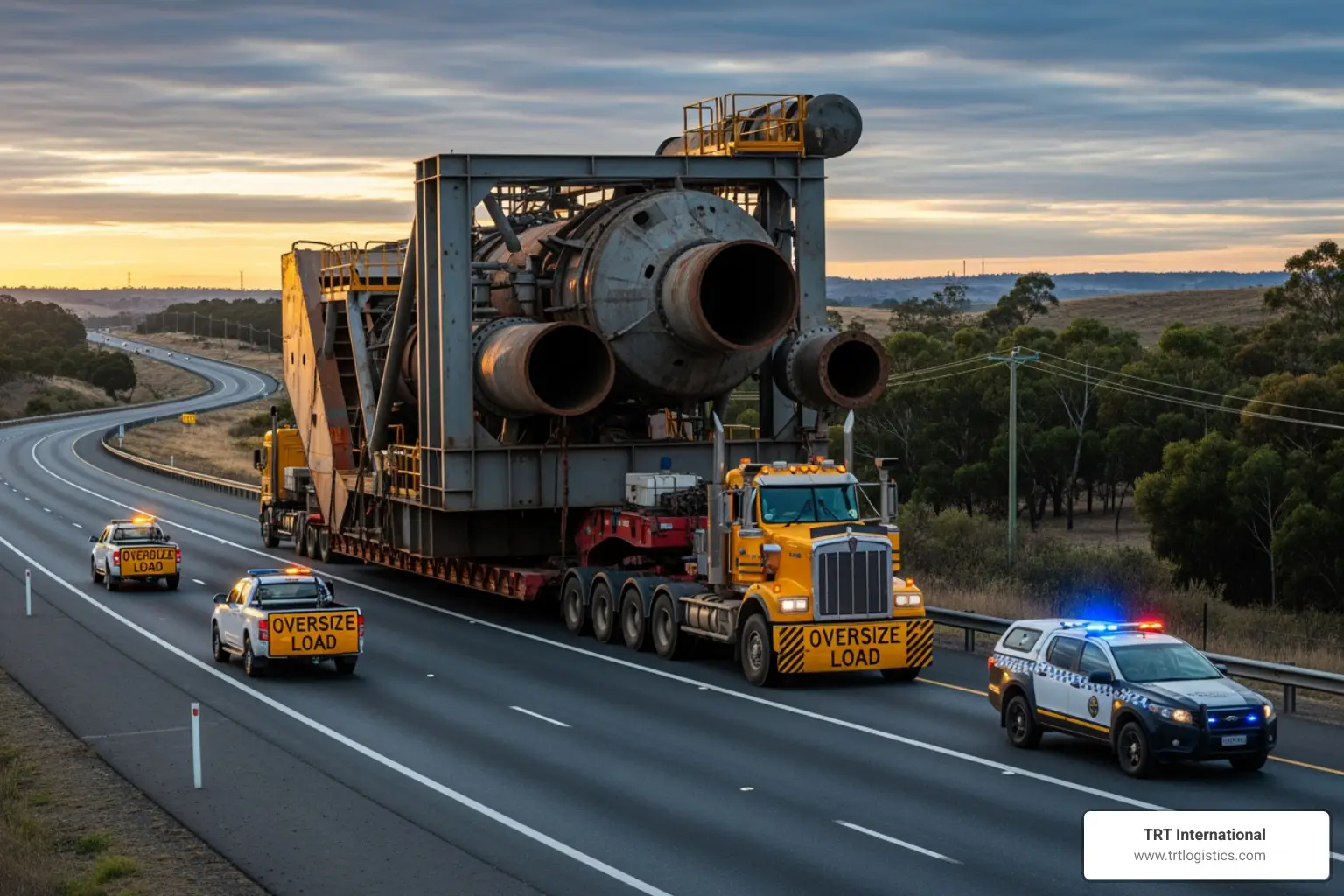
Out of gauge cargo is freight that is too wide, too tall, too long, or too heavy to travel inside a standard closed shipping container. Instead of being boxed in, out of gauge cargo (often shortened to OOG cargo) is secured on a flat rack, loaded through the open top of an open top container, or handled as breakbulk — and every inch and every pound has to be planned before the freight moves. At TRT International, OOG is core work, not an exception: we move it through our warehouses in Port Newark-Elizabeth and in the Port of Savannah, and over the road across the United States, Canada, and Mexico.
This guide explains how out of gauge cargo actually moves, step by step — what qualifies, which equipment carries it, and what a shipper needs to have ready so the move does not stall at the port.
What counts as out of gauge cargo?
A standard container has fixed internal dimensions. Freight becomes out of gauge the moment any part of it exceeds those dimensions — a machine that is wider than the container door, a tank that stands taller than the container walls, or a steel structure that is longer than the box itself. Weight matters too: a load can fit by size and still need special handling because of how its weight is concentrated.
Typical OOG freight includes industrial machinery, manufacturing equipment, tanks and vessels, steel structures, generators, and large crated project pieces. What these shipments share is that none of them can be treated like ordinary palletized freight. The dimensions, the exact weight, and the center of gravity decide everything that follows — the equipment, the securing plan, the permits, and the route.
How out of gauge cargo is carried
There are three common ways OOG freight travels, and choosing the right one is the first real decision in the move:
- Flat rack: The cargo sits on a flat platform with no side walls or roof, so it can overhang in width or height. Flat racks are the workhorse for wide and tall machinery. Because the freight is exposed and overhanging, professional flat rack lashing is what keeps it safe in transit.
- Open top container: The cargo is loaded from above by crane and travels under a removable roof or tarpaulin. This suits freight that is too tall for a standard box but still fits the container footprint — see how our open top loading service works.
- Breakbulk and on-deck handling: The largest project pieces travel as individual units rather than in any container, lifted on and off the vessel and then onto specialized trailers.
Our oversize transportation team matches each load to the right option. TRT’s fleet includes flatbeds, step decks, RGNs, and perimeter trailers, supported by 300+ company chassis including tri-axles and 85+ Freightliner day-cab trucks — so the port equipment and the road equipment are planned as one move, not two separate problems.
How an OOG move works, step by step
1. Measure and document. Everything starts with exact length, width, height, and weight — plus the center of gravity and lifting points where the manufacturer provides them. Drawings and photos of the actual piece are worth more than estimates. A few inches of error here becomes a rejected load at the terminal.
2. Match the equipment. With confirmed dimensions, we select the flat rack, open top, or trailer configuration and plan how the load will sit, where it will overhang, and how it will be blocked, braced, and lashed.
3. Plan the route and permits. Over-dimensional road moves need state permits, route checks for bridge heights and road restrictions, and escort planning where required. That work happens before pickup day, not during it.
4. Receive, stage, and secure at the warehouse. OOG freight often arrives before its vessel or its road permit window. Our Newark warehouses total 150,000 sq ft in Port Newark-Elizabeth, and our brand-new Savannah warehouse offers 316,800 sq ft on 30 acres in the Port of Savannah — so the freight can be received, inspected, staged, protected with heat shrink wrapping where needed, and loaded out on schedule. Electric forklifts and heavy handling equipment are on site at both main hubs.
5. Move it — and track it. From the port, TRT runs local bonded drayage and over-the-road transport throughout the US, Canada, and Mexico, with state of the art tracking so the shipper can follow an oversized load the same way they would follow a standard container.
OOG handling in Newark and Savannah
TRT International is headquartered at 250 Port St, Newark, NJ 07114, with warehouses in Port Newark-Elizabeth — one of the busiest container ports on the US East Coast. Our Savannah operation, at 117 A Parkway Dr, Rincon, GA 31326, works in the Port of Savannah with the same OOG capability: heavy handling, staging space, and drayage under one roof. TRT has many warehouses across the country; Newark and Savannah are the main hubs, and both are set up for project and oversized freight, not just standard containers. You can see both operations on our Port Newark location page and Savannah location page.
What to send us for an OOG quote
You do not need a perfect file to start — but these items make the difference between a fast, accurate plan and a week of back-and-forth:
- Exact dimensions (length x width x height) and total weight of each piece
- Photos or drawings showing the shape, lifting points, and center of gravity if known
- Where the freight is now, which port it moves through, and the final destination
- Whether the piece can be lifted by crane, rolled, or must stay level
- Your target dates — vessel sailing, port cutoff, and delivery window
Call us at +1 973 344 7100 ext 221 with those details and our team will build the move around them. TRT International — Delivering Excellence since 1994.
Common OOG mistakes that cost time
Most OOG delays are preventable. The ones we see most: dimensions taken from a sales brochure instead of the actual piece; weight that excludes the skid, crate, or rigging; freight delivered to the port before the equipment or permit is ready; and lashing treated as an afterthought on an overhanging load. Each one is avoided by the same habit — measure the real freight, share the real numbers early, and let the handling plan drive the schedule instead of the other way around.
Frequently asked questions
What is out of gauge cargo?
Out of gauge cargo is freight that exceeds the internal dimensions or safe loading limits of a standard shipping container — too wide, too tall, too long, or too concentrated in weight — so it travels on a flat rack, in an open top container, or as breakbulk instead of inside a closed box.
What is the difference between out of gauge and overweight cargo?
Out of gauge describes size: the freight does not fit standard container dimensions. Overweight describes weight: the freight exceeds standard weight limits. A shipment can be one or the other, or both at once, and each condition needs its own equipment and permits.
Can out of gauge cargo travel in a container?
Partly. Freight that is only too tall can travel in an open top container, and wide or tall freight can travel on a flat rack, which is a container platform without walls or a roof. The very largest project pieces travel as breakbulk, handled as individual units rather than in any container.
What information do you need to quote an out of gauge shipment?
We need the exact dimensions and weight of each piece, photos or drawings if available, the origin, port, and final destination, how the piece can be lifted or moved, and your target dates. With those details we can select equipment, plan lashing, and check routes and permits.
Does TRT handle out of gauge cargo in both Newark and Savannah?
Yes. TRT handles out of gauge cargo through its warehouses in Port Newark-Elizabeth, where our Newark facilities total 150,000 sq ft, and in the Port of Savannah, where our brand-new warehouse offers 316,800 sq ft on 30 acres.
How far in advance should I book an out of gauge move?
As early as you can. OOG moves need equipment positioning, lashing plans, route checks, and permits, and vessel cutoffs are fixed. Sharing dimensions and dates as soon as they are known gives the move the best chance of sailing and delivering on schedule.