
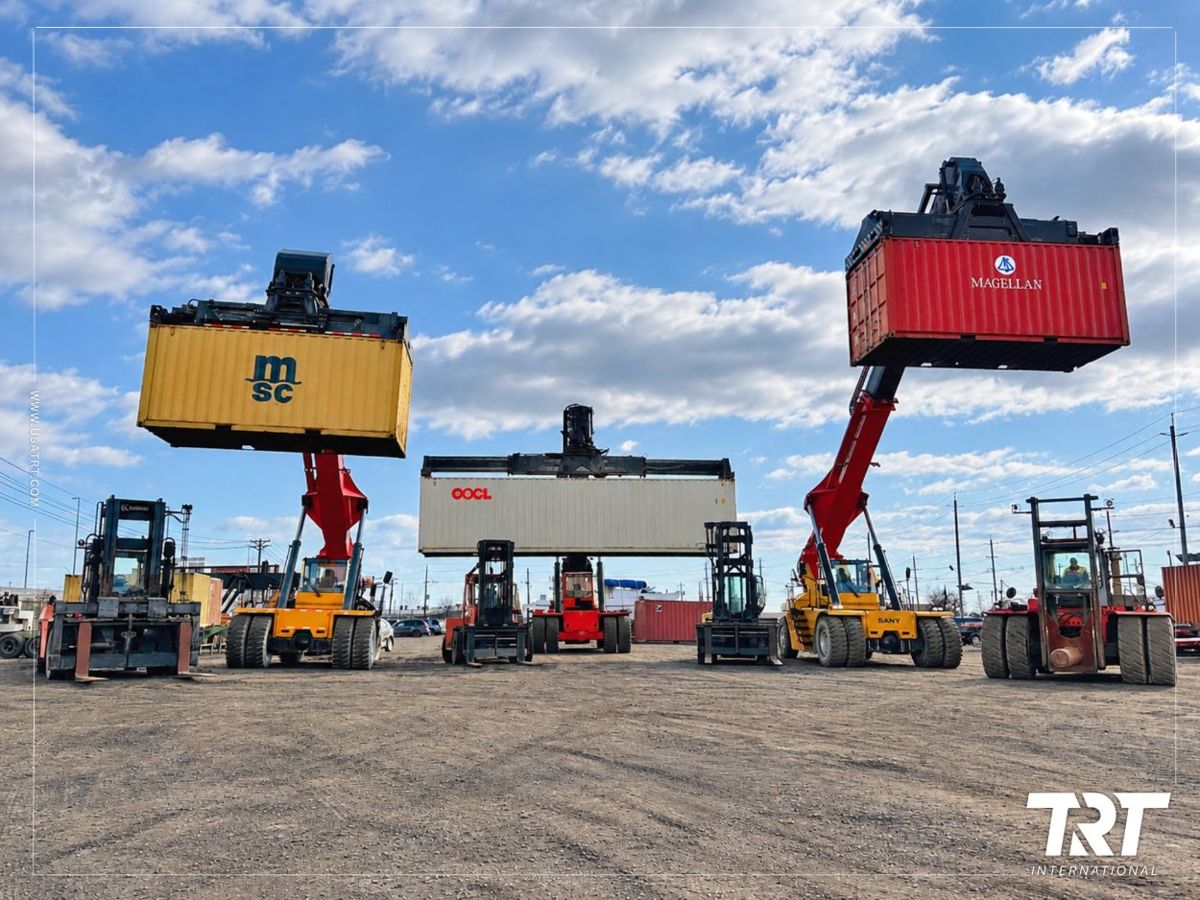
Outdoor storage is secure yard storage for cargo that cannot fit inside a warehouse bay, or does not belong in one: oversized and out-of-gauge pieces, heavy machinery, project cargo, and containers, held in a fenced, monitored yard that is part of a working port facility. It is not an empty lot where freight is dropped and forgotten. At TRT International, outdoor storage runs inside Port Newark-Elizabeth and inside the Port of Savannah through our outdoor storage service, with every piece positioned, secured, and accounted for in the facility inventory while it waits. This guide explains how outdoor storage works step by step, which cargo belongs in the yard and which belongs indoors, how stored cargo is protected and secured, and what a shipper should send us before a piece arrives.
Why Some Cargo Cannot Wait Indoors
A warehouse bay is built around a standard: a door height, an aisle width, a rack size. Oversized cargo does not respect any of those. A transformer component, a prefabricated steel section, a piece of construction equipment, or a boat on a cradle may be too tall for the door, too wide for the aisle, or simply heavier and longer than indoor handling allows. Forcing that cargo indoors is either impossible or an expensive way to store something that never needed a roof. There is also a timing problem. Project cargo moves in phases: a vessel discharges, a site is not ready, a permit window opens weeks later, an installation crew is booked for next month. The cargo has to wait somewhere between those events, and where it waits matters. Waiting on a terminal runs up port time. Waiting at a job site that is not ready creates a security and handling problem. A secure yard inside the port, run by the same company that will move the cargo onward, is the practical answer — the piece is off the terminal, under watch, and already positioned for its next leg.
Step 1: Send the Cargo Details Before Anything Arrives
Outdoor storage starts with information, not with a truck at the gate. Tell us what is coming, how big and heavy each piece is, and how long it may stay. From those details we confirm the facility, plan the yard space, and arrange any handling equipment the pieces need on arrival. Dimensions decide placement: a long piece needs a clear run of yard, a heavy piece needs ground and equipment matched to its weight, and a tall piece needs to be positioned where cranes and reach stackers can work around it later. Expected duration matters just as much. A piece staying four days between a vessel and a delivery window is placed for fast release. A piece staged for a longer project timeline is placed so other cargo can move around it without it being handled again and again. Every extra handling is cost and risk, so the yard plan is drawn before the cargo is, not improvised on the day.
Step 2: Arrival at the Facility
Cargo reaches the yard the way it reaches everything at TRT. Our drayage team collects containers inside Port Newark-Elizabeth or inside the Port of Savannah and brings them into the facility, and trucks deliver oversized pieces direct to the yard on open equipment. Because our facilities sit inside the ports, an import piece can come off the terminal and into storage under one company’s control, with no separate carrier, no second handoff, and no gap where nobody owns the cargo. Oversized pieces arriving on flat racks, flatbeds, or specialized trailers are received by the same teams that will store them, so the people who position the piece in the yard are the people who watched it come off the equipment and know how it was secured for the road.
Step 3: Positioning and Securing in the Yard
Each piece is positioned in the yard and secured by our professional team, and accounted for in the facility’s inventory systems while it is with us — so a stored piece is a tracked piece, not a forgotten one. Positioning is deliberate work. Pieces are set down so they are stable for the whole stay, not just for the day they arrive, with weight spread properly and access kept open for the equipment that will lift them again. Pieces that will be prepared while they wait are placed where wrapping and crating crews can work around them. Pieces due out first are not buried behind pieces due out last. That sounds obvious, and it is exactly the discipline that separates a working yard from a crowded one. When the delivery window opens, the call-forward should be a lift and a load, not a day of moving other people’s cargo out of the way.
Step 4: Protection and Preparation While It Waits
Outdoor does not have to mean exposed and idle. If the next leg calls for it, the piece is prepared in place while it waits, so no time is lost when the delivery window opens. Our wrapping and crating teams can heat shrink wrap a piece against the weather, sealing it inside a fitted, weather-resistant skin before rain, dust, and salt air can work on finished surfaces, electrical cabinets, and machined parts. Where a piece needs structure rather than a seal, the same teams build custom crating around it in the yard. This is the step shippers most often under-plan. Cargo that sits unprotected for a month and is then wrapped the day before it ships has already taken the month’s weather. Protected on arrival, the same piece comes out of storage in the condition it went in — and the preparation the move needed is already done, in parallel with the wait, instead of stacked against the deadline.
Step 5: Release and Onward Movement
When the cargo is called forward, it is loaded and moved out under TRT coordination — onto oversize or standard transport, into the warehouse, or back toward the terminal — by the same company that received it. There is no retrieval problem to solve first, because the piece was inventoried and positioned for this moment from the day it arrived. Our fleet runs Freightliner day-cab trucks — 85+ trucks, all driven by company drivers — with 300+ company chassis including tri-axles, and flatbeds, step decks, RGNs, and perimeter trailers, on local bonded drayage and over-the-road service throughout the US, Canada, and Mexico, with electric forklifts and lower-emission equipment working across our facilities. One call releases the cargo and books the move, because storage and transport were never separate arrangements.
What Belongs Outdoors — and What Does Not
The yard takes oversized and out-of-gauge (OOG) cargo, heavy machinery, construction equipment, project cargo, industrial components and tanks, vehicles, boats and yachts, and containers — most types of cargo we handle can be kept outdoors when indoor bays do not fit it. The honest dividing line is the cargo itself, not the calendar. Cargo that holds its own shape, tolerates weather once it is properly protected, and is too large or too heavy for a bay belongs in the yard. Cargo that is small enough to rack, sensitive enough to need a controlled indoor environment, or packed in a way that weather would damage belongs in our warehousing instead — in Newark, 150,000 square feet of warehouse space, a 120,000-square-foot warehouse plus a 30,000-square-foot site whose feature is its loading docks. Many projects use both at once: the oversized pieces wait in the yard while their smaller components, hardware, and documentation-heavy crates sit indoors, and the whole project is staged in one facility rather than split between two providers.
How Secure Is Cargo Stored Outdoors?
This is the first question serious shippers ask about a yard, and it deserves a direct answer. Our Newark facility runs 24/7 security monitoring, and all TRT warehouses have state-of-the-art surveillance and 24-hour security guards. Just as important as the watch itself is where the yard is: our yards sit inside the ports as part of our working facilities — not in open, unattended lots — and cargo in them is professionally handled and carefully monitored, with every piece recorded in the facility inventory for the whole stay. Security in a working port facility is layered: the port environment itself, the facility’s surveillance and guards, and an inventory record that means a missing or moved piece would be noticed. A piece in our yard is accounted for the way a piece in our warehouse is accounted for. The roof is what changes, not the responsibility.
Outdoor Storage in Newark and Savannah
Our Newark facility includes a 200,000-square-foot secure outdoor yard alongside 150,000 square feet of warehouse space inside Port Newark-Elizabeth, with headquarters at 250 Port St, Newark, NJ 07114. In Savannah, outdoor storage for out-of-gauge cargo is available at our brand-new 316,800-square-foot warehouse on a 30-acre site inside the Port of Savannah, with our Savannah public address at 117 A Parkway Dr, Rincon, GA 31326. TRT has many warehouses; Newark and Savannah are the main ones. Between the two ports, an importer on either coast of the Southeast or Northeast can discharge, store, prepare, and forward project cargo without the cargo ever leaving a TRT facility between the vessel and the final leg. Container parking is also offered at our facilities, so containers can wait at the warehouse instead of accumulating time on a terminal — and where it makes more sense, a container can be unloaded, its cargo stored indoors or in the yard, and the empty box freed up and returned.
Short Stays, Long Projects: How Duration Changes the Plan
Both short-term and long-term storage are available, and the right setup depends on which one you are buying. A short stay — a few days between a vessel arrival and a delivery window — is about position and speed: the piece goes where it can be released first, protection is light unless the weather demands more, and the onward transport is booked alongside the storage so the two connect. A long stay — cargo staged for a project timeline measured in weeks or months — is about condition and cost control: the piece is protected properly at the start, positioned so it is not re-handled, and checked as part of the facility inventory for the whole period. Tell us your expected timing when you ask for a quote and the storage will be planned around it. What does not work is a long stay planned as a short one: a piece that was meant to wait four days and is still sitting, unprotected, on day forty is the most common outdoor storage failure we are asked to rescue, and it is avoidable with one honest conversation at the start.
What Drives the Cost of Outdoor Storage
Storage pricing follows the footprint, the weight, and the clock. The honest variables are how much yard space the piece actually occupies, what handling equipment it needs coming in and going out, how long it stays, and what preparation — wrapping, crating, or extra securing — you book with the stay. Oversized pieces are not priced like pallet positions, and any quote that treats them that way is guessing. Accurate dimensions, weight, and timing up front produce the most accurate quote. As with every TRT service, you receive a clear, detailed quote before work is accepted, with no hidden fees — and a storage quote built on your real timeline will hold, while one built on an optimistic week usually has to be revisited when the project slips, as projects do.
Shipper’s Checklist: What to Send Us
- What the cargo is, with exact dimensions (length x width x height) and total weight for each piece
- Clear photos of the cargo, including any finished, fragile, or weather-sensitive areas
- How long the cargo is expected to stay — and whether that timeline is firm or likely to slip
- Whether the piece needs weather protection, wrapping, or crating while it is stored
- How the cargo will arrive (container, flat rack, flatbed, or other open equipment) and at which port
- What happens when it leaves: the onward destination, the equipment it should leave on, and any delivery window or vessel cutoff
Talk to TRT About Outdoor Storage
If you have machinery, equipment, project cargo, or containers that need to wait — too big for a warehouse bay, too valuable for an unattended lot — send us the checklist above and we will confirm the facility, plan the yard space, and come back with a clear, detailed quote. Call us at +1 973 344 7100 ext 221. Our headquarters is at 250 Port St, Newark, NJ 07114, and our Savannah address is 117 A Parkway Dr, Rincon, GA 31326. TRT International – Delivering Excellence since 1994.
Frequently Asked Questions
What is outdoor storage?
Outdoor storage is secure yard storage for cargo that cannot fit inside a warehouse bay, or does not belong in one: oversized and out-of-gauge pieces, heavy machinery, project cargo, and containers. At TRT it is provided at our port facilities in Newark and Savannah, with 24/7 security, as part of a working warehouse operation, and every piece is positioned, secured, and accounted for in the facility inventory while it waits.
What types of cargo can be stored outdoors?
We store oversized and out-of-gauge (OOG) cargo, heavy machinery, construction equipment, project cargo, industrial components and tanks, vehicles, boats and yachts, and containers. Most types of cargo we handle can be kept outdoors when indoor bays do not fit it; cargo that is small enough to rack or too sensitive for weather is stored in our warehousing instead.
How much outdoor storage space does TRT have?
Our Newark facility includes a 200,000-square-foot secure outdoor yard, alongside 150,000 square feet of warehouse space inside Port Newark-Elizabeth. Outdoor storage for out-of-gauge cargo is also available in Savannah, at our brand-new 316,800-square-foot warehouse on a 30-acre site in the Port of Savannah.
How secure is cargo in outdoor storage?
Our Newark facility runs 24/7 security monitoring, and all TRT warehouses have state-of-the-art surveillance and 24-hour security guards. The yards sit inside the ports as part of our working facilities, not in open, unattended lots, and cargo is professionally handled, carefully monitored, and recorded in the facility inventory for the whole stay.
Can containers be parked or stored at TRT?
Yes. Container parking is offered at TRT facilities, so containers can wait at the warehouse instead of accumulating time on a terminal. A container can also be unloaded and its cargo stored, indoors or in the yard, while the empty box is freed up and returned.
How long can cargo stay in outdoor storage?
Both short-term and long-term storage are available. Some pieces stay a few days between a vessel arrival and a delivery window; others are staged for longer project timelines. The setup differs — short stays are positioned for fast release, long stays are protected and positioned so they are not re-handled — so tell us your expected timing when you ask for a quote.
Can cargo stored outdoors be prepared for its next move?
Yes. While cargo waits in the yard, our wrapping and crating teams can shrink-wrap it against the weather, build custom crating where it needs structure, and position it for loading. When the window opens, it moves out on TRT oversize or standard transport, prepared by the same company that stored it.
How do I get an outdoor storage quote?
Tell us what the cargo is, its dimensions and weight, which facility you want, and how long it needs to stay, or call +1 973 344 7100 ext 221. Headquarters is at 250 Port St, Newark, NJ 07114, and the Savannah public address is 117 A Parkway Dr, Rincon, GA 31326. You receive a clear, detailed quote before work is accepted, with no hidden fees.