
Heat shrink wrapping is the sealing of a piece of cargo inside a fitted plastic film that is heated so it tightens closely around the cargo, forming a durable, weather-resistant barrier against moisture, dust, and other environmental factors. Unlike a loose tarp or a few turns of stretch film, heat shrink wrapping is shaped to the individual piece — its size, its outline, and its protrusions — and it stays taut in wind, in rain, and through handling. TRT International provides heat shrink wrapping inside Port Newark-Elizabeth and inside the Port of Savannah as part of our wrapping and crating service, and this guide explains how the process works, when wrapping is the right protection, when it is not enough on its own, and what a shipper should send us before a piece is wrapped.
Why Exposed Cargo Needs Real Protection
Plenty of valuable cargo cannot travel or sit inside a closed box. Industrial machinery, construction equipment, fabricated steel, marine vessels, and project cargo components are often too large, too heavy, or too irregularly shaped for a standard container, so they move on open equipment or sit in a yard waiting for a vessel, a permit, or the next leg of a project. Every day that cargo sits exposed, weather works on it: rain finds electrical cabinets and machined surfaces, condensation forms under loose covers and stays there, dust and salt air settle into moving parts, and ultraviolet light degrades paint, rubber, and exposed materials. A loose cover can make things worse, not better — it flaps in the wind, wears against finished surfaces, pools water on top, and traps moisture underneath. Heat shrink wrapping solves that specific problem: a tight, sealed skin that sheds water instead of collecting it, does not flap or chafe, and keeps the environment off the cargo for the full transport or storage period, not just the first dry day.
Step 1: Assess the Cargo Before Any Film Is Cut
Every wrapping job at TRT starts with the cargo itself. Our team carefully assesses each shipment — its size, weight, shape, and sensitivities — to determine the best wrapping and crating methods for that piece, because no two shipments are protected the same way. We need to know what must stay completely dry, what is finished and cannot be rubbed or pressed, where vents, intakes, exhausts, and access panels sit, and which parts protrude and will need the film fitted or supported around them. We also need the plan for what happens next: is this piece traveling on open equipment, going into outdoor storage, or being held for an export sailing? The answer changes how the wrap is built. A piece wrapped for a short road move is handled differently from a piece wrapped to sit through a season in a yard or to ride exposed on a flat rack, and the assessment is where that difference is decided — before the film comes off the roll, not after a problem shows up.
Step 2: Prepare and Support the Piece
Good wrapping starts before the film goes on. The cargo is positioned so the finished wrap can be lifted, secured, and transported safely, and anything that would damage the film from inside — sharp edges, bolt ends, corners, and protruding fittings — is padded or covered so the tightened film is not cut or worn through by the cargo itself. Delicate and finished areas get protection underneath the wrap where they need it. Where the piece has an irregular outline, the support plan matters: the film needs to bridge hollows and follow contours without leaving loose pockets where water can sit or wind can get underneath and work the wrap loose. This preparation is unglamorous work, and it is also the difference between a wrap that arrives tight and intact and one that arrives torn at exactly the corner nobody padded.
Step 3: Fit the Film and Apply Heat
With the cargo prepared, the shrink film is fitted around the piece and its seams are joined so the cargo sits inside a single continuous envelope. Heat is then applied evenly across the surface, and the film shrinks as it warms, tightening down onto the shape of the cargo until it is taut — drum-tight on flat surfaces and closely fitted around the outline of the piece. The crew works the surface systematically, checking tension as they go: areas left loose will flap, chafe, and collect water, while the goal is a smooth, tight skin with sealed seams and no pockets. Done properly, the finished wrap looks like the cargo itself, only sealed — you can read the outline of the machine, the fabrication, or the hull through it, and rain runs off it instead of into it. That tight fit is also what makes heat shrink wrapping different in kind from stretch film, which is only held by its own tension in a few bands, and from a tarp, which is never fitted at all.
Step 4: Check Seams, Drainage, and Access
Before a wrapped piece is released for transport or storage, the wrap is inspected as a whole: seams are checked for a complete seal, the tension is checked across large flat areas, and the shape is checked for low spots where water could pool instead of running off. Handlers also need the practical information a sealed piece hides — where it can be lifted, where it should be supported, and how much the wrapped unit weighs — marked or documented so the next crew does not have to guess through the film. If the cargo will need inspection or access while it is wrapped, that is planned at this stage rather than solved later by cutting the wrap open in the yard, which defeats the seal the shipper paid for. A finished, checked wrap should be able to be handed over, hauled, and set down without anyone needing to improve it along the way.
Step 5: Transport, Storage, and Handover
Wrapping is one stage of a move, and it works best when the same team handles the stages around it. If the piece is moving, it is loaded and secured with its wrap in mind — lashings and contact points planned so the transport securing does not cut or wear the film it is holding down, a discipline that connects directly to our flat rack and open-equipment work. If the piece is waiting, wrapped cargo can go into our outdoor storage with its protection already on, instead of sitting exposed while a schedule firms up. In Newark, our warehousing totals 150,000 square feet inside Port Newark-Elizabeth — a 120,000-square-foot warehouse plus a 30,000-square-foot site whose feature is its loading docks — with headquarters at 250 Port St, Newark, NJ 07114. In Savannah, the work runs through our brand-new 316,800-square-foot warehouse on 30 acres in the Port of Savannah, with our Savannah public address at 117 A Parkway Dr, Rincon, GA 31326. TRT has many warehouses; Newark and Savannah are the main ones. Our fleet runs Freightliner day-cab trucks — 85+ trucks, all driven by company drivers — with 300+ company chassis including tri-axles, and flatbeds, step decks, RGNs, and perimeter trailers, on local bonded drayage and over-the-road service throughout the US, Canada, and Mexico, with electric forklifts and lower-emission equipment used across our warehouses.
What Commonly Gets Heat Shrink Wrapped
The cargo we wrap shares a pattern: it is valuable, exposed, and not shaped like a box. Industrial machinery and manufacturing equipment are wrapped to keep moisture and dust out of motors, cabinets, and machined surfaces during transport and storage. Construction equipment is wrapped when it will sit between project phases or travel on open trailers. Steel fabrications and project cargo components are wrapped to protect finished and painted surfaces on the way to site. High-value electronics are wrapped as part of a wider protection plan where dust and moisture are the main threats. Marine vessels are a classic wrapping case — a boat that has been hauled and prepared for transport or winter storage needs a tight, weather-shedding cover fitted to the hull and superstructure, which is why wrapping pairs so often with our boat and yacht transport work. If you are unsure whether your cargo should be wrapped, crated, or both, send us its dimensions, weight, and photos and we will tell you plainly which protection fits it.
Heat Shrink Wrapping vs. Stretch Film, Tarps, and Crating
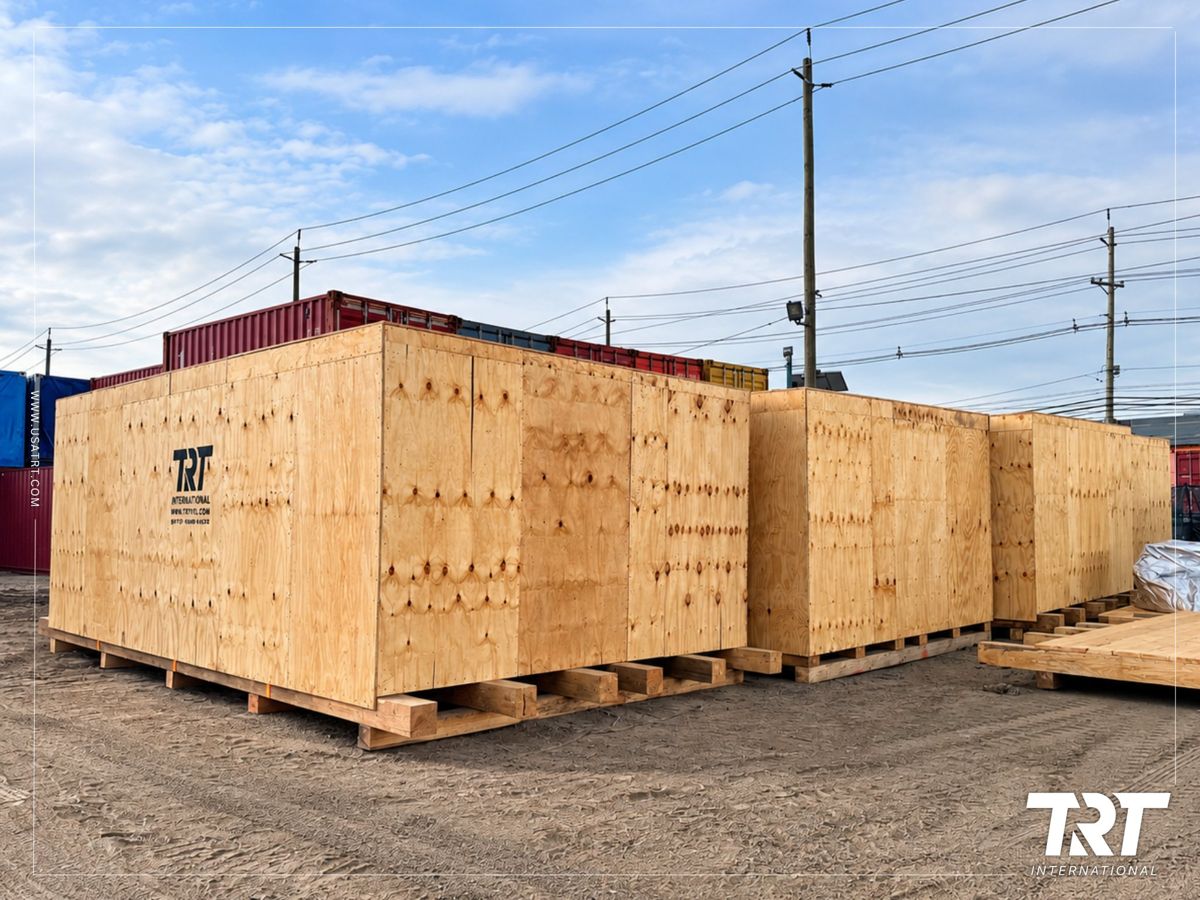
These four options get confused, and picking the wrong one either wastes money or leaves cargo exposed. Stretch film is fast and cheap for palletized goods on a short, sheltered move, but it is a banding material, not a sealed envelope — it leaves gaps, loosens, and was never designed to weather a yard or an ocean-facing terminal. A tarp covers, but it is not fitted: it flaps, chafes finished surfaces, pools water, and traps condensation underneath. Heat shrink wrapping is the sealed, fitted, weather-resistant answer for cargo that holds its own shape and needs the environment kept off it, for transport or for storage. A custom wood crate is the structural answer for cargo that also needs protection against impact, stacking pressure, and movement inside an enclosure — our guide to export crating covers that process in full. Many shipments use wrapping and crating together, with the piece wrapped first and then crated, and part of the assessment is honestly matching the protection to the route and the wait, not selling the heaviest option for every load.
Wrapping for Outdoor Storage
Storage is where wrapping quietly earns its cost. Project cargo rarely moves on the schedule first drawn up: vessels slip, permits take time, sites are not ready, and equipment bought for a later phase has to wait somewhere. Unwrapped, that wait is when corrosion, water intrusion, and dust damage happen — slowly, and usually discovered at the worst moment, when the cargo is finally needed. Wrapped before it goes into the yard, the same piece waits sealed: rain sheds, dust stays out, and the cargo that comes out of storage is in the condition it was in when it went in. That is why we treat wrapping and outdoor storage as one decision, not two — the assessment asks not just how the cargo will travel, but how long and where it will wait before it travels.
What Drives the Cost of Heat Shrink Wrapping
There is no honest flat rate, because no two pieces are the same size, shape, or sensitivity. Pricing is built from the cargo’s dimensions and outline, the amount of film and preparation work its shape requires — protrusions, sharp edges, and finished areas all take time to protect properly — any additional protection, crating, or support built with the wrap, and the handling, storage, or onward transport you book with it. Accurate details up front produce the most accurate quote. As with every TRT service, you receive a clear, detailed quote before work is accepted, with no hidden fees — and a quote built on real dimensions and photos will hold, while a quote built on a guess usually has to be rebuilt when the cargo arrives.
Shipper’s Checklist: What to Send Us
- What the cargo is, with exact dimensions (length x width x height) and total weight
- Clear photos of the cargo, including any protrusions, fittings, sharp edges, or fragile and finished areas
- What must stay completely dry, and any vents, intakes, or panels that need special attention
- Whether the piece will travel on open equipment, go into outdoor storage, or both — and for roughly how long
- Where the cargo is now, and whether you also need crating, storage, drayage, or onward transport with the wrapping
- Any deadline you are working to, such as a vessel cutoff, a permit window, or a site delivery date
Talk to TRT About Heat Shrink Wrapping
If you have machinery, equipment, a vessel, or project cargo that will travel exposed or wait outdoors — or cargo you suspect a tarp is not really protecting — send us the checklist above and we will assess it and come back with a wrapping plan and a clear, detailed quote. Call us at +1 973 344 7100 ext 221. Our headquarters is at 250 Port St, Newark, NJ 07114, and our Savannah address is 117 A Parkway Dr, Rincon, GA 31326. TRT International – Delivering Excellence since 1994.
Frequently Asked Questions
What is heat shrink wrapping?
Heat shrink wrapping is the sealing of a piece of cargo inside a fitted plastic film that is heated so it tightens closely around the cargo, forming a durable, weather-resistant barrier against moisture, dust, and other environmental factors. It is fitted to the individual piece — its size, outline, and protrusions — and stays taut through handling, transport, and storage.
How is heat shrink wrapping different from stretch film or a tarp?
Stretch film is a banding material that leaves gaps and loosens, and a tarp is not fitted at all — it flaps, chafes finished surfaces, pools water, and traps condensation underneath. Heat shrink wrapping is a single sealed envelope, heated tight to the shape of the cargo, so rain sheds off it and the environment stays off the cargo for the full transport or storage period.
What cargo typically needs heat shrink wrapping?
Cargo that is valuable, exposed, and not shaped like a box typically needs heat shrink wrapping, including industrial machinery, construction equipment, steel fabrications, project cargo components, high-value electronics, and marine vessels. These are pieces that move on open equipment or wait outdoors and cannot be protected by standard packaging.
Can heat shrink wrapped cargo be stored outdoors?
Yes. A heat shrink wrap is a durable, weather-resistant barrier, which makes it ideal for cargo that will wait outdoors between project phases, vessel sailings, or permit windows. TRT treats wrapping and outdoor storage as one decision, so the piece goes into the yard already sealed and comes out of storage in the condition it went in.
Can TRT shrink wrap cargo as well as crate it?
Yes. Many shipments use both together, with the piece shrink wrapped first as a moisture and dust barrier and then placed inside a custom wood crate for structural protection against impact, stacking, and movement. The assessment decides which combination fits the cargo and its route, rather than defaulting to the heaviest option for every load.
Where does TRT provide heat shrink wrapping?
TRT provides heat shrink wrapping inside Port Newark-Elizabeth, where its warehousing totals 150,000 square feet, and in the Port of Savannah, where its brand-new warehouse is 316,800 square feet on 30 acres. TRT has many warehouses, and Newark and Savannah are the main ones. Headquarters is at 250 Port St, Newark, NJ 07114, and the Savannah public address is 117 A Parkway Dr, Rincon, GA 31326.
How do I get a quote for heat shrink wrapping?
Send TRT what the cargo is, its exact dimensions and weight, clear photos including any protrusions or finished areas, and whether it will travel on open equipment, go into outdoor storage, or both. Call +1 973 344 7100 ext 221. You receive a clear, detailed quote before work is accepted, with no hidden fees, and accurate dimensions up front produce the most accurate quote.