
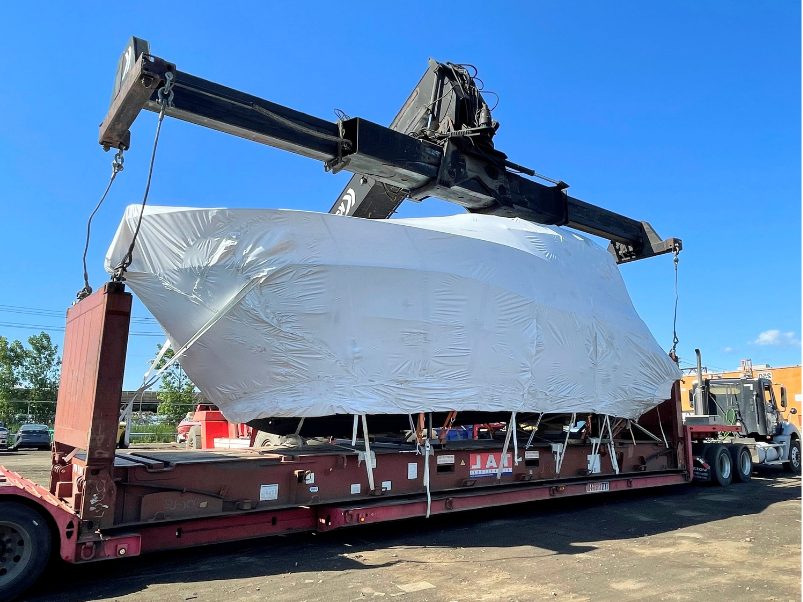
Heat shrink wrapping machinery is the sealing of a machine inside a fitted plastic film that is heated so it tightens closely around the machine, forming a durable, weather-resistant barrier against moisture, dust, and salt air. Unlike a loose tarp, the film follows the machine’s outline – its frame, its housing, its protruding hoses and fittings – and stays taut in wind, in rain, and through handling. TRT International provides heat shrink wrapping for machinery inside Port Newark-Elizabeth and in the Port of Savannah as part of our wrapping and crating service, and this guide is about machinery specifically: what on a machine must be sealed, what must be vented or desiccated, what must stay accessible, the preparation mistakes that damage machines, and when wrapping alone is not enough.
Why Machinery Is Not Ordinary Cargo
A machine is not a box, and that is the whole problem. A crate of boxed goods has flat sides, no openings, and nothing that has to work when it arrives. A machine has openings that lead straight into its working parts, fluids that must stay in, surfaces that must stay clean and true, and controls that must still answer when the machine is switched on at the other end. Damage to a machine is also discovered late. A dented box is obvious at the dock. A corroded bearing, a damp control cabinet, or a scored machined surface often shows up only at commissioning, weeks after the move, when the delay costs far more than the freight did.
That is why I never treat wrapping a machine as covering it up. The wrap is a skin fitted to a working piece of equipment, and every decision in the job – what gets sealed, what gets vented, what gets padded, what stays reachable – is a decision about that machine’s working parts. A press, a generator, a pump skid, a packaging line, a piece of construction equipment, or a manufacturing cell all share the same risks in transit, but they do not share the same openings, the same fragile points, or the same handling needs. The assessment has to be machine by machine, and the wrap has to be built around the answers.
What Heat Shrink Wrapping Protects on a Machine
Start with what the weather actually attacks. Rain and road spray find every opening. Salt air at a port terminal settles on bare metal and works into unprotected surfaces. Dust in a yard gets into moving parts and settles in control cabinets. Ultraviolet light degrades rubber hoses, seals, and exposed paint. Vibration and handling rub a loose cover against finished surfaces until the finish is gone. A fitted shrink wrap deals with all of that at once, because it is a sealed envelope rather than a cover draped over the top: rain sheds off it, dust and salt air stay outside it, and it does not flap or chafe the way a tarp does.
On a machine, the parts that gain the most from that envelope are the ones that are hardest to repair. Machined surfaces – shafts, slideways, bearing seats, flanges, and mating faces – corrode quickly once moisture reaches them, and a light film of rust on a surface that was ground to a tolerance is not a cosmetic problem. Control cabinets, motors, and electrical enclosures need to stay dry inside, not just look dry outside. Hydraulic and pneumatic fittings, hoses, and connectors need protection from grit and from water sitting against seals. Painted and finished surfaces need a barrier that does not rub them. And moving parts – exposed gears, chains, linkages, and cylinders – need to be kept clean and still, so grit does not get worked into them during the move.
The wrap does not do the machine’s structural work. It will not stop a forklift tine, hold a loose part in place, or keep a top-heavy machine upright. That is the job of preparation, crating, and securing. What the wrap does, and does well, is keep the environment off a machine that is sound, prepared, and properly secured, for the whole of its transport and storage – not just for the first dry day.
What to Seal, What to Vent, What to Desiccate, and What to Leave Accessible
Seal it. Every opening that leads into the machine gets dealt with before the film goes on. Intakes, exhausts, vents that are not needed during the move, filler necks, open pipe ends, and exposed electrical connections are capped or sealed so water, dust, and salt air cannot enter through them. This is not guesswork: the crew works from the machine itself and from the photos and information the shipper sends, and an opening nobody noticed is an opening that will let water in. Machined surfaces that will be exposed to any damp air inside the envelope get protected underneath the wrap as well, and delicate or finished areas get padding or a cover under the film so the tightened film never presses directly on them.
Vent it and desiccate it. A sealed envelope keeps weather out, but it also keeps in whatever air and moisture were sealed inside with the machine. That is the point most people miss, and it is where machinery wrapping differs most from wrapping a solid, inert piece of cargo. A machine that goes into the wrap wet, or that is wrapped in damp air, will sweat inside the film as temperatures change, and that condensation will sit on the very surfaces the wrap was meant to protect. So the machine is wrapped clean and dry, desiccant is placed inside the wrap where the machine and the expected storage period call for it, and vents are used where the machine needs them – for example where a sealed space would otherwise trap air or where a component needs to breathe. The goal is a dry envelope, not just a closed one, and the desiccant and venting plan is decided for the machine and the length of the wait, not copied from the last job.
Leave it accessible. A wrapped machine still has to be handled, inspected, and sometimes reached. Lifting points, fork pockets, and sling positions are identified before wrapping, and the weight and the lifting information are marked or documented so the next crew does not have to guess through the film. Panels, filler caps, drain points, and inspection covers that will be needed during transport or storage are left reachable with a built-in access flap or a marked opening. Data plates and markings that handlers, inspectors, or customs may need to see are not buried without a plan. If something will need to be reached, it is planned before the film is heated tight – cutting a sealed wrap open in the yard to reach a panel that should have been planned for breaks the seal the shipper paid for.
Before the Film Goes On: Preparing a Machine for Wrapping
Good wrapping starts before the film comes off the roll, and on machinery the preparation is most of the job. The machine is positioned so the finished wrap can be lifted, secured, and transported safely. It is cleaned and dried, because dirt holds moisture against surfaces and a wrap sealed over a dirty machine seals the dirt in with it. It is allowed to cool if it has just been run: wrapping a hot machine traps heat and moisture and can damage the film and the machine alike. Loose parts are secured or removed and packed separately, so nothing can shift inside the wrap and strike a finished surface. Hoses and cables are supported and tied back so they do not press against the film or hang where they can be snagged.
Anything that could damage the film from the inside is padded or covered: sharp edges, bolt ends, corners, brackets, and protruding fittings. A tightened film pressed against a sharp corner will cut or wear through, usually at exactly the point nobody padded, and a small tear is enough to let weather in for the rest of the move. The film also has to bridge hollows and follow the machine’s contours without leaving loose pockets where water can sit or wind can get underneath and work the wrap loose. That support plan – where the film is padded, where it is bridged, where it is fitted closely – is what separates a wrap that arrives tight and intact from one that arrives torn.
Preparation Mistakes That Damage Machinery
Most wrapping damage to machinery is not caused by the weather. It is caused by preparation that was rushed or skipped. The mistakes I see most often are specific to machines, and they are all avoidable.
Wrapping a wet or dirty machine. Moisture sealed inside the envelope becomes condensation, and condensation on a machined surface or inside a control cabinet is corrosion. The machine must be clean and dry before it is wrapped, and that takes time – time that is easy to skip when a vessel cutoff is pressing.
Wrapping a machine that has just been run. A hot engine, motor, or hydraulic system needs to cool first. Wrapping it hot traps heat, drives moisture into the envelope, and can soften or damage the film where it touches hot surfaces.
Sealing every opening with no venting or desiccant plan. Sealing is only half the job. A completely sealed envelope with damp air inside and no desiccant is a damp box. The inside of the wrap needs the same attention as the outside.
Letting the film press on controls, hoses, and wiring. A tightened film will press on whatever it touches. Control panels, gauges, connectors, and hoses need protection underneath the wrap, and cables need to be supported so the film does not pull or chafe them during handling.
Forgetting the lifting plan. A machine wrapped with no thought to how it will be lifted is a machine that will be lifted through its wrap. Lifting points covered, slings run over unprotected film, and forklift tines placed by guesswork all tear wraps and can damage the machine underneath.
Covering data plates, filler caps, and access panels. If the next handler cannot find the lifting point, the data plate, or the drain, they will cut the wrap to find it. Plan the access first, and the wrap stays intact.
Using the wrap as a substitute for securing the machine. Shrink wrap is a weather barrier, not a restraint. Loose parts, unsecured attachments, and a machine that can shift on its base need to be secured before wrapping, not held in place by film.
Lifting, Loading, and Securing a Wrapped Machine
A wrapped machine is handled the same way an unwrapped one is – with the lifting plan made in advance. Lifting points are identified from the machine and from the manufacturer’s information where the shipper has it, and the wrap is padded at every point where a sling, chain, or lashing will bear on it, so the securing does not cut the film it is holding down. Fork pockets and support points are kept usable, and the wrapped unit’s weight and center of gravity are documented so the crew lifting it is not working from a guess. That discipline matters on open equipment, where a machine rides exposed on a flatbed, step deck, or RGN, and where the lashings are the only thing between the machine and the road.
Loading a wrapped machine into an open-top container is the same idea from above: the piece is prepared first, then lifted and lowered in, as our guide to open top loading explains. On a flat rack, the wrap has to survive the same lashing and securing as the machine itself, with contact points planned so straps do not wear through the film on a long haul. Craning is part of that preparation from the start, not an afterthought: the heaviest pieces are lifted into position, and a wrap that was built without the lift in mind will be torn by the lift. When the wrap, the lift, and the securing are planned together, a wrapped machine can be handed over, hauled, and set down without anyone needing to improve the protection along the way.
Machinery in Port Storage: Wrapped, Waiting, and Checked
Project machinery rarely moves on the schedule first drawn up. Vessels slip, permits take time, sites are not ready, and equipment bought for a later phase has to wait somewhere. That wait is when wrapping earns its cost – or when a poor wrap is found out. A machine that goes into the yard sealed, dry, and desiccated waits with rain shedding off it and dust staying out. A machine that goes in wet, or with a torn wrap nobody noticed, waits with moisture working on it slowly, and the damage is usually discovered at the worst moment, when the machine is finally needed.
That is why we treat wrapping and storage as one decision, not two, and why a long wait changes the plan. A wrapped machine in outdoor storage should be inspected during the wait: seams checked, tension checked, low spots where water could pool checked, and any tear repaired or the piece re-wrapped before the damage spreads. Our Newark facility includes a 200,000-square-foot secure outdoor yard alongside our warehousing there, and wrapped machinery can also move indoors where the piece and the schedule call for it – our guide to port warehousing explains how that storage fits a project timeline.
The work is done at our facilities inside Port Newark-Elizabeth and in the Port of Savannah, so the wrapping, the storage, and the onward move are handled by one team. In Newark, our warehousing totals 150,000 square feet inside Port Newark-Elizabeth – a 120,000-square-foot warehouse plus a 30,000-square-foot site whose feature is its loading docks – with headquarters at 250 Port St, Newark, NJ 07114. In Savannah, the work runs through our brand-new 316,800-square-foot warehouse on 30 acres in the Port of Savannah, with our Savannah public address at 117 A Parkway Dr, Rincon, GA 31326. TRT has many warehouses; Newark and Savannah are the main ones. Our fleet runs Freightliner day-cab trucks – 85+ trucks, all driven by company drivers – with 300+ company chassis including tri-axles, and flatbeds, step decks, RGNs, and perimeter trailers, on local bonded drayage and over-the-road service throughout the US, Canada, and Mexico, with electric forklifts used across our warehouses.
When Wrapping Alone Is Not Enough
Wrapping is a weather barrier, and a shipper who asks it to do a structural job will be disappointed. A machine that also needs protection against impact, stacking pressure, rough handling, or movement inside an enclosure needs a crate, or a wrap inside a crate. That is the honest line, and it is drawn in the assessment, not after the damage.
Crating is the right call when the machine has fragile or finished parts that could be struck, when its shape must not shift, when it will be stacked on or handled by crews who cannot see the fragile points, or when an export move needs the crate as part of the protection and the handling plan. Many shipments use both together: the machine is shrink wrapped first as a moisture and dust barrier, then placed inside a custom wood crate for structural protection. Our guide to export crating covers that process in full, including what the crate is built around and what has to be documented before it is closed.
Indoor storage is the other answer when wrapping alone is not enough. A machine that cannot tolerate any moisture, that needs a controlled environment, or that will wait for a long period in severe weather may belong inside, in our warehousing, rather than in the yard under a wrap. The point of the assessment is to say that plainly before the machine is wrapped, rather than to sell the lightest option and hope the weather is kind. If wrapping alone will not protect your machine for the route and the wait you have, we will tell you – and we will tell you what will.
What Drives the Cost of Wrapping Machinery
There is no honest flat rate, because no two machines are the same size, shape, or sensitivity. Pricing is built from the machine’s dimensions and outline, the amount of film and preparation work its shape requires – protrusions, sharp edges, and finished areas all take time to protect properly – and any additional protection built with the wrap, such as padding for machined surfaces, desiccant and venting, access flaps, or crating. The handling, storage, or onward transport you book with it is part of the quote as well. Accurate details up front produce the most accurate quote. As with every TRT service, you receive a clear, detailed quote before work is accepted, with no hidden fees – and a quote built on real dimensions and photos will hold, while a quote built on a guess usually has to be rebuilt when the machine arrives.
Shipper’s Checklist: What to Send Us
- What the machine is, with exact dimensions (length x width x height) and total weight
- Clear photos of the machine, including any openings, controls, hoses, machined surfaces, and fragile or finished areas
- What must stay completely dry, and any vents, intakes, exhausts, or panels that need special attention
- Whether the machine has been run recently, whether it has any leaks, and whether it needs to cool or be drained before wrapping
- Lifting points and support points, if known, and anything that must not be pressed, lifted by, or stacked on
- Whether the machine will travel on open equipment, go into outdoor storage, or both – and for roughly how long
- Where the machine is now, and whether you also need crating, storage, drayage, or onward transport with the wrapping
- Any deadline you are working to, such as a vessel cutoff, a permit window, or a site delivery date
Talk to TRT About Heat Shrink Wrapping Machinery
If you have machinery or industrial equipment that will travel exposed or wait outdoors – or machinery you suspect a tarp is not really protecting – send us the checklist above and we will assess it and come back with a wrapping plan and a clear, detailed quote. Call us at +1 973 344 7100 ext 221. Our headquarters is at 250 Port St, Newark, NJ 07114, and our Savannah address is 117 A Parkway Dr, Rincon, GA 31326. TRT International – Delivering Excellence since 1994.
Frequently Asked Questions
Can all machinery be shrink wrapped?
No. Most machinery can be shrink wrapped, but not every machine should be wrapped in the same way, and a few should not be wrapped at all until a specific problem is solved. A machine with a fluid leak, a hot surface that has not cooled, an electrical fault, or a part that must stay open for ventilation needs that problem dealt with first. Tell us what the machine is and what it cannot tolerate, and we will tell you plainly whether wrapping fits it, what has to be prepared first, or whether crating or indoor storage is the safer answer.
What happens to engines, electrics and controls under shrink wrap?
Engines, electrics and controls are the reason the wrap has to be planned machine by machine, not just pulled tight. Openings are capped or sealed, control cabinets and panels are protected from direct pressure and rubbing, and wiring, hoses and connectors are kept dry and supported so the film does not press on them or trap water against them. A machine that has just been run must be allowed to cool before it is wrapped, and anything that needs air, drainage or access is dealt with in the plan, not discovered after the film is on.
How do you stop moisture and condensation inside the wrap?
Moisture is stopped by wrapping a clean, dry machine, sealing the envelope properly, and managing the air inside it. Desiccant is placed inside the wrap where the machine and the storage period call for it, vents are used where the machine needs them, and low spots where water could pool are avoided so rain sheds off the outside instead of collecting. The wrap is then checked for tears and loose seams, because a small opening can let in the moisture the wrap was meant to keep out.
How long does heat shrink wrapping protect machinery outdoors?
It depends on the machine, the film, the weather and how long the piece has to wait. A well-built wrap is made to protect machinery through transport and through a period of outdoor storage, not just for the first dry day, and it should be inspected during a long wait so a tear, a loose seam or a pooled-water spot can be dealt with before it becomes damage. If the wait is long, the exposure is severe, or the machine cannot tolerate any moisture at all, we will say so and talk about crating, indoor storage or re-wrapping instead of leaving a wrap to do a job it cannot do.
Can wrapped machinery be lifted, craned and loaded normally?
Yes, when the lifting plan is made before the machine is wrapped. Lifting points, fork pockets and sling positions are identified in advance, marked or documented so the next crew does not have to guess through the film, and the wrap is fitted and padded so lifting gear and lashings do not cut or wear through it. A wrapped machine is then lifted, craned and loaded the same way an unwrapped one would be, with the same care over where it is supported and how it is secured.
Can I inspect the machine or reach an access panel while it is wrapped?
Yes, if access is planned before the wrap goes on. Panels, filler caps, drain points and inspection covers that will be needed during transport or storage can be left reachable with a built-in access flap or a marked opening, so nobody has to cut the wrap open in the yard. Cutting a sealed wrap to reach something that should have been planned for breaks the seal the shipper paid for, so tell us in advance what will need to be reached and when.
When should machinery be crated instead of only shrink wrapped?
Machinery should be crated, or wrapped and then crated, when it also needs structural protection, not just a weather barrier. That means a machine with fragile or finished parts that could be struck, a shape that must not shift, a piece that will be stacked on or handled roughly, or an export move where the crate is part of the protection and the handling plan. The assessment will tell you plainly which combination fits your machine and its route.
What information does TRT need for a heat shrink wrapping quote?
Send us what the machine is, its exact dimensions (length x width x height) and total weight, clear photos including any openings, controls, hoses, machined surfaces and fragile areas, and whether it will travel on open equipment, go into outdoor storage, or both, and for roughly how long. Also tell us where the machine is now, what must stay dry or stay accessible, and any deadline you are working to. Call +1 973 344 7100 ext 221, and you will receive a clear, detailed quote before work is accepted, with no hidden fees.