
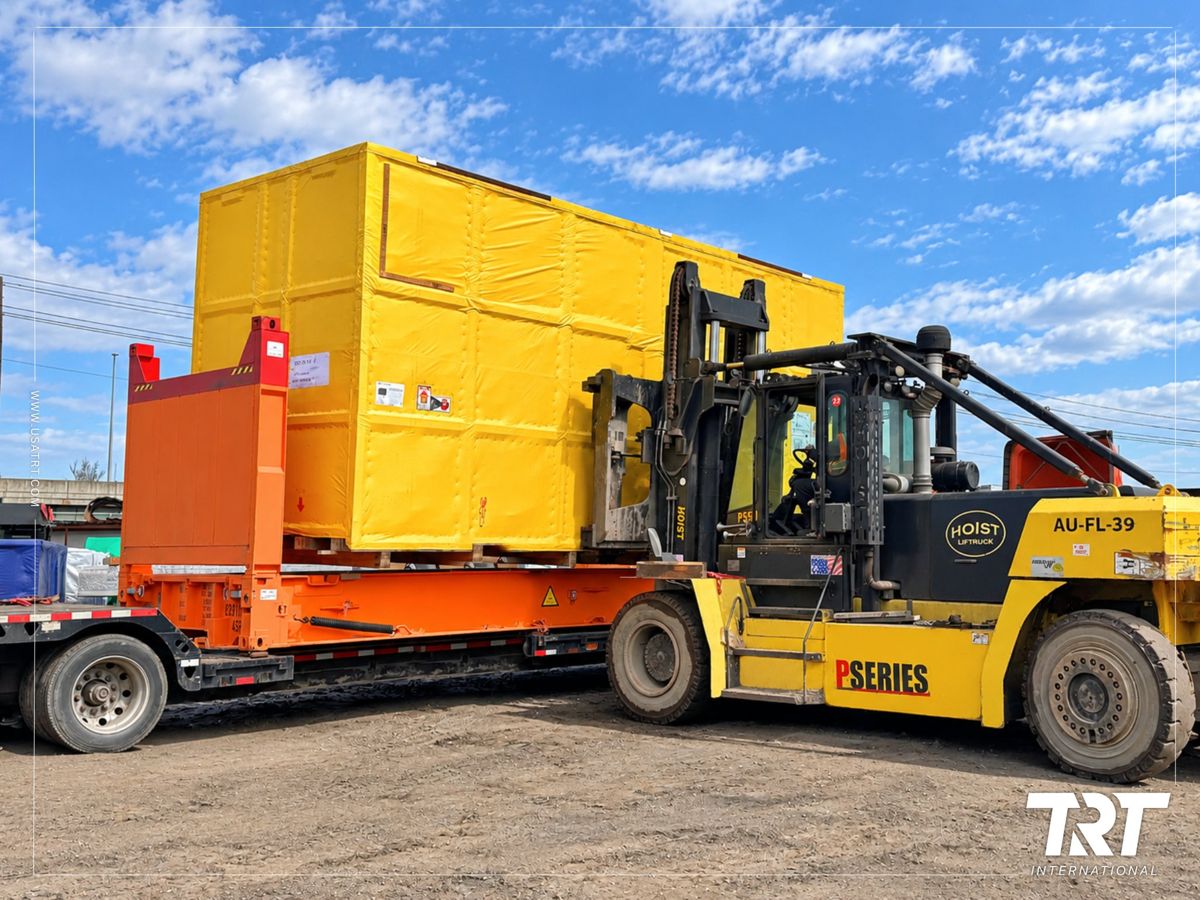
Transloading oversized cargo is the transfer of heavy or out-of-gauge freight from the equipment it arrived on — usually a shipping container — to different equipment built for its onward move, such as a flat rack, a flatbed, a step deck, or another trailer. It is needed when the cargo and the container no longer belong together: the piece is too tall, too wide, too heavy, or too awkward to travel onward in a closed box, or its final leg is a road move that a container cannot make. Done well, transloading is a planned change of equipment inside the port, with the lift, the securing, and the outbound truck booked as one job. Done badly, it is a heavy piece sitting on the ground while people argue about who was supposed to bring a crane. At TRT International, our transloading services handle this work every week in Port Newark-Elizabeth and in the Port of Savannah. This guide explains when oversized cargo needs a transload, how the transfer actually runs, and what to check before you book one.
What Makes a Transload ‘Oversized’?
A standard transload is mostly a forklift job: pallets or crates come out of a container, are counted and sorted, and go into a domestic trailer. An oversized transload is a lifting job. The pieces are individual, not uniform. One crate may weigh more than a whole trailer of cartons. A machine may have a high centre of gravity, lifting points in specific places, and parts that cannot bear weight. The outbound equipment is not a closed trailer but open equipment — a flat rack for an ocean leg, or a flatbed, step deck, or RGN trailer for a road leg — which means the cargo has to be secured for open travel, not simply placed inside walls. That difference changes everything about the job: the equipment needed to lift it, the space needed to stage it, the people needed to plan the lift, and the time it takes. If your freight needs a crane or a heavy forklift, blocking and lashing rather than straps over pallets, and a permit check for the road leg, you are not booking a standard transload. Price and plan it as oversized work from the start.
Five Signs Your Cargo Needs an Oversized Transload
1. It arrived in a container but cannot leave in one. This is the classic case: cargo was stuffed into a container overseas because that was the cheapest ocean leg, but its destination is a job site, a plant, or a yard that needs it delivered on open equipment, piece by piece, in a set order. The container was transport packaging, not the delivery plan.
2. It is out of gauge for the next leg. A piece that fits a standard container for one leg may be booked onward on a vessel or a route where it must travel as out-of-gauge cargo on a flat rack. The transload is where it changes from in-gauge freight to a lashed flat-rack load — the work our flat rack lashing team does after the lift.
3. The container is the problem, not the cargo. A damaged container, a container that must be returned urgently, or a box held for inspection can all force a transfer even when the freight itself is fine. Moving the cargo to other equipment frees the container and lets the freight continue on schedule.
4. Weight has to be redistributed. A container that is legal for the ocean leg can be overweight for the road, or loaded in a way that puts too much weight in the wrong place. Transloading lets the load be split across trailers, rebuilt on equipment rated for it, or re-worked until it is legal — the same ground covered by our overweight and distressed loads work.
5. Several containers become one delivery — or one becomes several. Project cargo often arrives in multiple containers and must be delivered as coordinated pieces, or arrives as one container whose contents go to different destinations on different trailers. The transload floor is where containers stop being the unit and individual pieces become the unit.
How an Oversized Transload Runs, Step by Step
Step 1: Plan the lift before the container moves. Send the piece list first: dimensions, weight, centre of gravity if you know it, lifting points, photos, and how each piece is packed. That information decides the lifting equipment, the outbound trailer, and whether permits are likely for the road leg. A transload booked on a container number alone is a guess; a transload booked on a piece list is a plan.
Step 2: Bring the container into the port facility. TRT drays the container with its own fleet — 85-plus Freightliner day-cab trucks with company drivers and 300-plus company chassis, including tri-axles for heavy containers — into our warehousing inside Port Newark-Elizabeth or inside the Port of Savannah. Because the transfer happens in port, the container is not hauled across a region just to be unloaded, and the empty can be returned promptly once the freight is out.
Step 3: Unload piece by piece, and inspect as you go. Heavy pieces come out one at a time, with the right equipment for each lift. Every piece is checked against the packing list as it lands, and its condition is noted while the container is still open. If a piece has shifted, a crate is broken, or packaging has failed, that is a re-work, and it is far cheaper to do it now, on the floor, than to discover it on a trailer at a job site. Our earlier guide to container transloading and re-works covers planned transfers and unplanned re-works in detail.
Step 4: Stage, prepare, and protect the pieces. Pieces are staged in order for the outbound move — not simply wherever they landed. Work that has to happen before onward travel happens here: rebuilding a crate, wrapping a piece for open travel, or holding pieces in our warehouse services or outdoor storage until the full set, the vessel, or the permit is ready. In Newark our warehousing totals 150,000 square feet — a 120,000-square-foot warehouse plus a 30,000-square-foot site whose feature is its loading docks. In Savannah our warehouse is brand new, at 316,800 square feet on a 30-acre site. TRT has many warehouses; Newark and Savannah are the main ones.
Step 5: Build the outbound load and secure it for open travel. Each piece is lifted onto the flat rack or trailer, positioned for weight and balance, then blocked, braced, and lashed. On open equipment there are no container walls to forgive a loose load, so securing is the step that protects the cargo, the driver, and everyone sharing the road. The finished load is inspected before it moves, not after a problem is reported.
Step 6: Dispatch, return the empty, and report the milestones. The outbound equipment leaves on its booked leg — a vessel sailing, or an over-the-road move throughout the United States, Canada, and Mexico — the empty container is returned, and the shipper gets a clear record of what moved, on what equipment, and when. That record matters: it closes the container’s clock, proves the transfer happened as planned, and gives the receiving site a load it can actually plan around.
Transload, Cross-Dock, or Hold in Storage?
Oversized cargo has three honest options in port, and choosing the wrong one is a common source of cost. Choose a transload when the cargo must change equipment — container to flat rack, container to flatbed, or one configuration to a legal one. Choose a cross-dock loading when the cargo stays on the same type of equipment and should pass straight from inbound to outbound without storage: the point there is speed, not a change of equipment. Choose storage — indoor warehousing for pieces that need cover and floor work, outdoor storage for large pieces that need a secure yard — when the cargo is ready but something else is not: the vessel, the permit, the rest of the set, or the receiving site. Many real jobs combine them: transload the pieces out of the containers, hold the set briefly, then dispatch together. The mistake is booking a simple cross-dock price for a job that is really a lift, a re-work, and a lashing job. Name the work honestly at booking and the quote, the equipment, and the schedule will all match the job.
What Drives the Cost of an Oversized Transload?
No responsible operator can price this work from a container count alone, and we do not publish a flat rate for it, because the drivers vary so much. The main ones are: the number and weight of the pieces and the lifting equipment they require; the outbound equipment — a flat rack, flatbed, step deck, or specialised trailer costs differently; the preparation work, from simple blocking and lashing to a crate rebuild or a full re-work; any storage days while a set, vessel, or permit comes together; and the onward leg itself, including permits and escorts where the road move requires them. A quote that looks low usually leaves one of those out — most often the lifting equipment or the securing — and the missing item reappears as a delay or a surcharge with your cargo already out of its container. Ask for the quote to name the lift, the outbound equipment, the securing, and the storage terms separately. If a line is missing, ask about it before the container is opened, not after.
Where TRT Does This Work
TRT International is headquartered at 250 Port St, Newark, NJ 07114, inside Port Newark-Elizabeth — see our Port Newark, NJ operations — and our Savannah public address is 117 A Parkway Dr, Rincon, GA 31326, with warehousing inside the Port of Savannah — see our Savannah, GA operations. Both sites run the same pattern: our own drayage fleet brings the container in, our warehouse and yard teams do the transfer and the preparation work, and the same operation dispatches the onward move. Our warehouses run electric forklifts and lower-emission equipment for handling work. One operator across those steps means one plan and one phone call when something changes — and with oversized cargo, something usually changes.
Shipper Checklist: Before You Book an Oversized Transload
- Piece list for every item: dimensions, weight, and packing, plus photos if you have them.
- Lifting information: lifting points, centre of gravity, and any part that cannot bear weight or must stay upright.
- How the cargo arrives: container type and number, vessel or arrival details, and the last free day if you know it.
- How the cargo must leave: flat rack for an ocean leg, or flatbed, step deck, or other trailer for the road — and the destination.
- Timing: the sailing, permit, or site-delivery date the transload has to hit, and what happens if it slips.
- Preparation needs: any crating, wrapping, re-work, or lashing you already know the cargo needs.
- One contact who can approve a change — a different trailer, an extra day of storage, a re-work — the same day.
Talk to TRT About Transloading Oversized Cargo
If you have heavy or oversized freight arriving in a container at Port Newark-Elizabeth or the Port of Savannah that needs to leave on different equipment, send us the piece list and the onward plan and we will tell you plainly how the transfer would run and what it needs. Call us at +1 973 344 7100 ext 221, or email sales@usatrt.com. TRT International – Delivering Excellence since 1994.
Frequently Asked Questions
What is transloading oversized cargo?
Transloading oversized cargo is the transfer of heavy or out-of-gauge freight from the equipment it arrived on, usually a shipping container, to different equipment built for its onward move, such as a flat rack, a flatbed, a step deck, or another trailer. It includes the lift, staging, any preparation or re-work, and securing the cargo for open travel.
Why would cargo arrive in a container but need to leave on other equipment?
Because the container often suits only the ocean leg. The destination may need the cargo delivered piece by piece on open equipment, the next leg may require the cargo to travel out of gauge on a flat rack, the container may be damaged or due back, or the load may need to be split or redistributed to be legal for the road.
What is the difference between an oversized transload and a standard transload?
A standard transload is mostly a forklift job with uniform pallets or crates moving into a closed trailer. An oversized transload is a lifting job with individual heavy pieces, specific lifting points, open outbound equipment, and blocking, bracing, and lashing instead of container walls to keep the load secure.
What equipment is used to transload oversized cargo?
Heavy forklifts and, where a piece requires it, crane lifting, together with the outbound equipment the cargo is being built onto — flat racks, flatbeds, step decks, and other trailers. TRT also runs its own drayage fleet of 85-plus Freightliner day-cab trucks and 300-plus company chassis, including tri-axles, to bring containers in and dispatch the onward move.
Can a transload include re-work if the cargo arrives damaged or shifted?
Yes. Pieces are inspected as they come out of the container, and if a piece has shifted, a crate is broken, or packaging has failed, the re-work is done on the floor before the outbound load is built. Fixing the problem at the transfer is far cheaper than discovering it on a trailer at the receiving site.
How long does an oversized transload take?
It depends on the number and weight of the pieces, the lifting equipment they need, the preparation and securing work, and whether the outbound equipment, vessel, or permit is ready. A transload booked with a full piece list in advance can be planned as one job; a load that needs a re-work or has to wait for a set or a permit will take longer, and storage covers the wait.
What does an oversized transload cost?
The cost is driven by the pieces and the lifting equipment they require, the outbound equipment, the preparation and securing work, any storage days, and the onward leg including permits where they are needed. Ask for the lift, the outbound equipment, the securing, and the storage terms to be named separately in the quote, so nothing essential has been left out.
What information does TRT need to quote a transload for oversized cargo?
The piece list with dimensions, weights, and packing, lifting points or centre of gravity if you know them, how the cargo arrives and in which container, how it must leave and to which destination, the date the move has to hit, and one contact who can approve changes the same day. Call +1 973 344 7100 ext 221 and we will confirm the plan before the container is opened.