
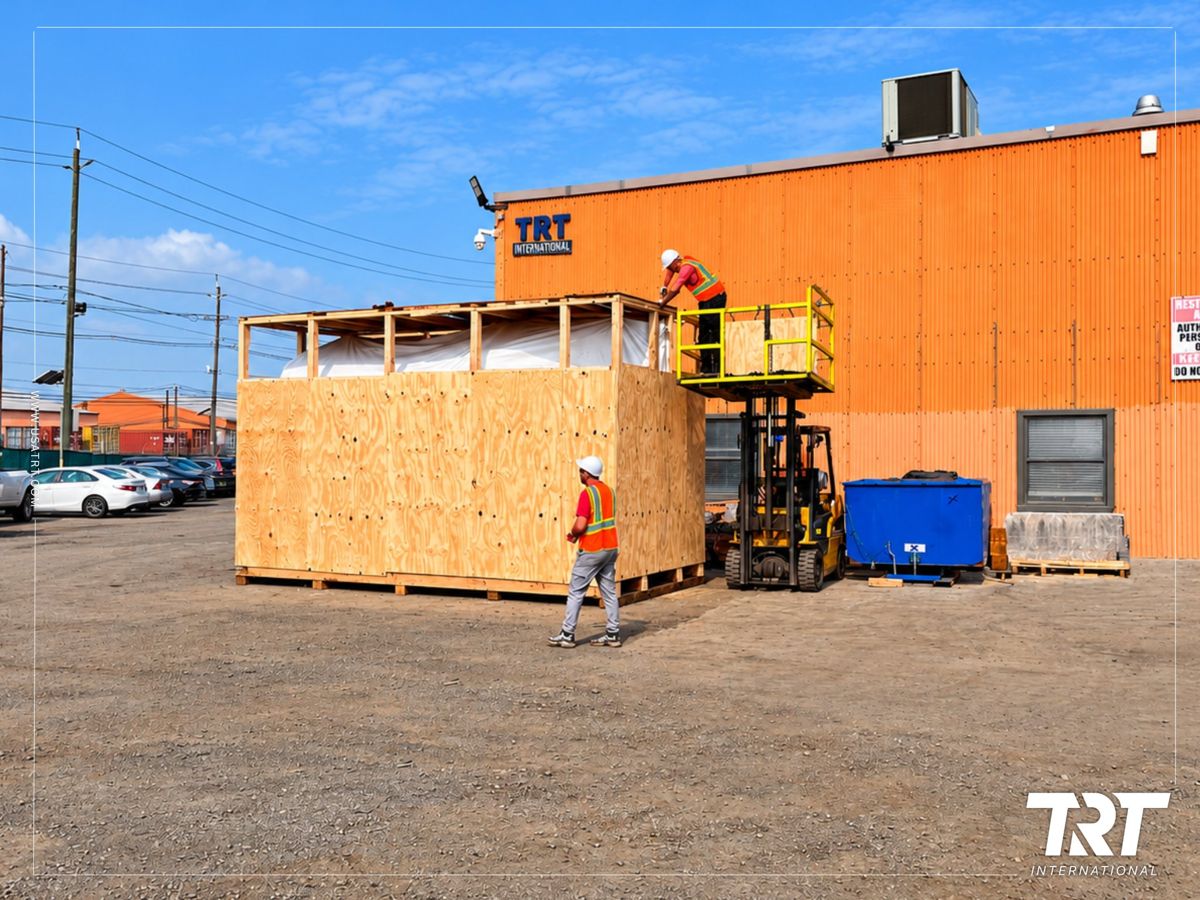
Export crating mistakes are the most common preventable cause of damage to cargo shipped overseas. Export crating is the building of a custom wooden crate around a piece of cargo so it can survive forklift handling, stacking, weeks of vibration and rolling at sea, and unloading in a foreign port. When the crate is built wrong, the cargo inside pays for it — bent frames, cracked housings, rust, and claims that take months to settle. In our warehouses in Port Newark-Elizabeth and in the Port of Savannah, we see the same seven mistakes again and again, usually on cargo that was crated somewhere else and arrives to us already at risk. This guide names each mistake, explains why it damages cargo, and shows how to prevent it before the crate is closed.
Mistake 1: Building the Crate Too Weak for the Weight Inside
A crate is a structure, not a box. The most basic export crating mistake is using thin panels, light framing, and too few fasteners for a heavy machine. The crate may look solid standing still in a warehouse, but ocean transport is not standing still. The container rolls, pitches, and vibrates for weeks. Forklifts lift the crate from below, other cargo may be stacked against it, and every weak joint works loose a little more each day.
The fix starts with honest numbers. The crate design has to begin with the verified weight and dimensions of the cargo, not an estimate from a sales sheet. Framing, panel thickness, base skids, and fasteners are then matched to that weight and to how the crate will be lifted and stacked. At TRT International, crating starts only after the cargo has been received, measured, and weighed at our facility, so the structure is designed for the load it will actually carry.
Mistake 2: Letting the Cargo Move Inside the Crate
A strong crate with loose cargo inside is still a failed crate. If a machine can shift even a few inches, every roll of the vessel turns it into a hammer against the crate walls. Blocking and bracing are what stop that movement: timber blocks fitted against the base and sides, bracing that ties the cargo to the crate structure, and securing at the points the manufacturer designed for lifting and tying down.
Common failures here include bracing against fragile covers or pipes instead of the frame, leaving gaps that let cargo build momentum, and using straps alone where solid blocking was needed. The test before closing is simple: the cargo and the crate should move as one unit. If the piece can rock, slide, or lift inside the crate, it is not ready for the ocean leg. Our related service, flat rack lashing, applies the same principle outside a crate: cargo that cannot move cannot damage itself.
Mistake 3: Skipping Moisture Protection
Water damages more export cargo than impact does. A crate crossing the ocean passes through heat, cold, and humid air, and temperature changes make moisture condense inside the crate even when no rain ever touches it. Bare metal surfaces rust, electrical cabinets corrode, and wood and packaging absorb damp air for weeks.
The prevention is layered. First, the cargo itself is wrapped — heat shrink wrapping or a barrier wrap keeps humid air and salt air off the surface. Second, desiccant inside the crate absorbs moisture that does get in. Third, the crate design avoids trapping water: a sealed box with no protection inside is worse than a crate built with the wrap and desiccant planned from the start. Skipping this step to save a small amount of money is the classic false economy in export packing, and it is covered in depth in our earlier guide to export crating for overseas cargo.
Mistake 4: Using Wood That Fails ISPM 15 Rules
Many destination countries require wood packaging to comply with ISPM 15, the international standard for treating wood to prevent the spread of pests. Crates built from untreated or unmarked wood can be delayed, treated at the destination, re-exported, or destroyed, depending on the country and the inspection. The cargo inside may be perfect while the crate itself becomes the problem.
Prevention means building with compliant, properly marked wood from the start and keeping the marks visible on the finished crate so an inspector can verify them without opening anything. This is not a detail to check after the crate is built. If your cargo is headed overseas, ask the crating provider directly what wood they use and how compliance is marked, before the first board is cut.
Mistake 5: Forgetting How the Crate Will Be Lifted
A crate is lifted many times: onto a truck, into a warehouse, into a container or onto a flat rack, and off again at destination. A frequent export crating mistake is building a strong box on a weak base, with no clear forklift access and no marked lifting points. Handlers then improvise — forks against panels, slings around framing that was never meant to carry the load — and the crate or the cargo is damaged by the lift, not the voyage.
The base deserves the most attention in the whole design. Skids and forklift openings must match the weight and the equipment that will handle the crate, including the electric forklifts we run in our own warehouses. Centre of gravity and lifting points should be marked on the outside so every handler along the route makes the same safe lift. A crate that is easy to handle correctly is a crate that arrives intact.
Mistake 6: Ignoring Weight Distribution and Stacking
Top-heavy cargo crated without thought to its centre of gravity can tip during handling or lean against the crate wall for the entire voyage. Cargo loaded high in a crate with a narrow base is a tipping risk every time it is moved. The same applies to stacking: a crate top that cannot bear weight will be stacked on anyway somewhere along the route unless the structure and the markings say it can.
Prevention is planning the crate around the balance point of the cargo, widening or reinforcing the base where the load demands it, and marking the crate clearly — this side up, centre of gravity, and do not stack where that applies. These markings cost almost nothing and prevent some of the most expensive damage we see.
Mistake 7: Closing the Crate Without Inspection, Photos, or Records
The last mistake happens after the building stops. Once a crate is closed, nobody can prove what condition the cargo was in, how it was blocked, or whether moisture protection was installed. If damage is found at destination, the shipper has no evidence, and every party in the chain can blame another.
Our routine is to inspect before closing, photograph the cargo, the blocking and bracing, and the moisture protection in place, and keep those records with the shipment file. That documentation also protects the consignee, who can open the crate at destination and compare what they find with what was shipped. If you use an outside crating service, ask before the job starts what photo and inspection records you will receive. No records is a warning sign.
How We Prevent All Seven: Crating at the Port
Most of these mistakes happen because crating is treated as an afterthought, done quickly wherever the cargo happens to be, far from the port and far from the people who will load it. We do it differently. Cargo is received at our warehouse services facilities inside the port — 150,000 sq ft of warehousing in Port Newark-Elizabeth and a brand new 316,800 SF warehouse on 30 acres in the Port of Savannah — measured and weighed, then crated in place by the same operation that will handle the onward move.
Because TRT also runs local bonded drayage and over-the-road transport with our own fleet of 85+ Freightliner day-cab trucks and 300+ company chassis including tri-axles, the crate is designed with the full journey in mind: the truck that collects it, the lift that loads it, and the container or flat rack it will travel in. One operator accountable for the cargo, the crate, and the move removes the handoff gaps where most damage and most disputes begin. Read more about our facilities in Port Newark, NJ and Savannah, GA, and about the crating and wrapping work itself on our wrapping and craning service page.
Shipper Checklist: Before Your Crate Is Closed
- Verified weight and dimensions supplied to the crating provider — not estimates.
- Crate structure matched to the weight, the lift method, and any stacking.
- Cargo blocked and braced so it cannot move inside the crate.
- Moisture protection installed: wrap on the cargo and desiccant in the crate.
- Wood compliant with ISPM 15 where the destination requires it, marks visible.
- Base, skids, and forklift access designed for the full weight.
- Centre of gravity, lifting points, and handling marks on the outside.
- Photos and an inspection record taken before the crate was closed.
Talk to TRT Before Your Next Export Shipment
If you are shipping machinery or oversized cargo overseas, get the crating reviewed before the crate is closed — afterwards is too late. Contact TRT International at +1 973 344 7100 ext 221, or visit us at our headquarters, 250 Port St, Newark, NJ 07114, or in Savannah at 117 A Parkway Dr, Rincon, GA 31326. TRT International – Delivering Excellence since 1994.
Frequently Asked Questions
What is the most common export crating mistake?
The most common mistake is letting the cargo move inside the crate. Weak blocking and bracing let the piece shift with every roll of the vessel, so the cargo damages itself and the crate from the inside during the ocean leg.
Why does cargo rust inside a closed crate?
Temperature changes during an ocean voyage make moisture condense inside the crate. Without a wrap on the cargo and desiccant inside the crate, that humid air sits on bare metal for weeks and causes rust and corrosion.
What is ISPM 15 and why does it matter for crates?
ISPM 15 is the international standard for treating wood packaging to stop pests spreading between countries. Crates built from untreated or unmarked wood can be delayed, treated, re-exported, or destroyed at the destination port.
How strong does an export crate base need to be?
The base must carry the full weight of the cargo through every forklift lift and truck move on the route. Skids and forklift openings are designed for the verified weight, and lifting points and centre of gravity are marked outside.
Should a crate be photographed before it is closed?
Yes. Photos of the cargo, the blocking and bracing, and the moisture protection taken before closing are the only proof of the condition and packing quality if damage is found at destination.
Is it better to crate cargo at the port?
Crating at the port means the cargo is measured, weighed, and crated by the same operator who handles the onward move. That removes handoffs, avoids an extra truck move for a finished crate, and lets the crate be designed for the actual loading plan.
Does TRT crate cargo that arrives already packed?
Yes. Cargo that arrives at our Newark or Savannah warehouses in weak or damaged packing can be inspected, re-worked, and re-crated before the ocean leg. It is far cheaper to fix packing at the port than to file a damage claim overseas.