
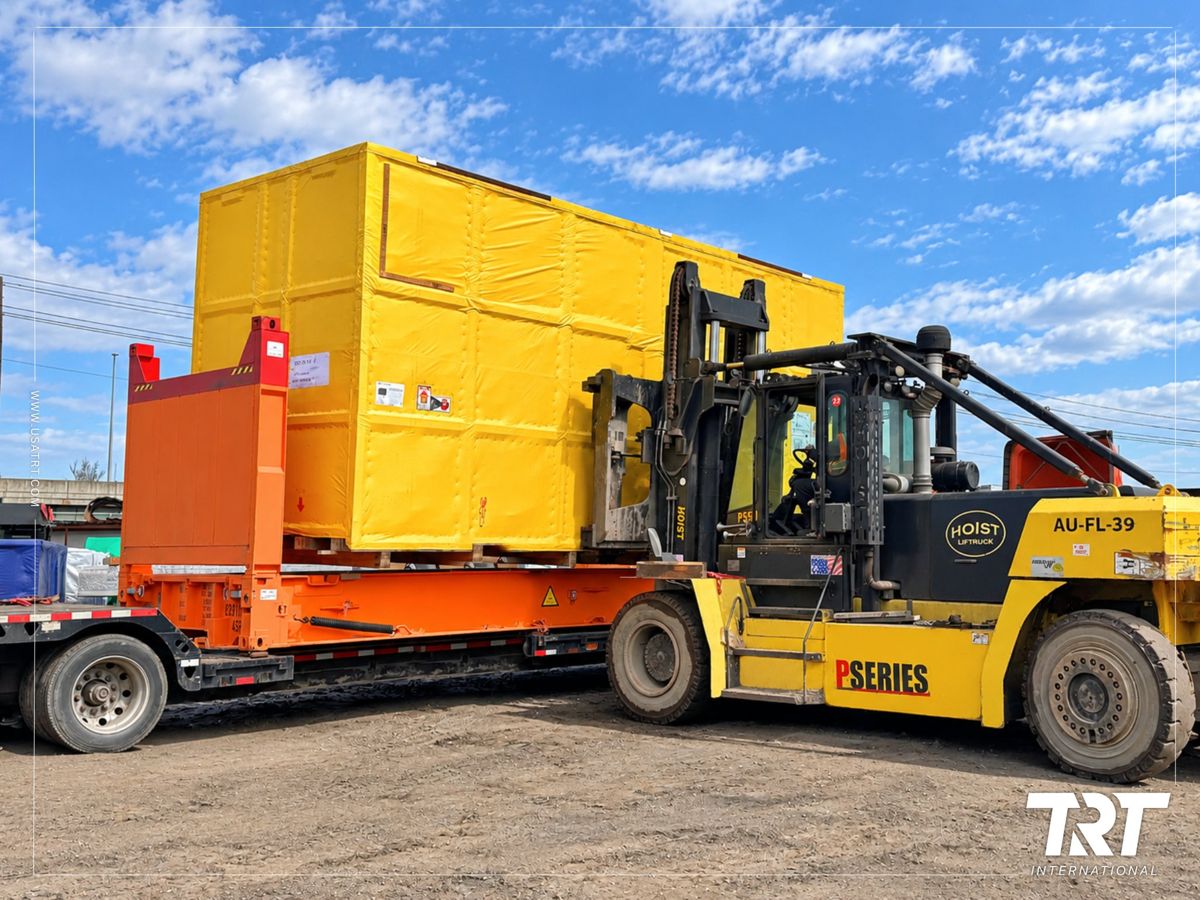
Cross-docking oversized cargo is the planned transfer of heavy or out-of-gauge freight from an inbound container or trailer directly to an outbound truck, flatbed, step deck, RGN or flat rack — with inspection, sorting and re-securing in between, but without putting the cargo into storage. For oversized cargo, cross-docking is not a forklift shortcut. It is a lifting job, a timing job and a securement job that have to happen in the same window, inside the port, before demurrage, detention or a missed outbound booking turns a fast transfer into an expensive delay.
At TRT International, we cross-dock oversized cargo in Port Newark-Elizabeth and in the Port of Savannah, using our own warehouses, our own Freightliner day-cab fleet of 85+ trucks and our own 300+ company chassis, including tri-axles. That matters because the inbound leg, the building, the lift equipment and the outbound leg are controlled by one operator. When one team owns every handoff, heavy freight does not wait for a second carrier to find the yard, a warehouse to find dock space, or a dispatcher to find a chassis.
When Oversized Cargo Needs Cross-Docking, Not Storage
Standard cross-docking was built for palletized freight that a forklift can move in minutes. Oversized cargo changes the calculation. A crate that is too tall for a standard container, a machine that must travel on a flat rack, or a heavy piece that needs a step deck or RGN cannot simply be rolled across a dock. It needs a lift plan, the right trailer positioned at the right dock, and a securement plan before the inbound box is even opened.
Shippers choose cross-docking for oversized cargo in a few common situations. The inbound container needs to be emptied and returned before detention charges build, but the outbound equipment is a different type — a flatbed, flat rack or open top. The cargo is changing mode, for example from container to over-the-road truck for delivery across the United States, Canada or Mexico. The final receiver is ready now, so warehousing would only add a second handling and extra days. Or several inbound pieces belong to one outbound load and need to be checked, sorted and built into a single secured shipment without a storage stay in between.
Cross-docking is the wrong choice when the outbound leg is not confirmed, when permits for an overweight or oversized move are not yet in place, or when the cargo needs work first — re-crating, heat shrink wrapping, lashing or a re-work of shifted or damaged packing. In those cases we say so up front. A short stay in warehousing or outdoor storage, with the work done in place, is cheaper and safer than forcing a same-day transfer that is not ready.
How a Cross-Dock for Heavy Freight Actually Works
Step one is planning both legs before anything arrives. We need exact dimensions and weight for every piece, photos of the cargo as packed, the inbound container or trailer details, and the outbound equipment type. For oversized pieces we plan the lift: forklift capacity, crane or reach stacker if needed, lifting points, spreader or sling needs, and where each piece will sit on the outbound trailer. Electric forklifts and lower-emission equipment handle most warehouse lifts; heavier pieces get heavier equipment matched in advance, not improvised on the dock.
Step two is the inbound move. Because our warehouses are in Port Newark-Elizabeth and in the Port of Savannah — not outside the port — the drayage leg is short and controlled by our own local drayage team. Our Newark warehouses total 150,000 square feet, and our Savannah warehouse is brand new at 316,800 square feet on 30 acres. TRT has many warehouses, with Newark and Savannah as the main ones. That in-port position is what makes a tight cross-dock window realistic: the container arrives, is positioned at the dock, and the empty can be released promptly once unloading is complete.
Step three is unload, check and sort. Each piece comes off piece by piece, is checked against the packing list, inspected for visible damage or shifted packing, and staged in the order it will be loaded outbound. This is the moment problems are cheapest to fix. A crushed corner, a broken pallet or a piece that is heavier than declared changes the lift and securement plan — finding that out on the dock, with equipment and crew present, is far better than finding it out after the outbound truck is loaded.
Step four is the reload and securement. The outbound trailer is positioned, pieces are lifted and placed to distribute weight correctly, and the load is blocked, braced and lashed for the road or for the port. Oversized pieces that will travel open get protected as needed. Nothing leaves on a visual guess: weight distribution, centre of gravity and lashing points are checked before the load is released.
Step five is dispatch and release. The outbound move leaves on its confirmed booking or delivery appointment, the empty inbound container is returned inside its free time, and every milestone is recorded so the shipper can follow the cargo through the transfer, not just before and after it. Our headquarters is at 250 Port St, Newark, NJ 07114, and our Savannah address is 117 A Parkway Dr, Rincon, GA 31326. For cross-dock planning, call +1 973 344 7100 ext 221.
Cross-Dock vs Transload vs Warehousing for Oversized Freight
These three services sound alike, and choosing the wrong one costs money. A cross-dock is a transfer without a storage stay: inbound and outbound are both planned and close together in time. A transload is also a transfer between equipment types, but it often involves more handling, re-working or building a different kind of load, and it may include a short staging period. Warehousing is storage with handling: cargo is received, put away, held, worked on if needed, and released later.
For oversized cargo the deciding question is readiness. If the cargo, the paperwork, the outbound equipment and the permits are all ready, cross-dock it and keep it moving. If the cargo needs work, or the outbound leg is days or weeks away, warehouse it or use outdoor storage and do the job properly. Forcing freight through a cross-dock before it is ready does not save the storage cost — it usually creates a re-handling cost, a missed appointment, or a load that has to come back.
The Mistakes That Break an Oversized Cross-Dock
The first mistake is booking the transfer on declared weights and dimensions that were never verified. Oversized work runs on exact numbers; a piece that is four inches taller or a ton heavier than declared can change the equipment, the lift and the route. The second mistake is scheduling the outbound truck before the inbound container has actually been discharged and is available. Port timing moves, and a truck waiting on a box that is not ready burns hours and money. The third mistake is treating securement as an afterthought. A heavy piece that was lashed for a container floor needs a new securement plan for a flatbed or flat rack — the old plan does not transfer with the cargo.
The fourth mistake is ignoring the empty container clock. A fast unload that leaves the empty sitting still creates detention. We plan the empty return as part of the same job, using our own chassis pool, so the box goes back inside free time. The fifth mistake is no photo and condition record at the transfer point. When cargo changes equipment, the cross-dock is the best evidence of its condition between legs. We document pieces as they come off and as they are loaded out, so there is no argument later about when damage happened.
What It Costs and What Drives the Time
We do not quote cross-docking from a generic rate sheet, because oversized transfers are not generic. Cost and time are driven by the number and weight of pieces, the lift equipment required, whether the outbound load needs flat rack lashing, crating or wrapping, how tight the inbound and outbound windows are, and whether permits are needed for the onward move. A straightforward container-to-flatbed transfer of a few crated pieces, with both legs confirmed, is a same-day job in most cases. A multi-piece project transfer that has to be sorted and built into one outbound shipment takes longer to plan, even if the physical transfer is fast. The honest way to get an accurate price is to send exact dimensions, weights and photos before the cargo arrives — that is what lets us fix the equipment, crew and window in advance.
Shipper Checklist Before You Book
Send the packing list with exact dimensions and weight for every piece, not just the total. Send photos of the cargo as packed, showing lifting points if you have them. Confirm the inbound container or trailer number and its arrival and free-time dates. Confirm the outbound equipment type and the delivery or vessel appointment. Tell us about any damage, shifted load or re-work you already suspect. Flag any piece that needs crating, wrapping or special lashing before it travels on. If you can send those six things, we can tell you plainly whether cross-docking is right for the load, or whether a transload or a short warehouse stay will serve you better.
TRT International – Delivering Excellence since 1994. If you have heavy or oversized freight that needs to change equipment and keep moving, talk to the team that controls the trucks, the chassis, the warehouses and the dock — all in the same ports your cargo moves through.
Frequently Asked Questions
What is cross-docking for oversized cargo?
Cross-docking for oversized cargo is the planned transfer of heavy or out-of-gauge freight from an inbound container or trailer directly to an outbound truck, flatbed or flat rack, with inspection and re-securing in between and no storage stay.
How long does an oversized cross-dock take?
A straightforward transfer with both legs confirmed is usually completed the same day. Multi-piece transfers that need sorting and building into one outbound load take longer to plan, and the timing depends on piece count, weight and lift equipment.
Do I need permits to cross-dock overweight cargo?
The cross-dock itself happens inside the port facility, but the onward road move of an overweight or oversized load may need permits. We check the outbound route and equipment before dispatch so the load does not leave before it is legal to move.
Can you cross-dock cargo that needs re-crating or wrapping?
If cargo needs substantial re-crating, wrapping or re-work, a short warehouse stay is usually safer than a same-day transfer. Minor protection and securement work can be done during the transfer; we will tell you which case your cargo falls into before you book.
What information do you need to plan a cross-dock?
We need exact dimensions and weight for every piece, photos of the cargo as packed, inbound container details and free-time dates, the outbound equipment type, and the delivery or vessel appointment.
How is cross-docking different from transloading?
Cross-docking is a transfer without a storage stay, with inbound and outbound legs close together. Transloading also changes equipment type but often involves more handling, re-working or building a different load, sometimes with a short staging period.
What happens to the empty container after a cross-dock?
The empty container is returned inside its free time as part of the same job. We use our own trucks and 300+ company chassis, including tri-axles, to move and return equipment without waiting on an outside carrier.
Which ports do you cross-dock in?
We cross-dock in Port Newark-Elizabeth and in the Port of Savannah, where our warehouses are located inside the port. Our Newark warehouses total 150,000 square feet and our Savannah warehouse is 316,800 square feet on 30 acres.