
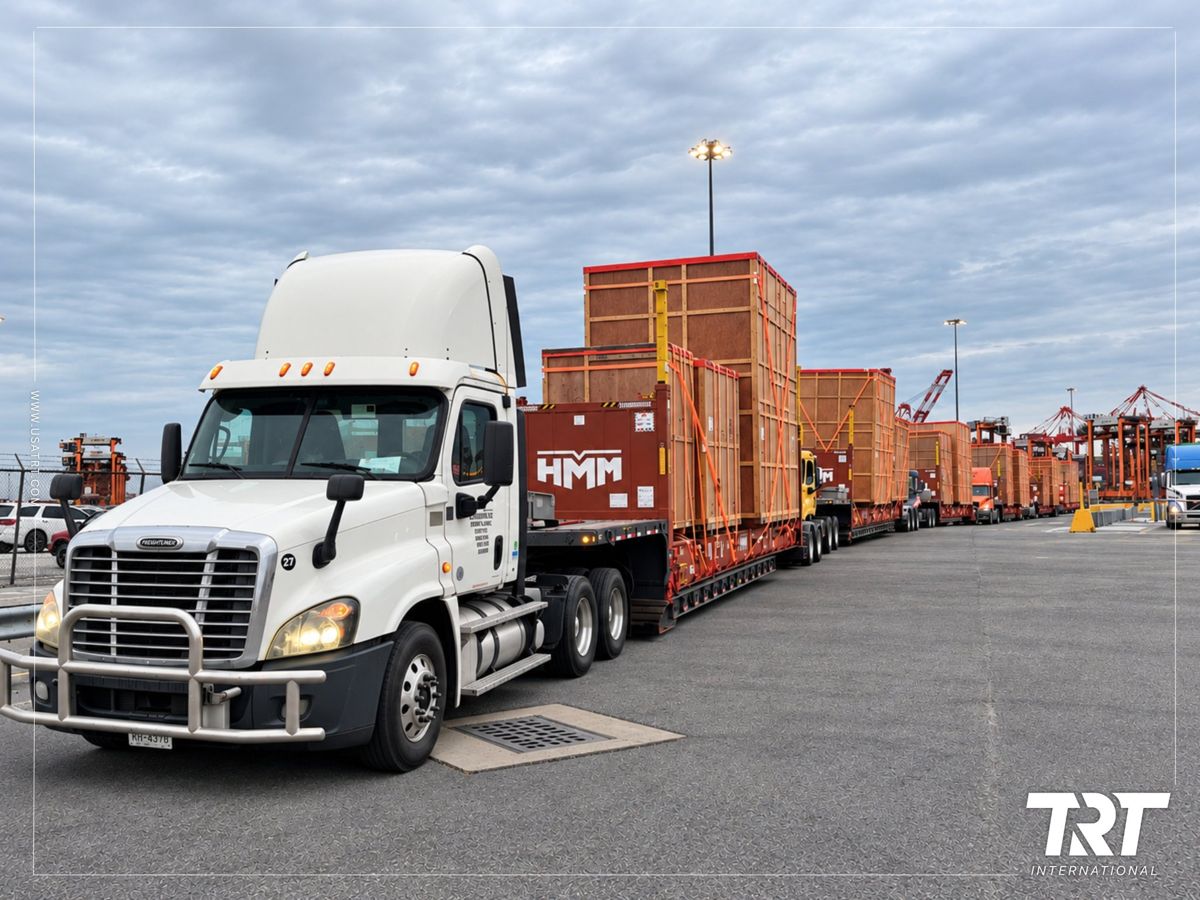
Out of gauge cargo is freight that exceeds the internal dimensions of a standard shipping container in length, width, or height, so it cannot travel inside a closed box and must move on a flat rack, an open top container, or as breakbulk. That single fact is why out of gauge cargo costs are quoted piece by piece instead of off a rate sheet: once cargo leaves the gauge, the equipment, the securing, the permits, and the handling all have to be planned around its actual measurements. At TRT International, out of gauge cargo is a core service we run inside Port Newark-Elizabeth and inside the Port of Savannah. This guide explains what actually drives the price of an OOG move, why two pieces that look similar can price very differently, and what to send us so the quote you get is the price you pay.
Why Out of Gauge Cargo Has No Standard Rate
Standard container freight prices cleanly because the box is always the same size. Out of gauge freight breaks that assumption in three directions at once. A piece can be over-length, over-width, over-height, or a combination of all three, and each excess changes the equipment that can carry it and the space it takes up on a vessel and on the road. A flat rack carrying cargo that overhangs on both sides can take the space of more than one container slot. A tall piece that needs an open top travels differently from a wide piece that needs a flat rack. Weight matters separately again: a heavy piece may be within gauge on size and still need a tri-axle chassis, a heavier trailer, or a permit for the road leg. Our oversize transportation team starts every quote from the measured piece, not from a category, because the category alone does not price the job. If you want the process itself first, our earlier guide on how OOG freight moves covers the flat rack, open top, and breakbulk options step by step.
Cost Driver 1: Dimensions — How Far Out of Gauge, and in Which Direction
Dimensions are the first and largest cost driver. Length, width, and height, measured at the cargo itself including any skid, crate, or protrusion, decide the equipment and how much vessel and trailer space the piece occupies. A small excess over height may still travel in an open top container with the top open. A large excess in width usually means a flat rack, and the wider the overhang, the more the carrier charges for the lost slots beside it. Height also drives the road leg: a tall load can need a different trailer, a surveyed route, and clearance checks under bridges and wires. This is why brochure dimensions are dangerous. A machine listed at one height that arrives with a lifting eye, a control cabinet, or a crate adding several inches can change equipment, change the sailing, and change the price. Measure the piece as it will actually travel, crated or uncrated, and send photographs with a tape or a person in frame if you can. Accurate dimensions at quote stage are the cheapest cost control in the whole move.
Cost Driver 2: Weight and Weight Distribution
Weight drives a different set of costs from size. The total weight decides the trailer and chassis: our fleet runs 300-plus company chassis including tri-axles for heavy container and flat rack moves, with flatbeds, step decks, RGNs, and perimeter trailers matched to the load. Weight distribution matters as much as the total. A piece that is heavy at one end, or whose centre of gravity sits high or off-centre, needs a specific loading position, extra securing, and sometimes a crane lift planned around that balance point instead of a simple forklift move. Electric forklifts and reach stackers handle many pieces in our yards, but a heavy, unbalanced piece is a rigging job, and rigging is priced on the lift plan, the equipment, and the crew it needs. Send the gross weight and, if you have it, the centre of gravity and the lifting points. Guessing at weight is how a load becomes an overweight problem at the port, and fixing that after arrival always costs more than planning for it before.
Cost Driver 3: Equipment Choice — Flat Rack, Open Top, or Breakbulk
The equipment the cargo requires is the third driver, and it follows directly from the first two. An open top container suits tall cargo that is otherwise within footprint, loaded from above by crane — see how that decision is made in our open top loading service. A flat rack suits wide, tall, or irregular cargo that needs to be lashed down on an open platform, and the lashing itself is skilled work priced into the move: our flat rack lashing team builds a securing plan for each piece and inspects it before the vessel sails or the truck rolls. Breakbulk, where the piece travels without any container equipment at all, suits the largest cargo and is priced around vessel space, lift capacity, and port handling. Choosing the cheapest equipment the cargo almost fits is a false saving. A piece booked on the wrong equipment that has to be re-booked, re-lashed, or re-loaded at the terminal costs more than the right equipment booked once, and it can miss the sailing it was planned around.
Cost Driver 4: Permits, Escorts, and the Route
Most out of gauge cargo also moves over the road at one or both ends, and the road leg has its own price structure. Oversize and overweight loads need state permits, and the permit cost and lead time vary with the size, the weight, and the states crossed. Larger loads can require escort vehicles, restricted travel hours, and a surveyed route that avoids low bridges, tight turns, and weight-limited roads. Our oversize permits and escorts work and our route survey and feasibility checks exist for exactly this reason: the route is proven before the truck is loaded, not discovered with the cargo on the trailer. Our own fleet of 85-plus Freightliner day-cab trucks runs local bonded drayage inside the port and over-the-road work throughout the United States, Canada, and Mexico, so a short port drayage leg prices very differently from a multi-state oversize move with escorts. Tell us the full route at quote stage, pickup to final delivery, not just the port leg, or the road costs will arrive later as a surprise.
Cost Driver 5: Port Handling, Storage, and Timing
Where the cargo is handled, and how long it waits, also move the price. Handling an OOG piece takes more than handling a box: crane or reach stacker time, yard space for a piece that cannot be stacked, and labour to lash, brace, or re-secure it. Holding the cargo in the port while it waits for a sailing, a permit, or onward transport is warehousing or outdoor storage, and it is priced by the space the piece actually occupies and the time it stays. In Newark our warehousing totals 150,000 square feet inside Port Newark-Elizabeth: a 120,000-square-foot warehouse plus a 30,000-square-foot site whose feature is its loading docks, with headquarters at 250 Port St, Newark, NJ 07114 — see our Port Newark, NJ operations. In Savannah our brand-new 316,800-square-foot warehouse stands on a 30-acre site inside the Port of Savannah, with our Savannah public address at 117 A Parkway Dr, Rincon, GA 31326 — see our Savannah, GA operations. TRT has many warehouses; Newark and Savannah are the main ones. Timing matters too: cargo that arrives ready, documented, and matched to a confirmed sailing moves straight through, while cargo that arrives early, late, or with paperwork problems collects storage, demurrage, and re-handling. The cheapest OOG move is usually the one planned earliest.
What a Low OOG Quote Usually Leaves Out
When one quote for the same piece comes in far below the others, it is worth asking what it excludes. Common gaps are the lashing and securing, the permits and escorts for the road leg, the crane or rigging for the lift, storage while waiting for the vessel, and the re-work if the cargo arrives different from its description. Each of those is a real cost that someone pays; if it is not in the quote, it tends to appear after the cargo is already committed, when changing carrier is no longer practical. A complete OOG quote names the equipment, the securing, the handling at both ends, the permits and route for the road legs, and any storage assumed, so the comparison between quotes is like for like. We quote that way because we do the handling ourselves in the port: the drayage, the warehousing, the lashing, and the loading are our own teams, so the price we give covers the work we will actually do.
How to Get an Accurate Out of Gauge Quote
An accurate quote needs five things, and none of them takes long to gather. First, the measured length, width, and height of the piece as it will travel, including crate or skid. Second, the gross weight, plus lifting points and centre of gravity if known. Third, photographs of the piece from several sides, which let us see protrusions, fragile points, and securing options that numbers alone miss. Fourth, the full route: origin, port, destination, and who handles each leg. Fifth, the timing: when the cargo is ready, which sailing or delivery date you are aiming at, and whether storage may be needed. With those five, we can choose the equipment, plan the securing and the route, and price the whole move once. Without them, any carrier is estimating, and OOG estimates have a habit of growing after the cargo arrives.
Shipper’s Checklist: Send Us This for a Firm Price
- Measured length, width, and height as the piece will travel, including crate, skid, and any protrusion
- Gross weight, and lifting points and centre of gravity if you know them
- Photographs of the piece from several sides, ideally with a tape measure or a person for scale
- What the cargo is, what is fragile or weather-sensitive, and whether it needs crating, wrapping, or protection
- Full route: pickup, port of loading or discharge, and final delivery point
- Ready date, target sailing or delivery date, and whether storage before or after the move may be needed
Talk to TRT About Out of Gauge Cargo
If you have a piece that will not fit a standard container, send us the measurements, weight, and photographs from the checklist above and we will price the complete move — equipment, securing, handling, permits, and route — before anything is booked. Call us at +1 973 344 7100 ext 221, or email drayage@usatrt.com. Our headquarters is at 250 Port St, Newark, NJ 07114, and our Savannah address is 117 A Parkway Dr, Rincon, GA 31326. TRT International – Delivering Excellence since 1994.
Frequently Asked Questions
What is out of gauge cargo?
Out of gauge cargo is freight that exceeds the internal dimensions of a standard shipping container in length, width, or height. It cannot travel inside a closed container, so it moves on a flat rack, in an open top container, or as breakbulk, with securing and handling planned around its actual measurements.
How much does it cost to ship out of gauge cargo?
There is no standard rate, because the price is built from the piece itself: its dimensions and how far out of gauge it is, its weight and distribution, the equipment it needs, the permits and route for the road leg, and the port handling and any storage. Send measured dimensions, weight, and photographs and TRT will price the complete move before anything is booked.
Why do dimensions change the price so much?
Dimensions decide the equipment and the space the cargo occupies. A wide piece on a flat rack can take more than one container slot on the vessel, a tall piece may need an open top and a crane lift, and a tall road load can need a surveyed route and permits. A few inches added by a crate or a protrusion can change all three.
What is the difference between a flat rack and an open top for OOG cargo?
An open top container suits cargo that is tall but otherwise within the container footprint; it is loaded from above by crane and covered with a tarpaulin. A flat rack is an open platform with end walls, suited to wide, tall, or irregular cargo that is lashed down on the platform. TRT chooses based on the measured piece and explains the choice before booking.
Do out of gauge loads need permits?
Oversize or overweight road loads generally need state permits, and larger loads can also require escort vehicles, restricted travel hours, and a surveyed route. Permit cost and lead time vary with size, weight, and the states crossed. TRT handles oversize permits, escorts, and route surveys as part of planning the move.
What information do I need for an accurate OOG quote?
Measured length, width, and height as the piece will travel, gross weight, photographs from several sides, the full route from pickup to final delivery, and your ready date and target sailing or delivery date. Lifting points and centre of gravity help if you have them. With those, the quote can cover equipment, securing, handling, permits, and storage once.
Can TRT store out of gauge cargo before it ships?
Yes. OOG cargo waiting for a sailing, a permit, or onward transport can be held in our warehousing or in secure outdoor storage for oversized pieces. In Newark our warehousing totals 150,000 square feet inside Port Newark-Elizabeth. In Savannah our brand-new 316,800-square-foot warehouse stands on a 30-acre site inside the Port of Savannah.
Where does TRT handle out of gauge cargo?
Inside Port Newark-Elizabeth and inside the Port of Savannah, where our own teams handle drayage, warehousing, lashing, and loading. Headquarters is at 250 Port St, Newark, NJ 07114, and the Savannah public address is 117 A Parkway Dr, Rincon, GA 31326. Call +1 973 344 7100 ext 221 for a quote.