
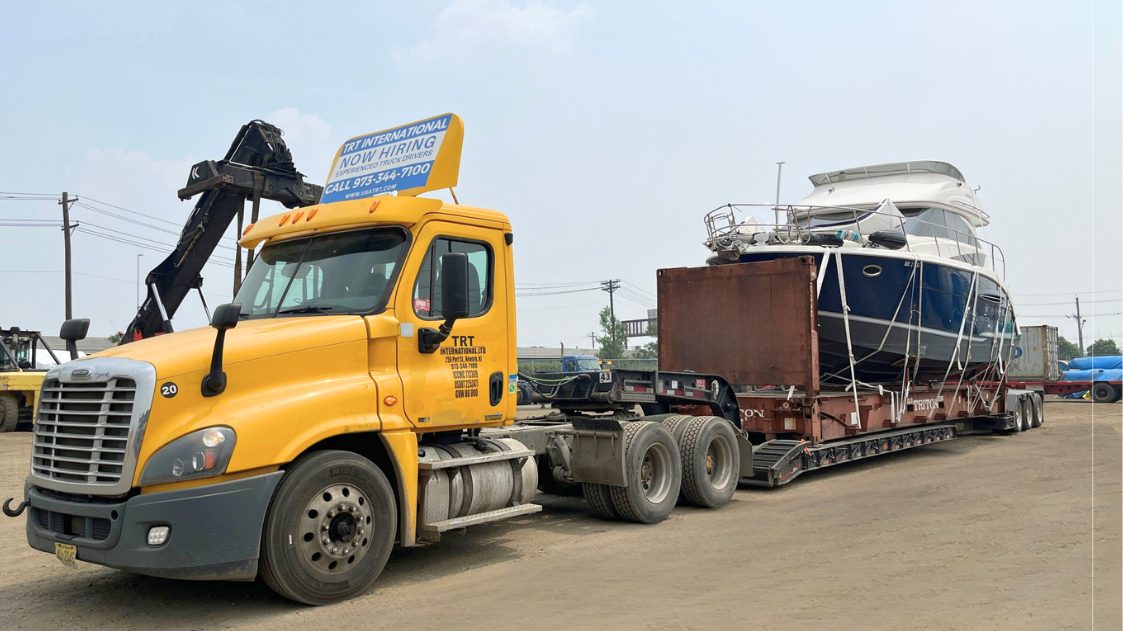
Boat and yacht transport is the movement of a marine vessel — by road, by container, and by vessel — between a marina, a yard, a buyer, or a storage facility and its destination, with the preparation, securing, documentation, and customs clearance an international move requires. A boat is not ordinary freight. It is wide, tall, heavy at the keel, fragile at the hull, and shaped in a way no standard container was designed to hold. Shipping one well means choosing the right method for its size, preparing it properly before it is lifted, securing it so it cannot move at sea, and coordinating every handoff from pickup to delivery. At TRT International, boat and yacht transport is one of our named solutions, run from our logistics operations inside Port Newark-Elizabeth and inside the Port of Savannah. This guide explains how a boat actually moves, which shipping method fits which vessel, how we prepare and secure it step by step, and what to send us so your boat arrives ready to launch — not as a repair job.
What Boat and Yacht Transport Covers
Most boat moves are one of three jobs. A domestic move takes a boat from one state to another — a purchase, a relocation, a seasonal move to storage — by road on a specialized trailer. An international move takes it overseas, usually by container, flat rack, or roll-on/roll-off (RoRo) vessel, with ocean freight and customs in the middle. And a dealer or broker move handles several boats at once, or the same boat repeatedly, on a standing arrangement. What the three jobs share is that the vessel itself is the cargo, and the cargo cannot be repacked. A crate can be rebuilt; a hull cannot. That is why our boat and yacht transport service plans each vessel individually — powerboats, motorboats, recreational boats, yachts, and other eligible marine vessels — around its dimensions, weight, route, and destination, rather than fitting it into a standard lane. The method follows the boat, not the other way around.
Step 1: Measure the Boat — the Numbers That Decide Everything
Every boat shipment starts with four measurements, and they decide the method, the equipment, and the price. Length overall, including the bow pulpit, swim platform, and any outboard or sterndrive that extends past the transom. Beam — the widest point, including fenders, rails, and anything bolted on. Height from the keel to the highest fixed point — the top of the flybridge, radar arch, or mast, with antennas and domes counted if they cannot be removed. And weight, including fuel, water, and gear left aboard, because a boat weighed dry and a boat weighed loaded are different loads. Add the pickup and delivery points, whether the boat is on a trailer or in the water, and the destination country’s import rules. A boat that fits a container on paper but not with its cradle is not a container boat. Measure twice, at the boat, not from a brochure — brochure dimensions are the most common reason a booking has to be changed.
Step 2: Choose the Shipping Method — Container, Flat Rack, or RoRo
For vessels that fit within a standard shipping container, enclosed container shipping gives the most protection from weather, exposure, and external contact during the ocean leg. The boat is loaded into the container on its cradle, braced so it cannot shift, and the container is sealed — the vessel travels inside a steel box rather than on open deck. For boats that exceed standard container dimensions, the flat rack is the workhorse: the vessel sits on a flat rack platform, professionally lashed and reinforced, and rides on deck. Our flat rack lashing team secures out-of-gauge cargo every day, and a boat on a flat rack gets the same treatment — a securing plan built around the hull, the cradle, and the lifting points, inspected before the vessel sails. RoRo shipping, where the vessel is rolled aboard on its own trailer or a carrier trailer, may offer an efficient solution for eligible trailer-mounted or rollable vessels, depending on vessel specifications, carrier requirements, and route availability. Oversized vessels that fit none of these neatly get specialized handling and transportation planning of their own. There is no single best method — there is the method that fits your boat’s measurements, your destination, and the sailing schedule. Our specialists evaluate the vessel and recommend one, and we explain why, before anything is booked.
Step 3: Prepare the Vessel — Cradles, Protection, and What Comes Off
Preparation is where most boat damage is prevented, and it happens before the boat is lifted. The hull needs a cradle or supports that match its shape — a cradle built for the boat, not a generic stand — because a hull supported in the wrong places flexes under its own weight on the road and at sea. Loose gear is removed or secured: canvas, cushions, electronics, and anything that can flap, fall, or blow away. Antennas, radar domes, and outriggers are lowered or removed where the height demands it, and the openings they leave are sealed. Fuel and water are reduced to the levels the carrier and the destination require, batteries are secured, and the engine is winterized or protected for the season and the route. Our Wrapping & Craning team builds custom crates where a part needs structural support and applies protective heat shrink wrapping where a vessel needs a weather barrier for open transport or the ocean leg — a wrapped boat travels with its hull, deck, and fittings sealed against salt spray and road grime. Preparation done at our facility, by the same team that loads the boat, means the protection is designed around the actual equipment it will ride on, not guessed at a marina weeks earlier.
Step 4: Loading — Cranes, Trailers, and the Lift That Matters Most
Loading a boat is the riskiest single moment in the move, and it is planned like one. A boat lifted by the wrong points, or by straps placed over a weak section of hull, can be damaged in seconds. The lift plan names the slings, the spreader, the crane capacity, and the crew positions before the boat leaves the water or the trailer. For a container load, the boat is eased into the container on its cradle and braced; for a flat rack, it is set down, centered, and lashed; for a road move, it is settled onto the trailer and secured for the highway. Our teams handle out-of-gauge cargo daily, and the discipline is the same: assess the cargo, match the equipment, lift once, and check the securing before the load moves. A boat that is loaded right does not need to be re-handled at the port — and every re-handling is another chance for damage.
Step 5: Port Handling, Storage, and the Ocean Leg
Once the boat is loaded, it moves through the port under our own coordination. Our drayage hauls containers and flat racks to the terminal inside the port for their vessel, and our ocean freight team manages the shipping leg. If the vessel is not ready, or the sailing is days away, the boat can be held in our warehousing or in secure outdoor storage — indoor space for crated and sensitive pieces, outdoor storage for the oversized loads that cannot go indoors. In Newark our warehousing totals 150,000 square feet inside Port Newark-Elizabeth: a 120,000-square-foot warehouse plus a 30,000-square-foot site whose feature is its loading docks, with headquarters at 250 Port St, Newark, NJ 07114. In Savannah our brand-new 316,800-square-foot warehouse stands on a 30-acre site, with our Savannah public address at 117 A Parkway Dr, Rincon, GA 31326. TRT has many warehouses; Newark and Savannah are the main ones. Holding the boat in the port keeps the sailing, the storage, and the onward move under one roof, with one team answering for the vessel at every stage. Our warehousing service and our bonded drayage — see our bonded drayage guide — are set up around exactly that kind of handoff.
Step 6: Customs, Documentation, and Delivery
An international boat move is a customs move as well as a transport move. Ownership papers, the bill of sale where one applies, the vessel’s registration, and the destination country’s import requirements all have to be in order before the boat sails — a missing document at the destination port can hold a vessel longer than the ocean crossing took. We coordinate the documentation alongside the physical move, so the paperwork and the boat describe the same vessel, the same dimensions, and the same consignee. At the destination, delivery is coordinated the same way the pickup was: the boat is unloaded, the securing and wrapping are removed, and it is handed over ready for launch or for its onward road leg. Tracking follows the vessel through every handoff — booking, pickup, arrival, storage position, loading, dispatch, and delivery — so the owner knows where the boat is at each step, not just when it left.
What Boat and Yacht Transport Costs — and What Drives It
Boat transport is priced per vessel, not off a flat rate, because no two boats are alike. The honest variables are the boat’s dimensions and weight, the shipping method those dimensions require, the distance and the route, the preparation it needs — cradle, wrapping, crating, removal of fittings — the port handling and any storage before sailing, and the customs and documentation work at the destination. Set against that price is what a badly planned boat move usually costs: a hull damaged by a wrong lift or a bad cradle, a sailing missed because the boat did not fit the booked equipment, a vessel held at the destination over paperwork, and the re-work when a boat arrives needing repairs before it can be used. A boat is a high-value cargo with no spare. Planning the method, the preparation, and the documentation before the boat moves is what keeps the price a quote instead of a surprise.
Shipper’s Checklist: What to Send Us
- The boat’s make, model, and year, with length overall, beam, height from keel to highest fixed point, and weight — measured at the boat, including everything that stays aboard
- Whether the boat is on a trailer, on stands, or in the water, and whether a cradle already exists or one needs to be built
- Pickup location and destination, and whether the move is domestic, international, or both
- What can be removed or lowered — antennas, radar, outriggers, canvas — and what must stay fitted
- Ownership and registration papers, and any import requirements you already know about at the destination
- Your sailing, delivery, or launch date, and whether you also need storage, wrapping, or onward transport combined with the shipment
Talk to TRT About Boat & Yacht Transport
If you are buying a boat in another state, moving a yacht overseas, or relocating a vessel between marinas, send us the measurements from the checklist above and we will recommend the shipping method, build the preparation and loading plan, and come back with a clear, detailed quote. Call us at +1 973 344 7100 ext 221, or email drayage@usatrt.com. Our headquarters is at 250 Port St, Newark, NJ 07114, and our Savannah address is 117 A Parkway Dr, Rincon, GA 31326. TRT International – Delivering Excellence since 1994.
Frequently Asked Questions
How do you ship a boat overseas?
A boat is shipped overseas by container, by flat rack, or by RoRo vessel, depending on its size. Boats that fit a standard container travel enclosed for maximum protection. Boats that exceed container dimensions travel on a flat rack, professionally lashed and secured. Eligible trailer-mounted vessels may travel by RoRo, depending on vessel specifications, carrier requirements, and route availability. TRT evaluates the vessel’s dimensions and recommends the method that fits.
How is a boat secured for ocean transport?
The boat is supported on a cradle built for its hull, then lashed and braced so it cannot shift at sea. On a flat rack, our lashing team builds a securing plan around the hull, the cradle, and the lifting points, and inspects it before the vessel sails. Loose gear is removed or secured, and openings left by removed fittings are sealed. A boat loaded and secured once, correctly, does not need re-handling at the port.
Can a boat be shrink wrapped for transport?
Yes. Heat shrink wrapping gives a boat a weather barrier for open transport or the ocean leg, sealing the hull, deck, and fittings against salt spray and road grime. It is one of the preparation options our Wrapping & Craning team provides, alongside custom crating where a part needs structural support. Wrapping is designed around the actual equipment the boat will travel on.
What measurements do I need to ship a boat?
Length overall including anything that extends past the transom, beam at the widest point, height from the keel to the highest fixed point, and weight including fuel, water, and gear left aboard. Also say whether the boat is on a trailer, on stands, or in the water, and where it is going. Brochure dimensions are not enough — measure at the boat.
Where does TRT ship boats and yachts from?
From our logistics operations inside Port Newark-Elizabeth and inside the Port of Savannah. In Newark, our warehousing totals 150,000 square feet and our bonded Container Freight Station handles receiving and customs-supervised holding. In Savannah, our brand-new 316,800-square-foot warehouse stands on a 30-acre site. Boats can be held in warehousing or secure outdoor storage before their sailing.
What paperwork is needed to ship a boat internationally?
Ownership papers, the bill of sale where one applies, the vessel’s registration, and the destination country’s import requirements. The documentation is completed alongside the physical move, so the paperwork and the boat describe the same vessel, dimensions, and consignee. A missing document at the destination port can hold a vessel longer than the ocean crossing.
Can TRT store my boat before it ships?
Yes. A boat waiting for its sailing can be held in our warehousing or in secure outdoor storage for oversized loads that cannot go indoors, at our facilities in Port Newark-Elizabeth or the Port of Savannah. Holding the boat in the port keeps the sailing, the storage, and the onward move under one roof with one team answering for the vessel.
How do I get a quote for boat and yacht transport?
Send us the boat’s make, model, and year, its measured length, beam, height, and weight, whether it is on a trailer or in the water, and the pickup and destination points — or call +1 973 344 7100 ext 221. Headquarters is at 250 Port St, Newark, NJ 07114, and the Savannah public address is 117 A Parkway Dr, Rincon, GA 31326. We will provide a plan and a clear, detailed quote before any work is accepted.