
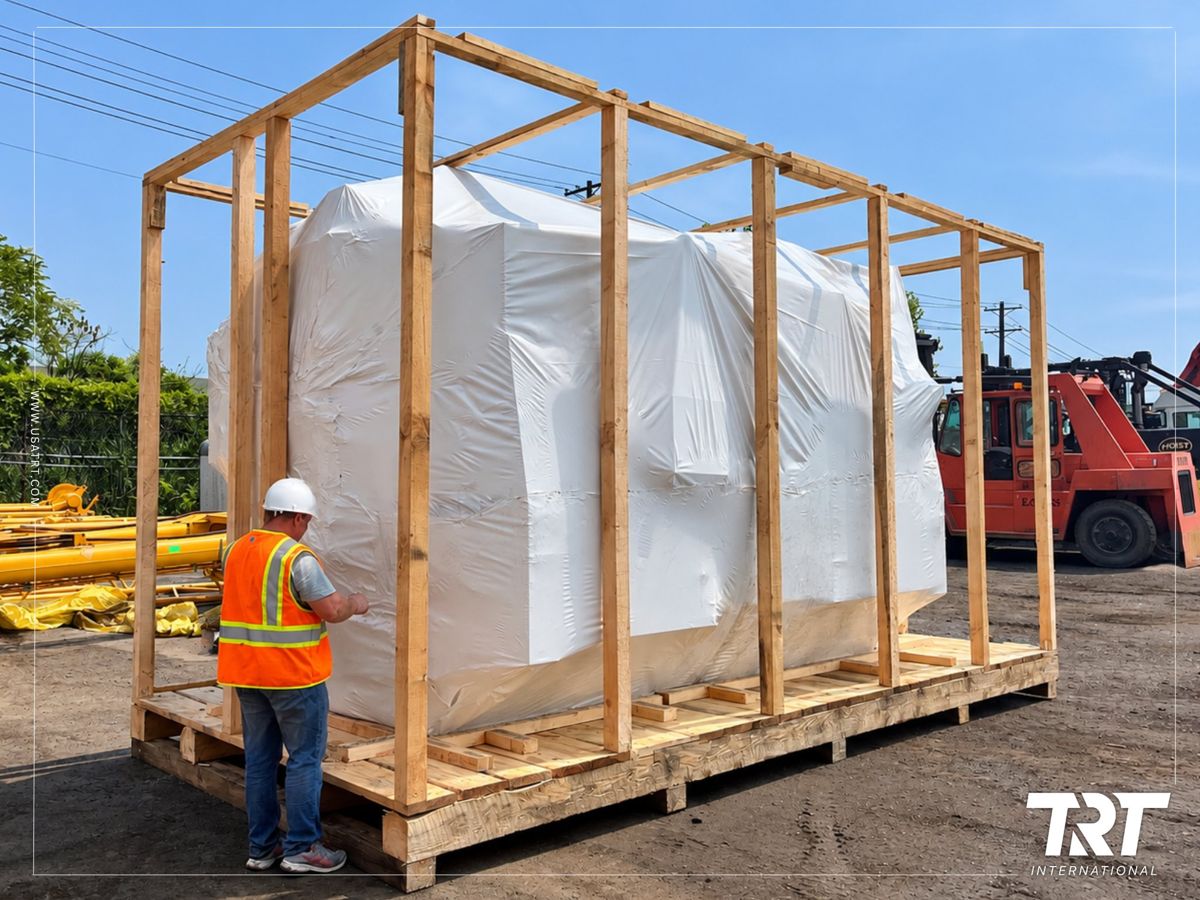
Export crating is the building of a custom wood crate around a piece of cargo so it can survive an international shipment — the lifts, the road legs, the terminal handling, and the weeks at sea — and arrive ready to use, not ready for a damage claim. It is not a pallet with a cardboard box on top. An export crate is engineered for one specific piece: its exact dimensions, its weight and where that weight sits, its fragile points, and the way it will be lifted and secured at every stage. TRT International builds custom crating inside Port Newark-Elizabeth and inside the Port of Savannah as part of our wrapping and crating service, and this guide explains how export crating works, how it differs from domestic packing, and what a shipper should send us before the first board is cut.
Why Export Cargo Needs a Different Kind of Packing
Domestic freight usually faces one truck, one or two lifts, and a few days in transit. Export freight faces a longer and rougher chain: a drayage move into the port, a lift into a container or onto a flat rack, a terminal stack, a vessel that rolls and pitches for weeks, discharge in a foreign port, and then another road leg — often with handlers who have never seen the cargo before and cannot read instructions the shipper assumed were obvious. Moisture is the quiet threat on top of the mechanical ones: temperature changes across an ocean voyage produce condensation inside containers, and unprotected steel, electronics, and finished surfaces can corrode or stain long before anyone opens the doors. Export crating answers all of that at once — structure against impact and stacking pressure, internal bracing against movement, and protection against moisture and dust for the full length of the voyage, not just the first leg.
Step 1: Measure, Weigh, and Assess the Cargo
Every export crate starts with the cargo itself, measured exactly — length, width, and height — and weighed, with its center of gravity identified where it can be. We need to know what is fragile, what is finished and cannot be scratched, where the piece can safely be lifted and supported, and whether parts should be removed, secured separately, or braced in place. A dense machine on a low base is crated differently from a tall, top-heavy fabrication, and a piece with protruding fittings is crated differently from a clean rectangular unit. This assessment also decides the question shippers often skip: does this cargo travel inside a closed container in its crate, or is it oversized and better carried as crated cargo on a flat rack or as breakbulk? That connects directly to our wider out-of-gauge cargo work — the crate, the platform, and the securing plan have to be designed together, not improvised separately at the terminal.
Step 2: Design the Crate Around the Piece
From the assessment, the crate is designed to fit the piece — not a standard box the cargo is forced into. The base is built to carry the weight and to give forklifts and cranes a safe way to lift the loaded crate. The framing and sheathing are sized for the stacking and impact loads the crate will meet, and the design leaves the right clearance around fragile or protruding parts. Inside, the cargo is blocked and braced so it cannot shift, slide, or tip within the crate: a crate that survives the voyage while the cargo rattles loose inside it has failed at its only job. Where the piece needs support under specific points, custom skids, saddles, or cradles are built to carry it exactly there. Good crate design is invisible when it works — the cargo comes out at destination in the same position and condition it went in.
Step 3: Protect Against Moisture and Movement for the Ocean Leg
Before the crate is closed, the cargo is protected for the environment it will travel through. Heat shrink wrapping can be applied to the piece itself as a durable, weather-resistant barrier against moisture, dust, and other environmental factors — the same protection our wrapping team uses for cargo that travels exposed or sits in storage before it sails. Inside the crate, bracing is checked, voids that would let the cargo move are filled or blocked, and anything that could rub, chafe, or vibrate loose over weeks at sea is secured or separated. This is the step that separates export crating from a domestic pack job: the crate is sealed for a voyage measured in weeks, through climate changes, with no opportunity to open it up and fix a problem halfway across an ocean.
Step 4: Wood Packaging Rules for International Shipments
Wood packaging that crosses a border is regulated, and shippers need to plan for it rather than discover it at destination. Many countries require solid wood packaging material to be treated and marked under the international ISPM 15 standard, so that pests cannot travel in the wood itself; unmarked or non-compliant wood packaging can be held, treated, or refused by customs at the destination port. The practical takeaway for a shipper is simple: tell your crating provider at the start that the shipment is an export, and to which country, so the crate is built with compliant materials and correct markings from the beginning. Rebuilding or re-treating a crate after it has been packed — or worse, after it has arrived overseas — is far more expensive and disruptive than building it correctly the first time. When you send us an export inquiry, the destination country belongs in the first message, on the checklist at the end of this guide.
Step 5: Marking, Documentation, and Loading
A finished export crate should tell every handler downstream what it is and how to handle it without opening it: what is inside, how much the loaded crate weighs, its outside dimensions, where its center of gravity sits, and where it can safely be lifted. Clear marking matters most at the ports and warehouses the shipper will never see, where the crate is one of hundreds and there is no time to guess. Once built and marked, the crate is loaded for its next leg — into a container, or secured to a flat rack using the same discipline covered in our guide to flat rack lashing, where the crate becomes the sound, regular surface that lashings can be run to. If the vessel timing requires it, the crated cargo can be held in our own warehousing first: in Newark our warehousing totals 150,000 square feet inside Port Newark-Elizabeth — a 120,000-square-foot warehouse plus a 30,000-square-foot site whose feature is its loading docks — with headquarters at 250 Port St, Newark, NJ 07114. In Savannah, the work runs through our brand-new 316,800-square-foot warehouse on 30 acres in the Port of Savannah, with our Savannah public address at 117 A Parkway Dr, Rincon, GA 31326. TRT has many warehouses; Newark and Savannah are the main ones, and our guide to port warehousing explains how that storage fits an export timeline.
Step 6: Onward Movement — One Team From Crate to Vessel
Crating is one stage of an export move, and it works best when the same team handles the stages around it. Our fleet runs Freightliner day-cab trucks — 85+ trucks, all driven by company drivers — with 300+ company chassis including tri-axles, and flatbeds, step decks, RGNs, and perimeter trailers for freight that travels on open equipment. Onward movement runs on our local bonded drayage and our over-the-road service throughout the US, Canada, and Mexico, with state-of-the-art tracking across the move, and with electric forklifts and lower-emission equipment used across our warehouses. When the company that built the crate also runs the drayage into the terminal, there is no handoff where a handler who did not build the crate guesses how it should be lifted — the documentation and the knowledge travel with the cargo.
What Commonly Gets Export Crated
The cargo we crate for export is typically valuable, heavy, fragile, or irregularly shaped — often several of those at once. Industrial machinery and manufacturing equipment, generators and industrial components, high-value electronics, steel fabrications and project cargo components, and marine equipment all share the same problem: they cannot be replaced off a shelf if they arrive damaged, and standard packaging was never designed for them. Irregular shapes are a crating specialty in themselves — protrusions, uneven weight, and pieces with no flat face to rest on are exactly what a custom-built crate, with its own skids and internal supports, is designed to solve. If you are unsure whether your cargo needs a full export crate, a shrink-wrapped pack, or a flat rack with a cradle, send us its dimensions, weight, and photos and we will tell you plainly which protection fits it.
Export Crating vs. Domestic Packing vs. Shrink Wrapping
These three get confused, and choosing the wrong one either wastes money or under-protects the cargo. Domestic packing — palletizing, banding, and stretch film — is built for short road moves and quick handling; it is not built for stacking in a terminal, weeks of vessel motion, or foreign customs requirements for wood packaging. Shrink wrapping gives a strong weather and moisture barrier and is the right answer for cargo that holds its own shape and travels on open equipment or into storage, and it is often combined with crating, applied to the piece before the crate is closed. Export crating is the structural answer: a rigid, braced, marked wood enclosure, built to the piece, that protects against impact, stacking, movement, and the full length of an international voyage. Many export shipments use two of the three together — wrapped, then crated — and part of the assessment is honestly matching the protection to the route, not selling the heaviest option for every load.
What Drives the Cost of Export Crating
There is no honest flat rate, because no two export crates are the same size, weight, or shape. Pricing is built from the cargo’s dimensions and weight, the crate design and materials it requires — including compliant treated wood for international shipments — any internal bracing, skids, saddles, or wrapping the piece needs, the handling and lifting involved in building and loading it, and the storage, drayage, or onward transport you book with it. Accurate details up front produce the most accurate quote. As with every TRT service, you receive a clear, detailed quote before work is accepted, with no hidden fees — and a quote built on real dimensions will hold, while a quote built on a guess usually has to be rebuilt when the cargo arrives.
Shipper’s Checklist: What to Send Us
- What the cargo is, with exact dimensions (length x width x height) and total weight
- The destination country and port, and your timing and vessel cutoff if you have one
- Where its center of gravity sits, if known, and any manufacturer lifting or support points
- Clear photos of the cargo, including any protrusions, fittings, or fragile and finished areas
- Anything that must not be pressed, stacked on, or exposed to moisture
- Where the cargo is now, and whether you also need wrapping, storage, drayage, flat rack loading, or onward transport with the crating
Talk to TRT About Export Crating
If you have machinery, equipment, or project cargo shipping overseas — or cargo you suspect needs more than a pallet to survive the trip — send us the checklist above and we will assess it and come back with a crating plan and a clear, detailed quote. Call us at +1 973 344 7100 ext 221. Our headquarters is at 250 Port St, Newark, NJ 07114, and our Savannah address is 117 A Parkway Dr, Rincon, GA 31326. TRT International – Delivering Excellence since 1994.
Frequently Asked Questions
What is export crating?
Export crating is the building of a custom wood crate around a piece of cargo so it can survive an international shipment — the lifts, road legs, terminal handling, and weeks at sea — and arrive ready to use. The crate is engineered for one specific piece: its exact dimensions, weight, center of gravity, fragile points, and how it will be lifted and secured at every stage.
How is export crating different from regular packing or palletizing?
Domestic packing such as palletizing and stretch film is built for short road moves and quick handling. Export crating is a rigid, braced, marked wood enclosure built to the piece, designed to protect against impact, stacking pressure, movement inside the crate, and moisture over a full ocean voyage, and built with wood packaging rules for international shipments in mind.
What is ISPM 15, and does my export crate need it?
ISPM 15 is the international standard many countries apply to solid wood packaging material, requiring it to be treated and marked so pests cannot travel in the wood. Unmarked or non-compliant wood packaging can be held, treated, or refused at the destination port. Tell TRT at the start that your shipment is an export and which country it is going to, so the crate is built with compliant materials and correct markings from the beginning.
What cargo typically needs export crating?
Cargo that is valuable, heavy, fragile, or irregularly shaped typically needs export crating, including industrial machinery, generators, high-value electronics, steel fabrications, project cargo components, and marine equipment. These are pieces that cannot be replaced off a shelf if they arrive damaged, and that standard packaging was never designed to protect.
Can TRT shrink wrap cargo as well as crate it?
Yes. Heat shrink wrapping can be applied to the cargo itself as a durable, weather-resistant barrier against moisture, dust, and other environmental factors, and it is often applied to the piece before the crate is closed. Wrapping is also the right protection on its own for cargo that holds its shape and travels on open equipment or into storage.
Where does TRT provide export crating?
TRT provides export crating inside Port Newark-Elizabeth, where its warehousing totals 150,000 square feet, and in the Port of Savannah, where its brand-new warehouse is 316,800 square feet on 30 acres. TRT has many warehouses, and Newark and Savannah are the main ones. Headquarters is at 250 Port St, Newark, NJ 07114, and the Savannah public address is 117 A Parkway Dr, Rincon, GA 31326.
How do I get a quote for export crating?
Send TRT what the cargo is, its exact dimensions and weight, photos if you have them, the destination country and port, where the cargo is now, and your timing. Call +1 973 344 7100 ext 221. You receive a clear, detailed quote before work is accepted, with no hidden fees, and accurate dimensions up front produce the most accurate quote.