
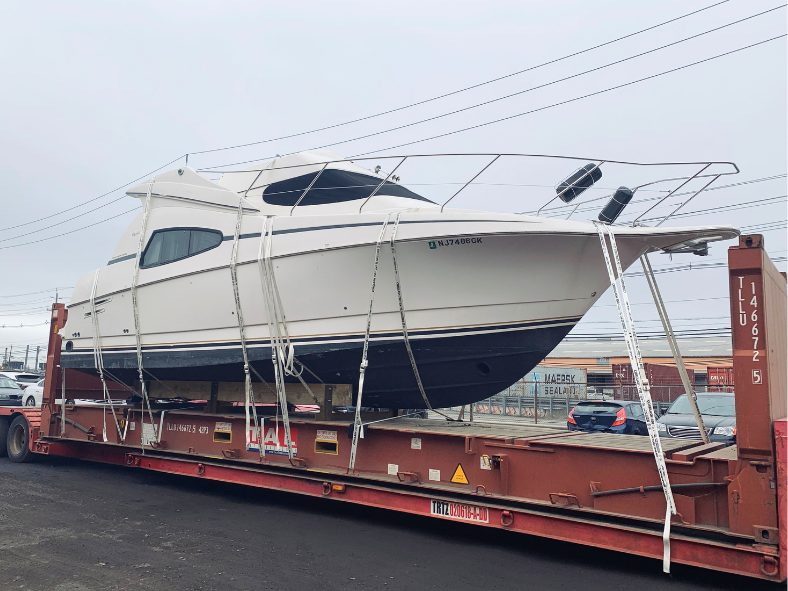
Flat rack lashing is the professional securing of out-of-gauge cargo to a flat rack container so the cargo and the platform travel as one unit through lifting, road transport, terminal handling, and the ocean voyage. A flat rack has a floor and end walls but no sides and no roof, which is exactly why it works for cargo that is too wide, too tall, or too heavy for a standard closed container — and exactly why the lashing matters. The cargo rides exposed. If it is not secured correctly, it can shift under a crane lift, under vessel motion, or on the road leg at either end. TRT International provides flat rack lashing inside Port Newark-Elizabeth and inside the Port of Savannah, and this guide explains how a lashing job is assessed, planned, built, and inspected before that flat rack is allowed to move.
What a Flat Rack Is, and Why Lashing Is Not Optional
Think of a flat rack as a heavy steel platform with collapsible or fixed end walls. There is no box to hold the cargo in place, no doors to close, and no ceiling to limit height. That open design lets a boat, a machine, a steel structure, or an industrial component sit on the platform even when it overhangs the sides or rises above where a roof would be. It also means every force the cargo will meet has to be answered by the securing itself: forward and backward movement during transport, sideways movement in a turn or in a seaway, lifting forces when the unit is craned, and vibration over a long move. Lashing is not a strap thrown over the top at the end. Done properly, it is an engineered securing plan built around that specific piece of cargo — its weight, its center of gravity, its shape, its own lifting and securing points, and what it can and cannot be pressed against without damage. Our flat rack lashing service starts there, not at the moment the cargo is already sitting on the platform.
Step 1: Cargo Assessment Before Anything Is Lifted
Every job starts with the cargo itself. We need exact dimensions — length, width, and height — total weight, and where that weight sits. A long, top-heavy piece is secured differently from a low, dense machine. A boat on a cradle is secured differently from a steel fabrication with hard edges and clear lashing eyes. We also need to know how the piece will be lifted and carried, whether it has manufacturer lifting points, whether any part is fragile or finished and cannot take direct contact, and whether it needs protection first. That assessment drives the securing plan, the equipment, and any reinforcement the load will need. Guessing at weight or center of gravity is how a load that looked secure on the floor shifts in its first lift, so shippers do the whole job a favor when they send accurate dimensions, weight, and clear photos with the first inquiry — the checklist at the end of this guide lists exactly what to send.
Step 2: The Securing Plan
From the assessment we build the lashing plan before the cargo is lifted: the securing points on the cargo and on the flat rack, the fastening methods to be used, the angles the lashings will run at, and any blocking, bracing, or reinforcement structures the load requires. Blocking and bracing work with lashing, not instead of it — timber or steel structures stop the cargo sliding on the platform, while the lashings hold it down and tie it to the flat rack so the whole unit lifts and travels together. The plan also accounts for protection. Where a finished surface needs a barrier, our wrapping and craning team can apply protective wrapping, and where a piece needs structural support, custom crating or a cradle can be built before fastening begins, so the lashing secures the cargo without damaging it. A plan made in advance is the difference between a controlled load and an improvised one, and improvised securing is what terminals and carriers reject.
Step 3: Positioning and Preparation on the Flat Rack
The cargo is then craned or loaded onto the flat rack and positioned precisely, with its weight distributed as the plan requires and overhangs, if any, placed deliberately rather than by accident. Positioning matters for more than balance: it affects how the unit will be lifted, how it will sit on a chassis or trailer for its road leg, and how it will be received at destination. Before fastening begins, the piece is prepared — protection in place, support structures built, and securing points confirmed accessible. Our handling equipment in the ports is matched to this work, and our warehouses pair the floor space to build a load properly with our own drayage operation, so the flat rack does not have to leave the port complex to be loaded correctly. In Newark, our warehousing totals 150,000 square feet inside Port Newark-Elizabeth — a 120,000-square-foot warehouse plus a 30,000-square-foot site whose feature is its loading docks — with headquarters at 250 Port St, Newark, NJ 07114. In Savannah, the work runs through our brand-new 316,800-square-foot warehouse on 30 acres in the Port of Savannah, with our Savannah public address at 117 A Parkway Dr, Rincon, GA 31326. TRT has many warehouses; Newark and Savannah are the main ones.
Step 4: Lashing and Reinforcement
With the cargo positioned, our lashing experts fasten it to the flat rack using professional securing methods, working the plan point by point. Lashings are run to the flat rack’s own securing points and to sound points on the cargo or its cradle, tensioned evenly, and protected where they pass over edges so they do not cut or chafe — and so they do not cut into the cargo. Reinforcement is added where the weight and movement of the cargo demand it. The goal is simple to state and exacting to achieve: a load that does not shift — under lifting, under vessel motion, or under road transport. That standard connects directly to our wider out-of-gauge cargo work, because most flat rack cargo is out-of-gauge by definition: it exceeds the width, height, or weight envelope of a standard container, and the flat rack and its lashing are what make that cargo shippable at all. Where cargo is tall but can travel under a removable roof rather than fully exposed, an open top loading plan may be the better fit, and part of the assessment is honestly telling a shipper which platform their cargo actually needs.
Step 5: Inspection and Onward Movement
Before the flat rack moves, the loaded and lashed unit is inspected — lashings, tension, blocking, protection, and the overall build checked against the plan. If something has settled or a point is not right, it is corrected on the floor, not discovered at the terminal gate or, worse, after loading. From there the unit travels as one piece: onto the vessel for its ocean leg, or onto a trailer for its road leg. Our fleet runs Freightliner day-cab trucks — 85+ trucks, all driven by company drivers — with 300+ company chassis including tri-axles, and flatbeds, step decks, RGNs, and perimeter trailers for freight that travels on open equipment. Onward movement runs on our local bonded drayage and our over-the-road service throughout the US, Canada, and Mexico, with state-of-the-art tracking across the move, and with electric forklifts and lower-emission equipment used across our warehouses. The securing plan is documented so every handler downstream knows how the load was built and how it should be lifted and released.
Cargo We Commonly Lash to Flat Racks
Flat racks carry the cargo standard containers cannot: boats and yachts on cradles, heavy machinery and industrial equipment, steel structures and fabrications, project cargo components, generators, and other oversized or unusually shaped freight. What these pieces share is not a category — it is a problem: they do not fit in a box, they are valuable or difficult to replace, and they cannot tolerate shifting. That is why the same discipline applies whether the piece is a yacht with a finished hull that cannot take a hard edge, or a dense machine that will punish an undersized securing point. If you are unsure whether your cargo needs a flat rack at all, send us its dimensions and weight and we will tell you plainly — some cargo belongs in a standard container, some in an open top, and some only on a flat rack or as breakbulk.
Why Flat Rack Loads Get Rejected or Delayed
Most flat rack problems we see were built in before the cargo reached us. The common causes are incomplete or inaccurate dimensions and weight, so the wrong platform or plan is booked; securing improvised at loading instead of planned in advance; no protection where lashings meet finished surfaces, so securing the cargo damages it; and no time left for inspection and correction before a vessel cutoff. Each of those is avoidable with an earlier conversation. A flat rack move should be planned like a project, not booked like a parcel: assessment, plan, positioning, lashing, inspection, then movement. Booking the lashing conversation at the same time as the ocean or road leg — not after the cargo is already sitting exposed on a platform — is the single easiest way to keep an out-of-gauge shipment on schedule.
What Drives the Cost of Flat Rack Lashing
There is no honest flat rate, because no two flat rack loads are the same size, weight, or shape. Pricing is built from the cargo’s dimensions and weight, the securing plan and materials it requires, any blocking, bracing, wrapping, or crating the piece needs, the handling and lifting involved, and the onward movement you book with it. Accurate details up front produce the most accurate quote. As with every TRT service, you receive a clear, detailed quote before work is accepted, with no hidden fees — and a quote built on real dimensions will hold, while a quote built on a guess usually has to be rebuilt when the cargo arrives.
Shipper’s Checklist: What to Send Us
- What the cargo is, with exact dimensions (length x width x height) and total weight
- Where its center of gravity sits, if known, and any manufacturer lifting or securing points
- Clear photos of the cargo, and of any cradle, crate, or support it travels on
- Anything fragile, finished, or sensitive that lashings must not press directly against
- Where the cargo is now, where it needs to go, and your timing and vessel cutoff if you have one
- Whether you also need wrapping, crating, storage, drayage, or onward road transport with the lashing
Talk to TRT About a Flat Rack Move
If you have cargo that will travel on a flat rack — or cargo you suspect will, because it does not fit a standard container — send us the checklist above and we will assess it and come back with a securing plan and a clear, detailed quote. Call us at +1 973 344 7100 ext 221. Our headquarters is at 250 Port St, Newark, NJ 07114, and our Savannah address is 117 A Parkway Dr, Rincon, GA 31326. TRT International – Delivering Excellence since 1994.
Frequently Asked Questions
What is flat rack lashing?
Flat rack lashing is the professional securing of out-of-gauge cargo to a flat rack container so the cargo and the platform travel as one unit through lifting, road transport, terminal handling, and the ocean voyage. A flat rack has a floor and end walls but no sides and no roof, so the lashing, blocking, and bracing are what hold the cargo in place.
What cargo needs a flat rack?
Cargo that is too wide, too tall, or too heavy for a standard closed container commonly travels on a flat rack, including boats and yachts, heavy machinery, steel structures, generators, and industrial project cargo. If you send TRT your cargo’s exact dimensions and weight, we will tell you plainly whether it needs a flat rack, an open top, or a standard container.
How is flat rack cargo secured so it does not shift?
The cargo is assessed first, then a securing plan is built around its weight, center of gravity, shape, and securing points. It is positioned precisely on the flat rack, blocked and braced against sliding, and lashed to the flat rack’s securing points with professional fastening methods, with protection where lashings meet finished surfaces. The finished unit is inspected before it moves.
Does TRT inspect a flat rack load before it ships?
Yes. Before a flat rack moves, the loaded and lashed unit is inspected against the securing plan — lashings, tension, blocking, protection, and the overall build. Anything that has settled or is not right is corrected on the floor before the unit goes to the terminal or onto a trailer, not discovered after loading.
Where does TRT provide flat rack lashing?
TRT provides flat rack lashing inside Port Newark-Elizabeth, where its warehousing totals 150,000 square feet, and in the Port of Savannah, where its brand-new warehouse is 316,800 square feet on 30 acres. TRT has many warehouses, and Newark and Savannah are the main ones. Headquarters is at 250 Port St, Newark, NJ 07114, and the Savannah public address is 117 A Parkway Dr, Rincon, GA 31326.
Can TRT protect cargo before it is lashed?
Yes. Where a piece needs a barrier, TRT’s wrapping and craning team can apply protective wrapping before fastening begins, and where it needs structural support, custom crating or a cradle can be built first. That way the lashing secures the cargo firmly without damaging finished or sensitive surfaces.
How do I get a quote for flat rack lashing?
Send TRT what the cargo is, its exact dimensions and weight, photos if you have them, where it is now, where it needs to go, and your timing. Call +1 973 344 7100 ext 221. You receive a clear, detailed quote before work is accepted, with no hidden fees, and accurate dimensions up front produce the most accurate quote.