
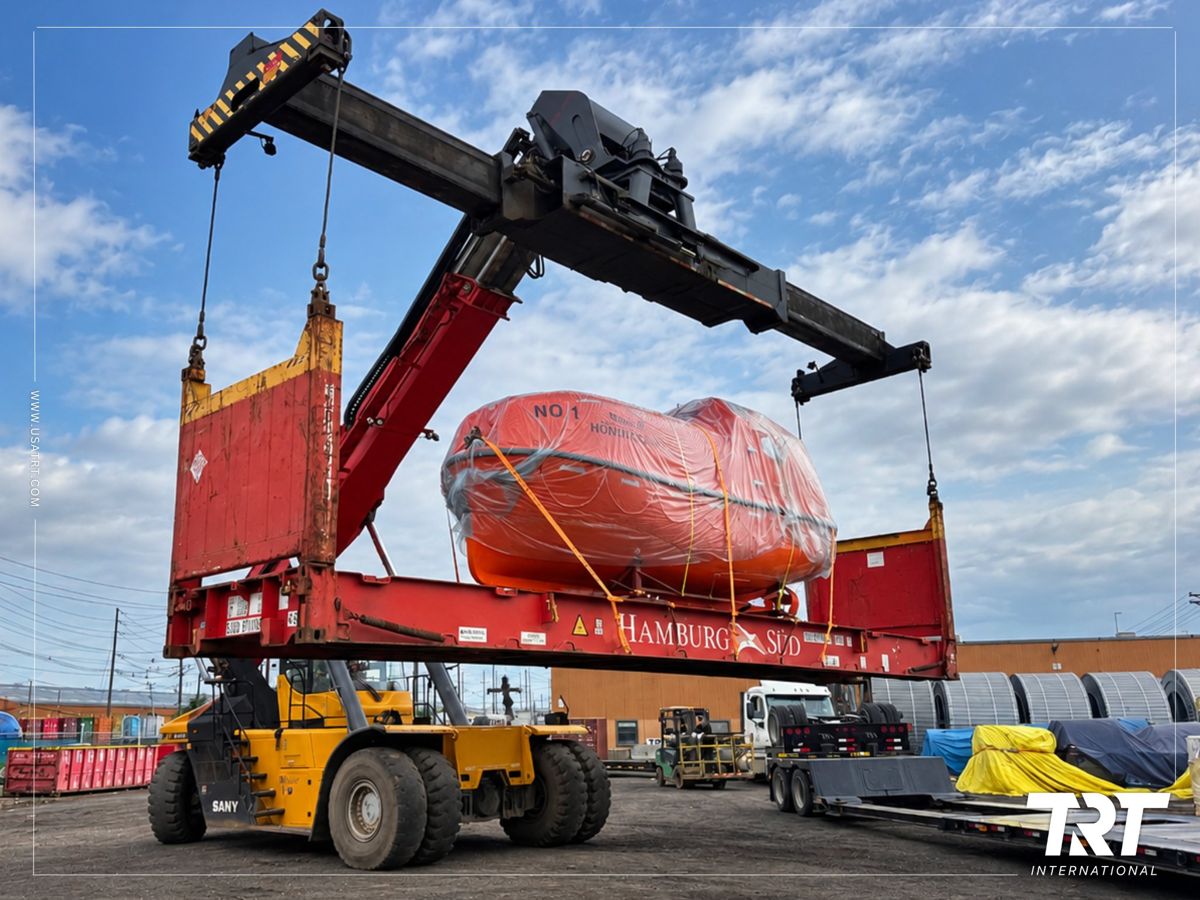
An overweight load is freight that exceeds the standard legal weight limits for the road it has to travel, and a distressed load is freight that can no longer move as it sits — shifted, damaged, badly secured, or stopped at an inspection. Overweight and distressed loads are the two calls nobody plans to make, and they are the calls we are set up to take. TRT International handles overweight and distressed loads inside Port Newark-Elizabeth and inside the Port of Savannah, in our own warehouses, with our own heavy handling equipment and our own trucks. This guide is the playbook we work from: what each problem actually is, what to do in the first hours after a load is stopped, and how that load gets legal, re-worked, and moving again.
Two Problems That Get Confused With Each Other
An overweight load is a weight problem. The cargo itself is usually fine — it was loaded correctly and nothing is damaged — but the total weight, or the weight sitting on one axle group, is over the legal limit for the move ahead of it. That load cannot simply drive. It moves legally only on equipment matched to its weight, over a planned route, with the permits the movement requires. A distressed load is a condition problem. Its weight may be perfectly legal, but the freight shifted in transit, the crate or packaging failed, the load was blocked or secured improperly at origin, or it failed an inspection — and as loaded, it is not safe or legal to move at all. Sometimes a load is both at once: freight that slid to one side of a container is a distressed load, and the same shift can put one axle over its limit, which makes it an overweight problem too. Telling the two apart matters, because the fixes are different — one needs permits and heavier equipment, the other needs a warehouse floor and a re-work crew first. Our overweight and distressed load service covers both, because in practice they arrive at the same door.
The First Hours After a Load Is Stopped
What happens right after a load is refused, flagged, or found shifted decides how expensive the problem becomes. The equipment the freight sits on — a container, a chassis, a trailer — is tied up while it waits, the delivery appointment slips, and every improvised fix attempted at the roadside or on the terminal risks making the cargo worse. Our advice is consistent. First, do not re-load it yourself and do not send a second truck out blind: a shifted heavy piece moved without the right lifting equipment is how a recoverable load becomes a damaged one. Second, secure the facts while they are fresh — where the load is now, what equipment it sits on, what the inspector, terminal, or driver actually reported, and clear photos of the load exactly as it sits, doors open, before anything is touched. Third, make one call to a facility that can take the load in and do the whole job: offload, re-work, storage if it has to wait, permits if it is overweight, and the onward truck. Splitting those steps between separate vendors is where stopped loads lose days. When that call comes to us, the details in this guide’s checklist are what let us quote and plan the recovery in one pass.
Making an Overweight Load Legal: Permits, Route, Equipment
An overweight move is a planned movement, not a heavier version of a normal one. It starts with the permits: the official approvals that let an overweight or oversize load travel its route legally. What a movement requires depends on the load’s weight and dimensions and on the regulations along the way, and securing those permits is part of our service — every movement follows Department of Transportation (DOT) rules from pickup to delivery. The route is planned with the same care, surveyed in advance for the bridges, tunnels, and port facilities the load has to pass, and pilot and escort vehicles are coordinated when the size of the load or the rules along the route require them. Then the equipment has to match the weight. Our fleet runs Freightliner day-cab trucks — 85+ trucks, all driven by company drivers — with 300+ company chassis including tri-axles for heavy container moves, and flatbeds, step decks, RGNs, and perimeter trailers for freight that travels on open equipment. Where a container is simply too heavy for one legal road move, the load can come into our warehouse and be split: part of the freight is transloaded to a second unit so each move runs legal. That is slower than driving it as it sits — it is also the difference between a load that moves and a load that gets stopped twice.
Re-Working a Distressed Load, Step by Step
A distressed load gets unstuck through a re-work, and a re-work follows a set sequence. Step one is the assessment: what the cargo is, what happened to it, and what state it is in now, from the shipper’s description and photos before the doors are opened at our facility. Step two is the offload: the freight comes out with equipment rated for the pieces involved — our container handlers provide 120,000 lbs of lifting capacity, and our forklift fleet runs to more than 80 machines ranging from 20,000 to 80,000 lbs, including electric forklifts used across our warehouses — so heavy pieces can be lifted, held, and re-positioned one at a time, in whatever position the shift left them. Step three is the rebuild: shifted freight is re-positioned and re-secured with professional methods, failed packaging is replaced with protective wrapping or a custom-built crate, and cargo that was loaded wrong is loaded right, in the order its delivery requires. Step four is reload and inspection: the load goes back onto its equipment — or onto the equipment it actually needed — secured and inspected before it moves. Step five, when the load has to wait for a decision, a permit, or its onward slot, is storage: the freight waits in our warehousing or secure outdoor storage instead of on a stopped trailer. We make no promises about cargo that is already damaged. What we provide is the facility, the equipment, and the handling team to recover the load and move it forward — the same crew and gear behind our planned transloading and re-works work every day.
Where the Recovery Happens: Inside the Ports
Distressed loads surface at ports — that is where containers are opened, weighed, and inspected — so that is where our facilities are. In Newark, our warehousing totals 150,000 square feet inside Port Newark-Elizabeth — a 120,000-square-foot warehouse plus a 30,000-square-foot site whose feature is its loading docks — with our headquarters at 250 Port St, Newark, NJ 07114, in the same port complex. Newark also holds our bonded Container Freight Station (CFS), so in-bond freight that needs re-working can be received and held under customs supervision while it is put right. In Savannah, the work runs through our brand-new 316,800-square-foot warehouse on 30 acres in the Port of Savannah, with our Savannah public address at 117 A Parkway Dr, Rincon, GA 31326. TRT has many warehouses; Newark and Savannah are the main ones, and both pair the warehouse floor with our own drayage operation, so the truck that brings a stopped load in and the truck that takes the recovered load out belong to the same company. Onward movement runs on our local bonded drayage and our over-the-road service throughout the US, Canada, and Mexico, with state-of-the-art tracking across the move.
Which Problem Do You Have?
A quick triage saves a day. If the cargo is sound, correctly loaded, and correctly secured, but the scale ticket or the paperwork says the move is over a legal weight limit, you have an overweight load: the work is permits, route planning, and heavier equipment — or splitting the load at our facility so each road move runs legal. If the weight is fine but the freight moved, leaned, crushed its packaging, or was flagged at inspection for how it is loaded or secured, you have a distressed load: the work is offload, re-work, and reload before any truck should move it. If nothing is wrong and the freight simply needs to change equipment — out of an ocean container and onto a domestic trailer or flatbed — that is a planned transload, not a recovery, and it books like ordinary work. And if the load is both overweight and shifted, treat it as distressed first: a load is re-worked and made safe on the warehouse floor, then permitted and moved at its true weight. Sending us photos and the inspection or scale details with your first call lets us make this call with you in minutes rather than after a wasted trip.
What Drives the Cost of a Recovery
There is no flat rate for this work, because no two stopped loads are in the same state. For an overweight load, pricing is built from the cargo’s weight and dimensions, the equipment it requires, the distance it travels, and the permits and escorts its route demands. For a distressed load, it is built from the state the cargo is in, the offloading and re-working it needs — re-securing, re-wrapping, re-crating, or transloading — the equipment and handling involved, and any storage while the load waits. Accurate details up front produce the most accurate quote: for a distressed load, an honest description of the damage or shifting is what lets us plan the recovery instead of discovering the job when the doors open. As with every TRT service, you receive a clear, detailed quote before work is accepted, with no hidden fees.
Shipper’s Checklist: What to Send Us
- What the cargo is, with exact dimensions (length × width × height) and total weight
- For a distressed load: what happened — shifted, damaged, improperly secured, or failed inspection — and photos of the load as it sits, if you have them
- Where the load is now: a port terminal, one of our facilities, a plant, a job site, or still on its equipment
- Where it needs to go, and your timing
- For an overweight load: whether permits or escorts have already been arranged, if any
- Anything fragile, high-value, or hazardous about the cargo that the handling team needs to know
Talk to TRT About a Stopped Load
If you have a load that cannot move as it sits — over its legal weight, shifted, damaged, or held at inspection — send us the checklist above and we will assess it and come back with a plan and a clear, detailed quote. Call us at +1 973 344 7100 ext 221 or email drayage@usatrt.com. Our headquarters is at 250 Port St, Newark, NJ 07114, and our Savannah address is 117 A Parkway Dr, Rincon, GA 31326. TRT International — Delivering Excellence since 1994.
Frequently Asked Questions
What is an overweight load?
An overweight load is freight that exceeds the standard legal weight limits for public roads. The cargo itself is usually sound, but it can only move legally on equipment matched to its weight, over a planned route, and with the permits the movement requires. TRT plans and permits overweight moves end to end, in full compliance with Department of Transportation (DOT) rules.
What is a distressed load?
A distressed load is a load that can no longer move as it sits: the cargo shifted in transit, the load or its packaging was damaged, it was loaded or secured improperly, or it failed an inspection. A distressed load has to be re-worked — unloaded, re-secured, re-packed, or re-loaded — at a facility like TRT’s before it can travel safely and legally again.
My load shifted in transit — what should I do first?
Do not try to re-load it yourself or send another truck out blind. Take clear photos of the load exactly as it sits, note where it is and what equipment it is on, and call TRT at +1 973 344 7100 ext 221. At our facility the cargo can be offloaded with specialized equipment, re-positioned, re-secured, and re-wrapped or re-crated if the original protection failed, then re-loaded and moved on.
Can TRT re-secure cargo that failed an inspection?
Yes. Re-securing and re-loading are core re-work. Cargo that failed an inspection because of how it was loaded or secured can be unloaded at our facilities in Port Newark-Elizabeth or the Port of Savannah, re-worked by our handling team, and re-loaded and inspected before it moves again. TRT cannot certify the cargo itself; our work is the handling, securing, and loading the freight needs to travel properly.
Do overweight loads need permits?
Yes. Permits are the official approvals that let an oversize or overweight load travel its route legally, and what is required depends on the load’s weight and dimensions and the regulations along the way. Securing the permits is part of TRT’s service, the route is surveyed in advance, and pilot and escort vehicles are coordinated when the load or the rules along its route require them.
Where does TRT recover overweight and distressed loads?
TRT recovers overweight and distressed loads inside Port Newark-Elizabeth, where its warehousing totals 150,000 square feet, and in the Port of Savannah, where its brand-new warehouse is 316,800 square feet on 30 acres. TRT has many warehouses, and Newark and Savannah are the main ones. Headquarters is at 250 Port St, Newark, NJ 07114, and the Savannah public address is 117 A Parkway Dr, Rincon, GA 31326.
How do I get a quote for an overweight or distressed load?
Send TRT what the cargo is, its exact weight and dimensions, where the load is now, where it needs to go, and your timing — plus, for a distressed load, what happened and photos if you have them. Call +1 973 344 7100 ext 221 or email drayage@usatrt.com. You receive a clear, detailed quote before work is accepted, with no hidden fees.