
Transloading Services
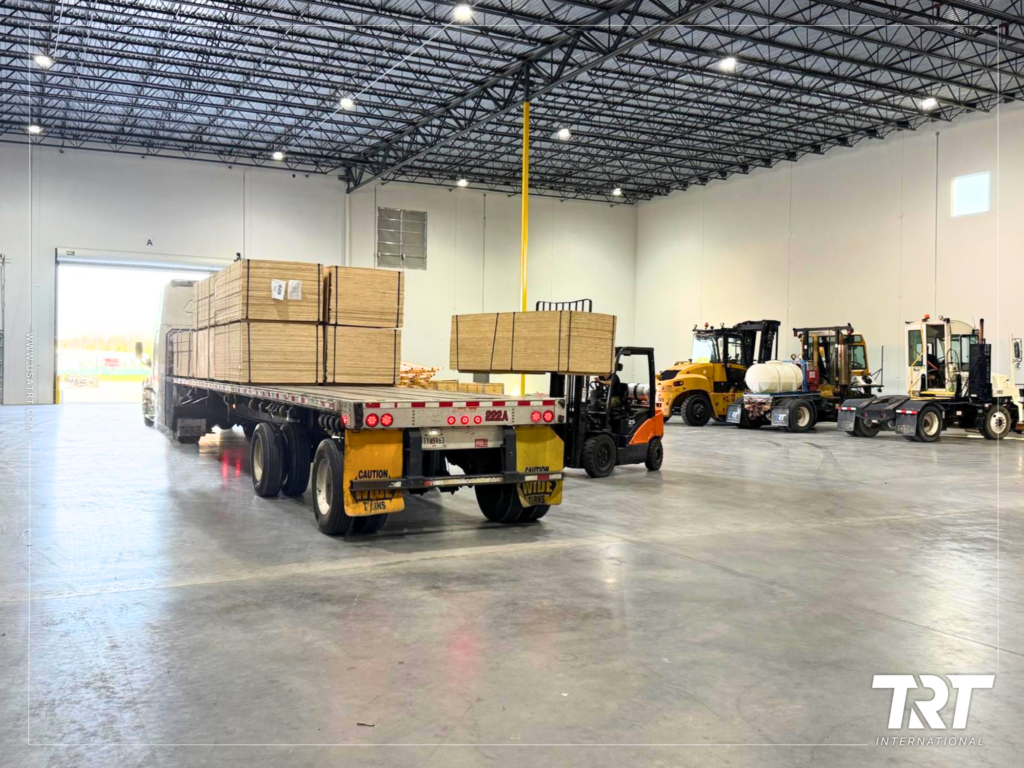
Transloading Services
What Is Transloading?
Transloading is the transfer of cargo from one mode of transport to another — most often, out of a shipping container and onto a truck, trailer, or flat rack for its next leg. It is how container freight changes its mode of travel. A container that crosses an ocean cannot deliver to a job site, and a regional trailer cannot collect cargo at a marine terminal; transloading is the handoff between the two, performed at a warehouse built for it. At TRT, transloading happens inside our own facilities in Port Newark-Elizabeth and the Port of Savannah, run by the same company that handles the drayage on both sides of the transfer — so the container, the cargo, and the onward vehicle are coordinated by one team instead of three.
How Transloading Works at TRT
The steps are simple. The value is that every one of them happens under one roof, with one team accountable for the whole transfer.
Step 1 — Port pickup
Our Drayage Services team collects your container at Port Newark-Elizabeth or the Port of Savannah and brings it a short distance into our warehouse — inside the same port, so the transfer starts right away instead of after an inland haul.
Step 2 — Unload and sort
The container is unloaded at our warehouse, and the freight is sorted and checked against your instructions. Every piece is accounted for as it comes out of the box, so what gets reloaded is exactly what you sent.
Step 3 — Store or stage
Cargo can move straight onto its next leg, or stay in short-term storage or our secure outdoor yard until its delivery window opens. The plan follows your schedule, not the container’s — and the empty container is freed up instead of sitting on your cargo’s timeline.
Step 4 — Prepare and reload
Freight that needs it is wrapped, crated, or secured by our Wrapping & Craning team, then reloaded onto the right equipment for its next leg — a standard trailer, a flat rack, or another container — using the facility’s heavy handling equipment.
Step 5 — Onward delivery
The reloaded freight leaves on its next leg under TRT coordination: local or regional delivery, or oversize transportation for pieces that need route planning, permits, and escorts. From the terminal to the final destination, one team has managed every hand the cargo passed through.
Cargo We Transload
Our transloading teams handle cargo well beyond standard palletized freight. Regular transload cargo includes solar panels, fiberglass rods, industrial transformers, lumber, aluminum coils, laser cutting machines, and construction equipment — a mix of long, heavy, fragile, and out-of-gauge pieces that need more than a standard dock door. Standard container freight is transloaded the same way: unloaded, sorted, and reloaded for onward delivery, whether it arrived as a full container, as part of a consolidated import load, or in bond through our CFS. If a piece is too big for a standard warehouse bay, it is handled through our yards with the same process — received, staged, prepared, and reloaded under one plan.
Equipment That Handles Your Cargo
Transloading heavy and oversized freight takes more than dock labor. TRT’s facilities work with overhead cranes, container handlers, and heavy-duty forklifts with lifting capacities from 10,000 to 120,000 lbs, so pieces that cannot be moved by standard equipment can still be unloaded, positioned, and reloaded safely and precisely. Combined with professional securing methods and our in-house wrapping and craning teams, that equipment is what lets a single facility take a shipment from sealed container to road-ready load without the cargo ever leaving TRT’s control — and without a second vendor being brought in for the heavy pieces.
Transloading for Oversized and Project Cargo
Out-of-gauge (OOG) transloading is a regular part of the work, not an exception. Oversized pieces are received into our secure outdoor yards, lifted and positioned with heavy equipment, and staged outdoors when they cannot go inside a warehouse bay. While they wait, they can be wrapped, crated, and secured by our specialized teams, and when the delivery window opens they move out on oversize transport with route planning, permitting, and pilot cars arranged by the same company. The 30,000-square-foot Newark warehouse with loading docks is built for specialized cargo handling, so dock-level loading and careful staging are available for the pieces that need them.
Transloading Plus Drayage, Warehousing and Bonded Storage
Transloading rarely stands alone — it is the middle of a chain, and at TRT the whole chain is one company. A container picked up at Port Newark-Elizabeth can move directly into our Warehouse Services space to be transloaded, held in short- or long-term storage, or prepared for its next move. In-bond imports go to our Bonded Warehouse — a bonded CFS inside the Port Newark–Elizabeth Marine Terminal — where cargo stays under customs supervision until it is released. Savannah runs the same pattern at a brand-new 316,800-square-foot warehouse in the Port of Savannah. One pickup, one transfer, one delivery — no hand-offs between vendors.
What Affects the Cost of Transloading
Transloading pricing is built from the specifics of each transfer, not a flat rate. The main factors are the number of containers, the cargo’s size and weight, the handling equipment the pieces require, how much sorting the load needs, any preparation work — wrapping, crating, or securing — and how long cargo is staged before its next leg, plus the distance and equipment of the onward move itself. As with every TRT service, you receive a clear, detailed quote before any shipment is accepted, with no hidden fees.
What to Send Us for a Transloading Quote
- What the cargo is, with dimensions and total weight for the pieces that matter
- How it arrives — container type and size, and which port: Port Newark-Elizabeth or the Port of Savannah
- How it leaves — standard trailer, flat rack, or container — and the delivery destination
- Any sorting instructions — one delivery, or split between several
- What the cargo needs during the transfer — wrapping, crating, securing, or storage
- Your timing — when the container is available, and when the outbound load is needed
Send the details through our contact page, call us at +1 973 344 7100 ext 221, or email drayage@usatrt.com, and we will plan the transfer and come back with a clear, detailed quote.
Transloading FAQs
What is transloading?
Transloading is the transfer of cargo from one mode of transport to another — for example, out of an ocean container and onto a truck, trailer, or flat rack for delivery. At TRT it happens at our warehouses in Port Newark-Elizabeth and the Port of Savannah, run by the same team that handles the drayage on both sides of the transfer.
How is transloading different from storage?
Storage holds cargo; transloading moves it between modes of transport. A transloaded shipment is unloaded, sorted, and reloaded for its next leg rather than put away in a warehouse. If the next leg is not ready, transloaded cargo can still be staged or held in short-term storage or our secure outdoor yard until its delivery window opens.
What types of cargo does TRT transload?
Regular transload cargo at TRT includes solar panels, fiberglass rods, industrial transformers, lumber, aluminum coils, laser cutting machines, and construction equipment, alongside standard container freight. Oversized and out-of-gauge pieces that cannot go indoors are handled through our secure outdoor yards with the same process.
What equipment does TRT use to transload cargo?
Our facilities work with overhead cranes, container handlers, and heavy-duty forklifts with lifting capacities from 10,000 to 120,000 lbs, so heavy and oversized pieces can be unloaded, positioned, and reloaded safely. Professional securing methods, wrapping, and crating are available during the transfer.
Where does TRT provide transloading?
At our warehouses inside Port Newark-Elizabeth and the Port of Savannah. TRT operates many warehouses; Newark and Savannah are the main ones — 150,000 square feet of warehouse space in Newark, and a brand-new 316,800-square-foot warehouse in Savannah — so containers come off the terminal and into the transfer without an inland haul first.
Can oversized or out-of-gauge cargo be transloaded?
Yes. Out-of-gauge (OOG) transloading is a regular part of our work. Oversized pieces are received into our secure outdoor yards, lifted and positioned with heavy equipment, staged outdoors when they cannot go inside, prepared by our wrapping and craning teams, and moved out on oversize transport with route planning and permits arranged.
Can my cargo be stored if its next leg is not ready?
Yes. Cargo can move straight onto its next leg, or stay in short-term or long-term storage — indoors, or in our secure outdoor yard for oversized pieces — until its delivery window opens. In-bond cargo can be held at our bonded Container Freight Station (CFS) in Newark under customs supervision.
How do I get a transloading quote?
Call us at +1 973 344 7100 ext 221, email drayage@usatrt.com, or reach us through our contact page. Tell us what the cargo is, how it arrives and how it leaves, which port it moves through, and your timing, and we will provide a clear, detailed quote before any shipment is accepted.
Related services
Related services: Warehouse Services, Drayage Services and Oversize Transportation.