
Freight Consolidation Services
Freight Consolidation Services
What Is Freight Consolidation?
Freight consolidation is the practice of combining multiple smaller shipments into a single, full container load. Instead of several partial shipments — LCL, Less than Container Load — each travelling on its own, compatible cargo is grouped together so it moves as one full container: one box, one movement, one coordinated arrival. The reverse process, deconsolidation, breaks an arriving container back down so each shipment reaches its own consignee. At TRT, consolidation happens at our bonded Container Freight Station (CFS) in Newark, inside the Port Newark–Elizabeth Marine Terminal — the facility where our team receives, consolidates, and deconsolidates container freight, for both ocean and air export programs. Done well, consolidation maximizes the space inside every container and reduces transportation costs across the whole shipping program.
How Freight Consolidation Works at TRT
Step 1 — Send us the shipment details
Tell us what is moving: how many separate shipments you have, who they are coming from, how each one is packed, and where the combined load needs to go. From those details we plan the consolidation — what arrives when, and how the outbound container will be built.
Step 2 — Receiving at the CFS
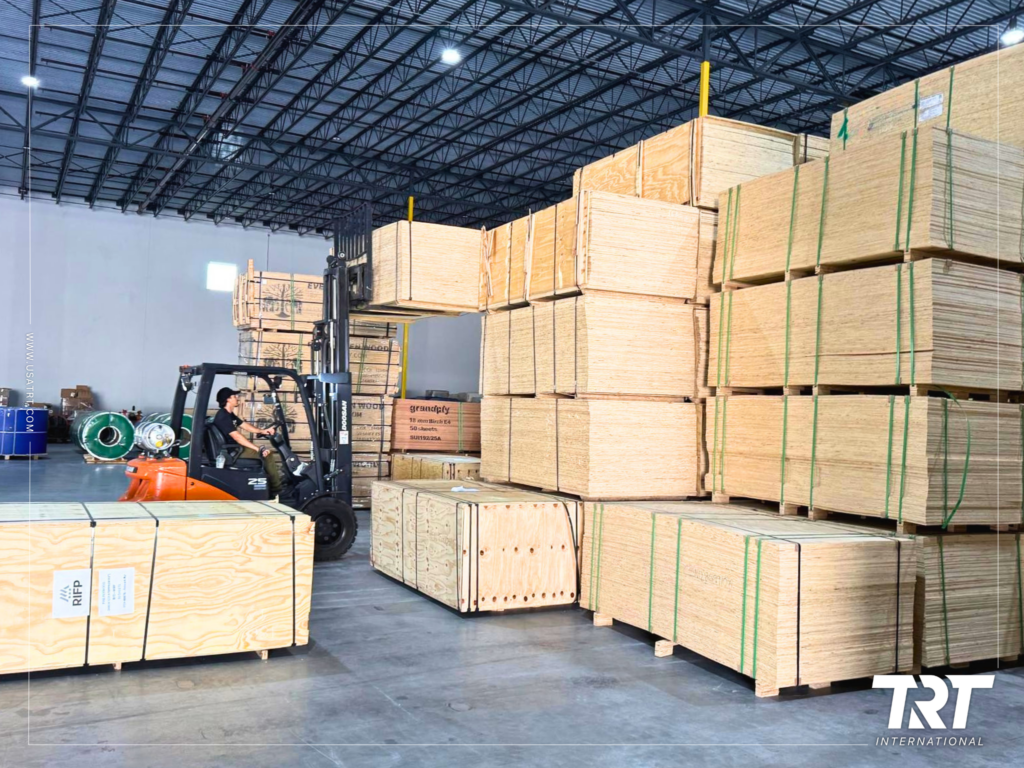
Each shipment is received at our bonded CFS in Newark and checked in against its paperwork. Cargo waits securely — bonded or non-bonded — in a facility equipped with advanced shelving, pallets, and climate control where necessary, until every piece of the consolidated load is on hand.
Step 3 — Building the container
Our experienced staff consolidates the smaller shipments into a single container, maximizing space and securing the combined load for its journey. Professional handling and proven processes keep handling risks low while the load is built, piece by piece.
Step 4 — Documentation and compliance
Consolidated cargo still has to clear like any other shipment. While the load is built, our team assists with the required paperwork, filings, and coordination with regulatory authorities. The facility is fully compliant, bonded, and regularly inspected for U.S. Customs and Border Protection (CBP) standards — so the customs side is handled by the same team that built the load.
Step 5 — Onward movement
The finished container moves out under TRT’s own coordination: our Drayage Services team hauls it the short distance to the terminal for its vessel, and our Ocean Freight team manages the shipping leg — including weekly consolidations for shippers running regular LCL programs.
Export Consolidation and Import Deconsolidation
Consolidation runs in both directions at the CFS. For exports, smaller shipments — including cargo arriving from multiple suppliers — are consolidated into single containers, maximizing space and reducing transportation costs. For imports, the process reverses: cargo is carefully deconsolidated so that each consignee receives the correct goods promptly and intact. We handle both LCL and FCL (Full Container Load) cargo, and shipments that need to wait — for a vessel, for paperwork, or for the rest of a consolidated load to arrive — can be held in secure short-term storage at the same facility, bonded or non-bonded. In-bond imports stay under customs supervision the whole time, so duties and taxes are not paid until the shipment is released. One facility, one team, both directions of the flow.
Who Uses Freight Consolidation?
Consolidation is built for shippers whose freight rarely fills a container on its own. Exporters combining shipments from several suppliers can send each supplier’s cargo to one point and let it leave as a single load. Importers receiving regular LCL shipments get one coordinated deconsolidation instead of a series of separate arrivals to chase. Freight forwarders use TRT as an end-to-end CFS partner for consolidating and deconsolidating LCL and FCL cargo, with full documentation and compliance support. And project shippers moving cargo in stages can hold pieces at the CFS until the full load is ready to build. If your cargo moves in partial loads today, consolidation is the step that turns them into full ones.
Why Shippers Consolidate With TRT
Experience is the first reason: TRT brings over 30 years of experience in both air and ocean export consolidation. The second is position — the CFS sits inside the Port Newark–Elizabeth Marine Terminal, so consolidated containers move a short distance to the terminal instead of crossing the region on a truck first, which is part of how the service stays fast and efficient. The third is what full containers do to a supply chain: fewer partially filled boxes moving the same freight means a more efficient, more sustainable supply chain, with the transportation cost of each move spread across the whole load instead of paid shipment by shipment. And because the same company runs the CFS, the drayage, and the warehouses, a consolidation program is never handed off between vendors at any point.
Consolidation Plus Warehousing, Bonded Storage and Ocean Freight
Consolidation rarely stands alone. A typical program touches several TRT services in sequence: shipments arrive and are received at the Bonded Warehouse, wait in Warehouse Services space if the program needs more room or a longer hold, are built into full containers at the CFS, and leave under our drayage and ocean freight coordination. Import programs run the same chain in reverse — deconsolidation at the CFS, then storage, transloading, or direct delivery to consignees. Because every step sits inside one company with facilities in the port, the plan for each shipment is made by people who can see the whole chain, not just their own link in it.
What Affects the Cost of Freight Consolidation
Consolidation pricing is built from the specifics of your program, not a flat rate. The main factors are the number and size of the shipments being combined, how many different suppliers or origins they arrive from, how the cargo is packed, how long pieces need to be held before the container is built, the documentation and compliance work involved, and the onward transport you want after consolidation. As with every TRT service, you receive a clear, detailed quote before any shipment is accepted, with no hidden fees.
What to Send Us for a Consolidation Quote
- What the cargo is, and how each shipment is packed — palletized, crated, or loose
- How many separate shipments are being combined, and how many suppliers they come from
- The size and weight of each shipment, and the total volume you expect
- Where the cargo is coming from, and where the consolidated load is going
- Your timing — when the shipments arrive, and when the outbound container needs to sail or fly
- What the program needs around the consolidation — bonded holding, storage, drayage, or ocean freight
Send the details through our contact page, call us at +1 973 344 7100 ext 221, or email drayage@usatrt.com, and we will plan the consolidation and come back with a clear, detailed quote.
Freight Consolidation FAQs
What is freight consolidation?
Freight consolidation is combining multiple smaller shipments into one full container load, so cargo that would travel as separate partial (LCL) shipments moves together as a single container. At TRT, consolidation happens at our bonded Container Freight Station (CFS) in Newark, maximizing container space and reducing transportation costs across the program.
What is the difference between consolidation and deconsolidation?
Consolidation builds a load: smaller shipments are combined into a single container, usually for export. Deconsolidation is the reverse, usually on import: an arriving container is broken down so each shipment inside it can be delivered to its own consignee. TRT performs both at our bonded CFS in Newark.
Where does TRT consolidate freight?
At our bonded Container Freight Station (CFS) in Newark, inside the Port Newark–Elizabeth Marine Terminal — in the port, not outside it. TRT operates many warehouses; Newark and Savannah are the main ones. The CFS is part of the Newark location, alongside 150,000 square feet of total warehouse space.
Can TRT consolidate shipments from multiple suppliers?
Yes. For exports, we consolidate smaller shipments — including cargo from multiple suppliers — into single containers, maximizing space and reducing transportation costs. Each supplier’s cargo is received and checked in at the CFS, then built into the combined load.
Does TRT handle both LCL and FCL cargo?
Yes. We handle both LCL (Less than Container Load) and FCL (Full Container Load) cargo. LCL shipments are what consolidation is built from; FCL cargo moves as a full container of its own. On the import side, both are deconsolidated and delivered to their consignees.
Can cargo wait at the CFS before or after consolidation?
Yes. Shipments can be held in secure short-term storage at the CFS — bonded or non-bonded — while they wait for the rest of a consolidated load, a vessel, or their paperwork. In-bond cargo stays under customs supervision, and duties and taxes are not paid until the shipment is released.
How experienced is TRT with freight consolidation?
TRT has over 30 years of experience in both air and ocean export consolidation. That experience shows in how consolidation programs are planned and run: fast, efficient service at the CFS, full documentation and compliance support, and one team coordinating the receiving, building, and onward movement of every load.
How do I get a freight consolidation quote?
Call us at +1 973 344 7100 ext 221, email drayage@usatrt.com, or reach us through our contact page. Tell us how many shipments you are combining, what the cargo is, where it comes from and where it is going, and your timing, and we will provide a clear, detailed quote before any shipment is accepted.
Related services
Related services: Bonded Warehouse, Ocean Freight and Warehouse Services.