Overweight & Distressed Load Services
Overweight & Distressed Load Services
What Are Overweight and Distressed Loads?
An overweight load is freight that exceeds the standard legal weight limits for public roads. It can still move — legally and safely — but only on the right equipment, over a planned route, with the permits the movement requires. A distressed load is different: it is a load that can no longer move as it sits. The cargo shifted in transit, the load or its packaging was damaged, it was loaded or secured improperly, or it failed an inspection — and before it can go anywhere, it has to be re-worked: unloaded, re-secured, re-packed or re-loaded so it can travel safely and legally again. TRT lists overweight & distressed loads among its named solutions, and transloads & re-works alongside them — because the two problems meet in the same place: a TRT facility, with the equipment and the team to put the load right and move it on.
Overweight Loads: Permitted, Planned and Legal
An overweight load cannot simply drive — it has to be permitted. Permits are the official approvals that let an over-size or overweight load travel its route legally, and what each movement requires depends on the load’s dimensions and weight and on the regulations along the way. Securing them is part of our service: we obtain all necessary permits so your shipment meets local and federal regulations, and every movement strictly follows Department of Transportation (DOT) rules from pickup to delivery. The route is planned with the same care — surveyed in advance for bridges, tunnels, and port facilities that must accommodate the shipment — and pilot and escort vehicles are coordinated when the size of the load or the rules along its route require them. The result is heavy freight that moves as one planned, legal movement, on equipment matched to its weight: the lowboy, extendable, and multi-axle trailers of our Oversize Transportation service.
Distressed Loads: Re-Working Cargo That Cannot Move As Loaded
Distressed loads arrive with a story: a load that shifted against its securing, machinery that moved inside a damaged crate, a container whose cargo was found leaning, damaged, or improperly blocked when the doors opened, a shipment stopped because it failed an inspection. Whatever the cause, the freight is stuck — it cannot legally or safely continue as loaded, and the clock is usually running on the equipment it sits on. Re-working is how it gets unstuck. The cargo is carefully offloaded at a TRT facility, assessed in its current state, and then rebuilt: re-secured with professional methods, re-wrapped or re-crated where the original protection failed, and re-loaded onto the same equipment or onto the trailer or platform the load actually needs. If the freight has to wait — for a decision, for parts of the shipment to be separated, or for its onward slot — it waits in secure TRT storage, not on a stopped trailer. We make no promises about cargo that is already damaged; what we provide is the facility, the equipment, and the handling team to recover the load and move it forward.
How Overweight and Distressed Load Work Proceeds
Step 1 — Send us the load details
For an overweight load: what the cargo is, its exact weight and dimensions, pickup, destination, and timing. For a distressed load: where the load is now, what happened to it, and — if you have them — photos of the load in its current state. Those details drive everything that follows.
Step 2 — Assessment and plan
Our team assesses the load and builds the plan. For overweight freight, that means the equipment, the route, and the permits. For distressed freight, it means how the cargo will be offloaded, what re-working it needs — re-securing, re-wrapping, re-crating, transloading — and what it will travel on when it moves again.
Step 3 — Offload and re-work (distressed loads)
At a TRT facility, the cargo is unloaded with specialized equipment and professional handling, then re-worked: shifted freight is re-positioned and re-secured, failed packaging is replaced with protective wrapping or a custom-built crate, and cargo that was loaded wrong is loaded right.
Step 4 — Reload, secure and inspect
The load goes back onto its equipment — or onto the right equipment — secured with professional methods and inspected before it moves. Every shipment is inspected and secured to prevent movement or damage during transit.
Step 5 — Storage if the load has to wait
Re-worked and overweight freight can wait in TRT warehousing or our secure outdoor yards — in Newark or Savannah, with 24/7 security — until its delivery window, its permits, or its onward connection is ready.
Step 6 — Permitted onward movement
The load moves on under TRT’s own transport services — oversize and heavy-haul for overweight freight, drayage and ocean connections at the ports — planned end to end by the same team that did the work.
Equipment for Heavy and Re-Worked Loads
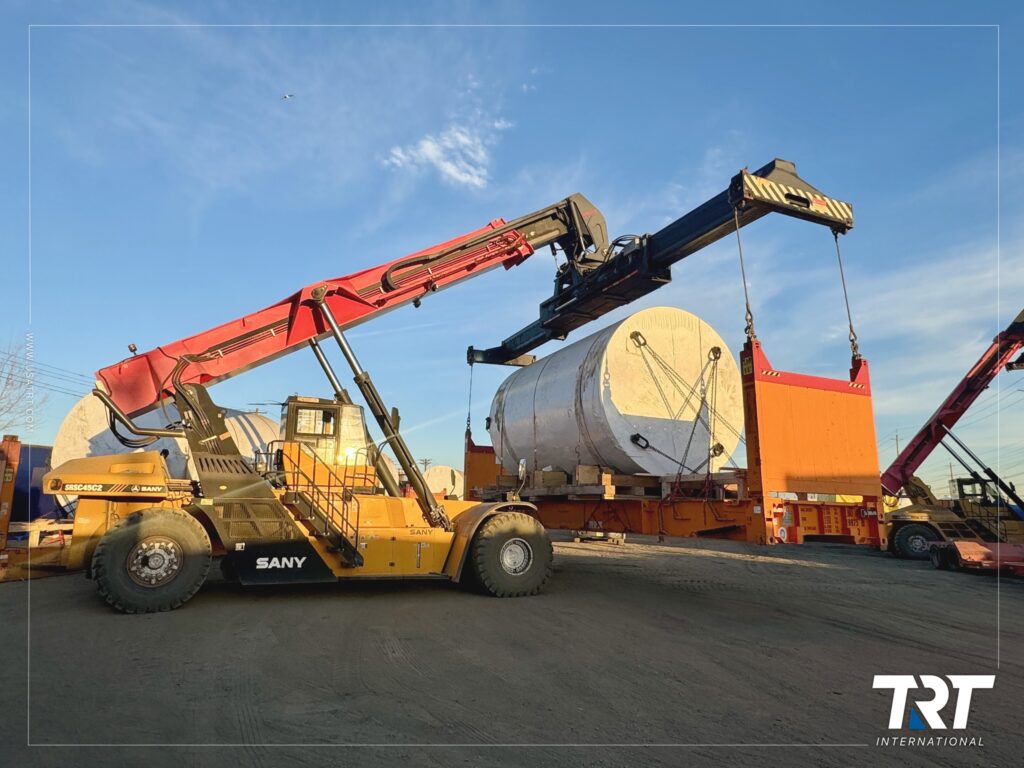
Heavy and distressed work is equipment work. TRT’s booklet describes the gear behind our out-of-gauge operation: container handlers providing 120,000 lbs of lifting capacity, over 80 forklifts ranging from 20,000 to 80,000 lbs, and special equipment including RGNs, lowboys, perimeter deck trailers, and double drops. That range matters for both halves of this service. Overweight freight needs trailers and lifting equipment rated for its weight; distressed freight needs to be lifted, held, and re-positioned piece by piece — often the heaviest pieces, in the least convenient positions. It is the same equipment base our Specialized Services team uses for OOG cargo every day.
Re-Working at Our Port Facilities
Distressed loads surface at ports — that is where containers are opened, inspected, and found wanting — and TRT’s facilities are inside the ports. Our main warehouses are in Newark, in Port Newark-Elizabeth, and in Savannah, at the Port of Savannah. Newark offers 150,000 square feet of total warehouse space, including a 30,000-square-foot warehouse with loading docks built for specialized cargo handling, outdoor storage for out-of-gauge pieces, and our bonded Container Freight Station (CFS), so in-bond freight that needs re-working can be received and held under customs supervision. Savannah adds our brand-new 316,800-square-foot warehouse on a 30-acre site. Transloading is a core TRT service at both locations: freight comes out of one unit, is re-worked, and goes out on another — under one roof and one team.
What Affects the Cost of Overweight and Distressed Load Work
Pricing is built from the specifics of the job, not a flat rate. For overweight loads: the cargo’s weight and dimensions, the equipment it requires, the distance it travels, and the permits and escorts its route demands. For distressed loads: the state the cargo is in, the offloading and re-working it needs — re-securing, re-wrapping, re-crating, transloading — the equipment and handling involved, and any storage while the load waits. Accurate details up front produce the most accurate quote: for a distressed load, an honest description of the damage or shifting is what lets us plan the recovery. As with every TRT service, you receive a clear, detailed quote before work is accepted, with no hidden fees.
What to Send Us
To plan the work and price it accurately, send us:
- What the cargo is, with exact dimensions (length × width × height) and total weight
- For a distressed load: what happened — shifted, damaged, improperly secured, failed inspection — and photos if you have them
- Where the load is now — a port, one of our facilities, a plant, a job site, or still on its equipment
- Where it needs to go, and your timing
- For an overweight load: whether permits or escorts have already been arranged, if any
- Anything fragile, high-value, or hazardous about the cargo that the team needs to know
Send the details through our contact page, call us at +1 973 344 7100 ext 221, or email drayage@usatrt.com, and we will assess the load and come back with a plan and a clear, detailed quote.
Overweight & Distressed Load FAQs
What is an overweight load?
An overweight load is freight that exceeds the standard legal weight limits for public roads. It can still be transported, but only on equipment matched to its weight, over a planned route, and with the permits the movement requires. TRT plans and permits overweight moves end to end, in full compliance with Department of Transportation (DOT) rules.
What is a distressed load?
A distressed load is a load that can no longer move as it sits: the cargo shifted in transit, the load or its packaging was damaged, it was loaded or secured improperly, or it failed an inspection. Distressed loads are re-worked — unloaded, re-secured, re-packed or re-loaded — so the freight can travel safely and legally again.
My load shifted in transit — what can TRT do?
Send us the details and, if you have them, photos of the load in its current state, and tell us where the load is now. At a TRT facility the cargo can be offloaded with specialized equipment, re-positioned, re-secured with professional methods, and re-wrapped or re-crated if the original protection failed — then re-loaded and moved on. If it has to wait, it can be held in secure TRT storage in Newark or Savannah.
Can TRT re-secure or re-load cargo that failed an inspection?
Yes — re-securing and re-loading are core re-work. Cargo that failed an inspection because of how it was loaded or secured can be unloaded at our facilities, re-worked by our handling team, and re-loaded and inspected before it moves again. What we cannot do is certify cargo itself; our work is the handling, securing, and loading that the freight needs to travel properly.
Do overweight loads need permits?
Yes. Permits are the official approvals that let an over-size or overweight load travel its route legally, and what is required depends on the load’s dimensions and weight and the regulations along the way. Securing them is part of our service, and pilot and escort vehicles are coordinated when the size of the load or the rules along its route require them.
What equipment does TRT use for heavy and distressed loads?
TRT’s out-of-gauge equipment base includes container handlers providing 120,000 lbs of lifting capacity, over 80 forklifts ranging from 20,000 to 80,000 lbs, and special equipment including RGNs, lowboys, perimeter deck trailers, and double drops — alongside the lowboy, extendable, and multi-axle trailers used across our oversize transportation service.
Can a distressed load be stored while it is re-worked?
Yes. Cargo can be held in TRT warehousing in Newark and Savannah — 150,000 square feet in Newark and our brand-new 316,800-square-foot warehouse in Savannah — including secure outdoor storage for out-of-gauge pieces and our bonded Container Freight Station (CFS) in Newark for in-bond freight. Storage, re-working, and onward transport are coordinated by the same team.
How do I get a quote for overweight or distressed load services?
Call us at +1 973 344 7100 ext 221, email drayage@usatrt.com, or reach us through our contact page. Send the cargo type, exact dimensions and weight, where the load is now, and — for a distressed load — what happened to it. We will provide a clear, detailed quote before work is accepted.