
Flat Rack Lashing Services
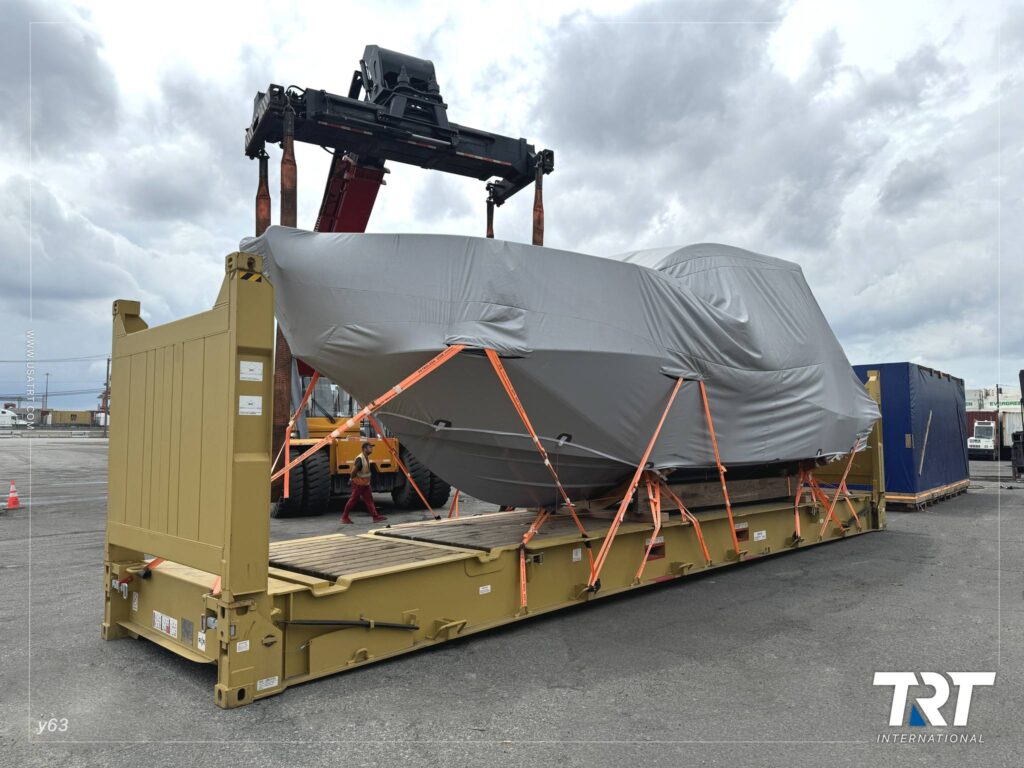
Flat Rack Lashing Services
What Is Flat Rack Lashing?
A flat rack is an open platform container — a floor with end walls, but no sides and no roof — built for cargo that is too wide, too tall, or too heavy for a standard closed container. Because the cargo rides exposed on that platform, it cannot simply be set down and shipped: it has to be lashed. Flat rack lashing is the professional fastening of out-of-gauge (OOG) cargo to the flat rack itself — securing applied so the load and the platform travel as one unit through craning, loading, vessel transport, and every handling in between. TRT lists flat rack lashing among its named solutions, and our team of lashing experts handles professional container and flat rack loading for cargo that standard loading methods cannot touch — boats and yachts, heavy machinery, and industrial project freight included.
How Flat Rack Lashing Works at TRT
Step 1 — Cargo assessment
Every lashing job starts with the cargo itself: its exact dimensions, weight, and shape, where its weight sits, and how it will be lifted and carried. A long, top-heavy piece is secured differently from a low, dense machine, and that assessment drives the securing plan, the equipment, and the reinforcement the load will need.
Step 2 — The securing plan
From the assessment we build the lashing plan: the securing points on the cargo and the flat rack, the fastening methods to be used, and any reinforcement structures the load requires. The plan is made before the cargo is lifted — not improvised on the day of the move.
Step 3 — Positioning and preparation
The cargo is craned or loaded onto the flat rack and positioned precisely. Before fastening begins, the piece can be protected by our Wrapping & Craning team — protective wrapping where it needs a barrier, custom crating or structural support where it needs it — so the lashing secures the cargo without damaging it.
Step 4 — Lashing and reinforcement
Our lashing experts fasten the cargo to the flat rack using professional securing methods, and add reinforcement structures where the weight and movement of the cargo demand them. The goal is a load that does not shift — under lifting, under vessel motion, or under road transport on either end of the voyage.
Step 5 — Inspection and onward movement
Before the flat rack moves, the loaded and lashed unit is inspected. From there it travels as one piece: onto the vessel through our Ocean Freight coordination, or onto a trailer for its road leg — with the securing plan documented so every handler downstream knows how the load was built.
Cargo We Lash to Flat Racks
If a shipment is oversized, overweight, unusually shaped, or too valuable to travel unsecured, it belongs on a flat rack — lashed by the team that planned the move:
- Boats and yachts — marine vessels loaded and lashed to flat racks for export and transport
- Heavy machinery — large industrial and plant equipment that exceeds standard container dimensions
- Industrial components and tanks — massive pieces that ship as out-of-gauge freight
- Construction and agricultural equipment — heavy site and farm machinery moved between ports, plants, and job sites
- Wind turbine components — long, delicate pieces that demand careful securing and route planning
- Prefabricated steel structures — oversized fabricated pieces that need a platform, not a box
Lashing Experts, Fastening and Reinforcement Structures
Lashing is a specialty, and TRT treats it as one. Our booklet describes a team of lashing experts providing skillful container fastening and flat rack lashing — and, where the cargo requires it, adding reinforcement structures to handle the weight and movement of the cargo. That combination is what separates a lashed load from a merely tied-down one: the fastening is engineered around the individual piece, its weight distribution, and the movements it will meet in transit. It is the same discipline our Specialized Services team applies across OOG cargo — professional securing methods and specialized equipment at every step, from loading to final delivery.
Flat Rack Lashing at Our Port Facilities
Flat rack work happens where the cargo is — at TRT facilities inside the ports. Our main warehouses are in Newark, in Port Newark-Elizabeth, and in Savannah, at the Port of Savannah. The Newark location pairs 150,000 square feet of total warehouse space with a dedicated 30,000-square-foot warehouse with loading docks built for specialized cargo handling, plus outdoor storage for out-of-gauge pieces and 24/7 security; Savannah adds our brand-new 316,800-square-foot warehouse on a 30-acre site. Craning, wrapping, crating, storage, and lashing all happen under one roof, so a flat rack load can be received, prepared, secured, and held — then moved out by the same company that built it.
One Team From Loading Dock to Vessel
A flat rack shipment rarely needs just lashing. The cargo has to arrive, be prepared, be loaded, be secured, and then actually travel. At TRT those steps stay inside one company: drayage brings the cargo in, the Wrapping & Craning team prepares and protects it, the lashing experts secure it to the rack, and Oversize Transportation or Ocean Freight moves it onward. One team plans the path with one point of contact, instead of your freight being handed off between vendors who have never seen each other’s work.
What Affects the Cost of Flat Rack Lashing
There is no flat rate for lashing, because no two loads are secured the same way. Your quote is built from the specifics of the cargo: its size, weight, and shape; the securing points and fastening the piece requires; any reinforcement structures that have to be built; preparation work such as wrapping or crating; the craning and loading involved; and any storage or onward transport combined with the job. Accurate dimensions and details up front produce the most accurate quote. What you receive from TRT is a clear, detailed quote before any work is accepted — no hidden fees.
What to Send Us for a Flat Rack Lashing Quote
To plan your lashing and price it accurately, send us:
- What the cargo is, with exact dimensions (length × width × height) and total weight
- How it is currently packed or protected, and anything fragile or high-value about it
- Where the cargo is now — at one of our facilities, a port, a plant, or a job site
- Where it is going, and how it travels — vessel, road, or both
- Your timing — when the cargo is ready, and when it needs to move
- Anything else it needs — wrapping, crating, storage, or onward transport
Send the details through our contact page, call us at +1 973 344 7100 ext 221, or email drayage@usatrt.com, and we will build the loading and securing plan and come back with a clear, detailed quote.
Flat Rack Lashing FAQs
What is flat rack lashing?
Flat rack lashing is the professional fastening of out-of-gauge cargo to a flat rack — an open platform container with a floor and end walls but no sides or roof. Because the cargo rides exposed on the platform, it is secured to the rack itself with professional fastening, and reinforcement structures are added where the weight and movement of the cargo require them, so the load and the platform travel as one unit.
Why can’t oversized cargo just go in a standard container?
Standard containers have fixed walls, a roof, and a door opening, so cargo that is too wide, too tall, or too heavy simply does not fit. Flat racks and open-top containers exist for exactly that freight — but open equipment means the cargo must be professionally secured to the platform, which is what lashing does.
What types of cargo does TRT lash to flat racks?
We lash boats and yachts, heavy machinery, industrial components and tanks, construction and agricultural equipment, wind turbine components, and prefabricated steel structures — oversized, overweight, and high-value project cargo of all kinds. If your freight falls outside standard categories, our lashing experts plan the securing around the individual piece.
Can TRT lash a boat or yacht to a flat rack?
Yes. TRT provides professional container and flat rack loading for boats and yachts, with a team of lashing experts handling the fastening. Marine vessels can also be shrink-wrapped or crated by our Wrapping & Craning team before loading, and received, prepared, and stored at our port facilities as part of the same job.
What are reinforcement structures, and when are they needed?
Reinforcement structures are added supports built around or under a load to help handle the weight and movement of the cargo in transit. They are needed when a piece’s weight, shape, or weight distribution means standard fastening points alone are not enough — the structure gives the lashing something engineered to hold against.
Does TRT handle the loading and transport, or only the lashing?
All of it. TRT’s team manages loading and unloading with specialized equipment, our Wrapping & Craning team prepares and protects the cargo, and the same company provides the drayage, warehousing, ocean freight, and oversize transportation the load connects to. The lashing is planned as part of the whole move, not as an isolated task.
Where does TRT perform flat rack lashing?
At our facilities in Newark, in Port Newark-Elizabeth, and in Savannah, at the Port of Savannah. The Newark location includes a 30,000-square-foot warehouse with loading docks built for specialized cargo handling and outdoor storage for out-of-gauge pieces; Savannah is home to our brand-new 316,800-square-foot warehouse.
How do I get a quote for flat rack lashing?
Call us at +1 973 344 7100 ext 221, email drayage@usatrt.com, or reach us through our contact page. Send the cargo type, exact dimensions, weight, where it is now, and where it is going, and we will provide a clear, detailed quote before any work is accepted.